




Sales territory design is one of the least glamorous parts of running a sales organization. It involves no closing, no pipeline, no customer relationships — just maps, spreadsheets, and difficult tradeoffs. Which is exactly why it gets neglected, and exactly why neglecting it is expensive.
Get the structure right, and your team spends its time in front of the right customers with a fair shot at their number. Get it wrong, and you’re managing quiet attrition, chronic underperformance in certain territories, and a sales team that suspects — often correctly — that the game is rigged.
What a Sales Territory Actually Is
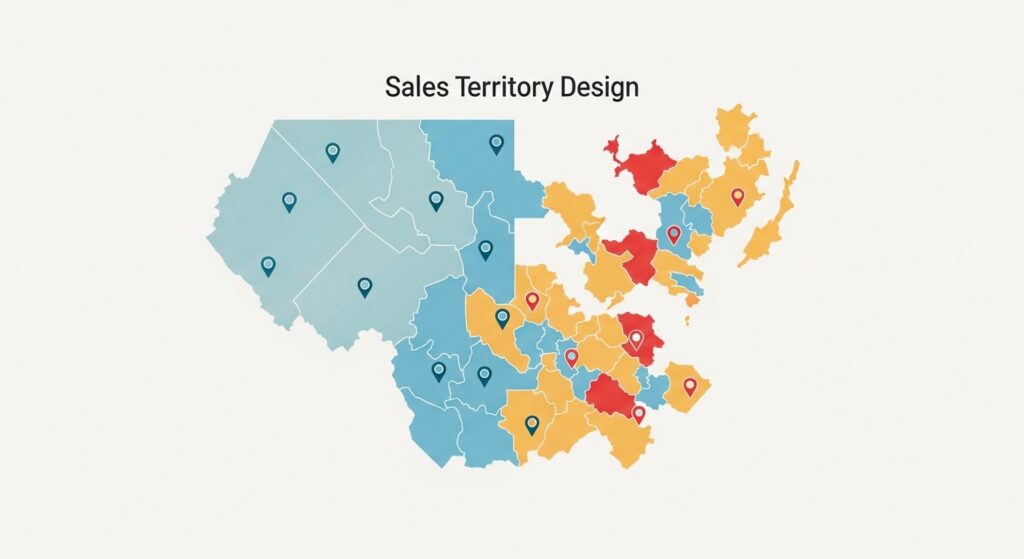
A sales territory is the defined slice of market a salesperson or team is responsible for. That slice can be drawn by geography, by account type, by industry, by product line, or by some combination. The goal is to divide your total addressable market into units that are workable for individual reps and equitable across the team.
“Workable” and “equitable” sound simple. They aren’t. A territory can be geographically compact but commercially thin. Another can contain high-value accounts that would take three reps to cover properly. Good territory design means resolving these tensions systematically, not by gut feel or historical inertia.
Why It Has a Direct Impact on Revenue
The costs of poor territory design don’t show up in a single bad quarter. They accumulate:
Uneven performance across the team. Reps in rich territories hit quota; reps in structurally weak ones struggle regardless of effort or skill. This distorts your read on who’s actually performing and makes comp decisions harder to defend.
Wasted time in transit. Fragmented or illogical geographic territories mean field reps spend hours in the car between accounts. That time doesn’t close deals.
Account neglect. Without clear ownership, high-potential accounts get inconsistent attention or fall through entirely. No one is accountable for what no one owns.
Attrition. Reps who feel structurally disadvantaged leave. They’re often right to. And the reps who replace them inherit the same broken territory.
The flip side is equally true: when sales territories are designed well, reps develop real familiarity with their accounts, build credibility in their market segment, and have a clear and achievable path to their number.
The Four Things That Make a Territory Work
1. Comparable Revenue Potential
Every sales territory should offer a meaningful and roughly equivalent opportunity to hit quota. This doesn’t mean equal account counts — a sales territory with five enterprise accounts can carry the same potential as one with fifty mid-market accounts. What matters is the total addressable revenue, not the headcount.
Use historical sales data, third-party market size data, and firmographic information to estimate potential. Don’t rely solely on past performance — it reflects what you’ve sold in a region, not what the market can bear.
2. Manageable Workload
Potential and workload are separate variables, and both matter. A territory with 100 active accounts requiring weekly check-ins is structurally different from one with 20 accounts on long sales cycles, even if the revenue potential is comparable. Factor in account complexity, renewal volume, sales cycle length, and travel burden when sizing territories.
3. Geographic Logic (Where It Applies)
For field sales roles, contiguous territories reduce transit overhead and allow reps to build local presence over time. Fragmented boundaries — common when territories are assigned reactively rather than designed deliberately — create inefficiency that compounds across hundreds of selling days per year.
4. Match to Rep Strengths
A rep with deep experience in healthcare procurement is more effective in a sales territory heavy with hospital systems than one filled with manufacturing companies. This alignment isn’t always possible, but it should be an explicit consideration during assignment rather than an afterthought.
Territory Models: Which Structure Fits
The right structure depends on your sales motion, product complexity, and how much specialization your market demands.
Geographic territories assign coverage by physical boundaries — region, city, or zip code. They work best for broad-market products with field sales motions where presence and proximity matter. The weakness is that geography doesn’t correlate with deal complexity or strategic importance.
Account-based territories assign specific named accounts regardless of location. This model makes sense when individual relationships are worth more than regional coverage — typical in enterprise sales where a single account can represent millions in revenue. The tradeoff is coverage gaps in the broader market.
Vertical territories organize reps by industry. This model pays off when your product requires genuine industry fluency — selling into hospital systems, financial institutions, or government agencies requires knowledge that generalist reps don’t have. The cost is that reps may end up covering large geographies, complicating field logistics.
Product-based territories make sense for organizations with diverse portfolios where deep product knowledge is a prerequisite for the sale. The risk is fragmented account ownership — a customer may be called on by three different reps from the same company.
Most mature sales organizations end up with a hybrid: geographic coverage as the default, with named account or vertical carve-outs where deal complexity or strategic importance justifies a different model. Getting to the right hybrid requires honest assessment of where your sales motion actually wins deals, not where it’s convenient to draw lines.
How to Design Territories: A Practical Process
Step 1: Gather Data Before Drawing Lines
Start with the inputs you’ll need before making any decisions:
- Historical sales performance by region, industry, and account type
- Pipeline and win rate data to understand where deals close and why
- Market potential estimates using external sources, not just internal history
- Account concentration — how much revenue is tied up in a small number of accounts, and where are they?
- Coverage gaps — if you have no historical data for a region, that tells you something about current coverage
Don’t let gaps in your data stop you. Missing information is itself a signal.
Step 2: Define What “Fair” Means Before You Start
Before you can design equitable territories, you need an agreed-upon definition of equity. Is it equal revenue potential? Equal account count? Equal expected travel time? In most cases, it’s a weighted combination. Define your criteria explicitly and document them — this makes disputes easier to resolve later and keeps the process defensible.
Step 3: Build Scenarios, Not a Single Map
Use your criteria to carve up the market, then run multiple scenarios. Territories that look balanced on paper often reveal problems when tested against real account data. A single large account can skew the potential of an entire territory. Build in thresholds to handle outliers — accounts above a certain size are often better managed as named accounts outside the standard territory structure.
Step 4: Assign Reps Deliberately
Don’t default to “whoever was there before owns it.” Consider rep experience relative to territory complexity, existing relationships that shouldn’t be disrupted, and industry knowledge that maps to the territory’s account mix.
New reps generally need more structured, bounded territories with clear account lists and shorter sales cycles. Senior reps may be better suited to complex, high-value patches that reward relationship depth and patience.
Step 5: Explain the Rationale, Don’t Just Announce the Decision
Territory changes are a reliable source of sales team friction. The most effective way to reduce resistance is to show your work — explain what data drove the design, what tradeoffs were considered, and why the result is equitable even if it isn’t identical. Reps can accept a territory they don’t love if they believe the process was fair.
Step 6: Build in a Revision Cycle
Markets change. Accounts grow or churn. Reps leave. New products launch. Plan to revisit territory design at least annually, and establish a clear, lightweight process for mid-year adjustments when material changes occur. A territory structure that worked at 20 reps won’t necessarily work at 50 — and the signs that it’s breaking down are often invisible until the damage is done.
Common Mistakes — and Why They Happen
Designing for today’s headcount. If you’re planning to hire, build your sales territory structure around your target team, not your current one. Retrofitting territories after headcount growth is disruptive and often unfair to the reps who were there first.
Mistaking past performance for market potential. What your team sold in a region last year reflects your coverage and execution, not the market’s capacity. A sales territory that looks weak in the CRM may be underpenetrated. Use external market data to pressure-test your assumptions before writing off a region.
Treating rep feedback as noise. Sales reps carry account-level context that never makes it into your CRM — relationship history, competitive dynamics, why certain deals stalled. This information is operationally valuable. Build a structured channel for collecting and acting on it; informal complaints in Slack don’t count.
Setting and forgetting. A sales territory design that worked two years ago may be quietly underperforming today. The design itself won’t announce when it’s stopped working — attrition and missed quota will. Regular review isn’t optional; it’s maintenance.
Conclusion
Territory design doesn’t generate pipeline or close deals. Its effects are structural: in how evenly quota attainment distributes across your team, in how much time reps spend in transit versus in front of customers, in whether high-potential accounts receive consistent attention or drift. Most of the dysfunction poor design creates is invisible until it isn’t — a rep who leaves, a region that chronically underperforms, a quarter where nothing closes despite healthy pipeline. Fixing the structure doesn’t guarantee results. It removes one of the more avoidable reasons results don’t come.
Optimize your sales territory design today with FieldPie. Streamline your territories, reduce inefficiencies, and ensure every rep has a fair shot at their number. Book a demo with FieldPie and see the difference in your team’s performance.