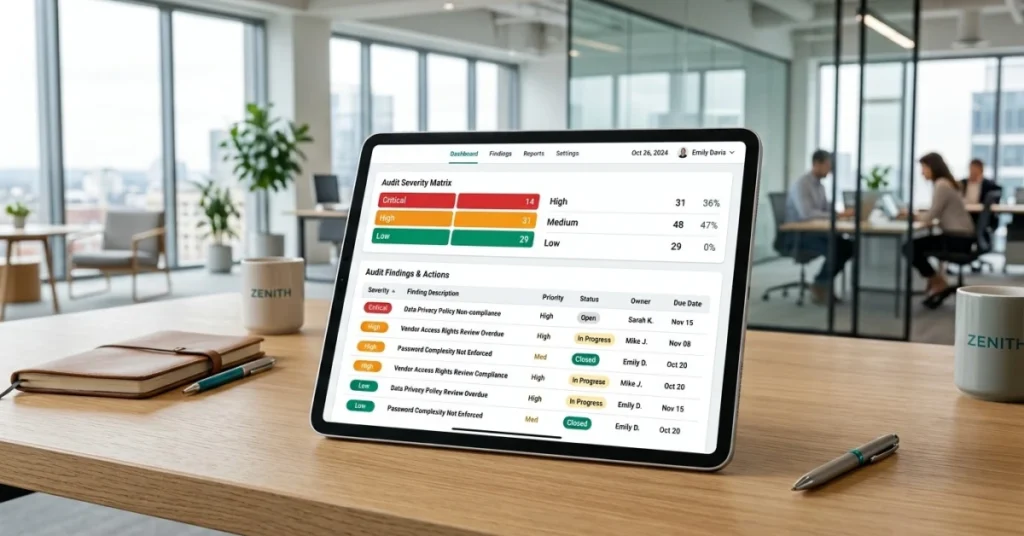
A Non-Conformance Report (NCR) in construction is a formal QA/QC document issued when work, materials, testing, or documentation fails to meet contract specifications, approved drawings, or applicable standards. It identifies the non-compliance, assigns corrective action, and tracks resolution through to verified close-out.
What Is an NCR in Construction?
An NCR — short for Non-Conformance Report — is the backbone of any credible quality management system on a construction project. When a deviation from agreed specifications is confirmed, the NCR creates a controlled, traceable record that forces accountability at every level of the project team.
As Designing Buildings notes, NCRs are a standard conformity reporting mechanism embedded within formal quality management frameworks across the construction industry. They are not optional paperwork. On most commercial, infrastructure, and government contracts, issuing and closing NCRs is a contractual obligation.
NCRs are also known by several alternative names depending on the client or jurisdiction:
- Non-Conformity Report
- Non-Compliance Notice (NCN)
- Defective Work Notice
- Rejection Notice
- Corrective Action Request (CAR)
Regardless of the label, the purpose is identical: document the problem, contain it, correct it, and verify the fix.
Why Do NCRs Matter on a Construction Project?
Poor NCR management is not a minor administrative inconvenience. It directly drives rework costs, schedule overruns, and failed handover inspections.
Consider what happens when defects go unrecorded on site. Without a formal NCR process, non-conforming work can be covered up, repeated, or discovered only at practical completion — when remediation is exponentially more expensive. According to research cited by Visibuild, poorly managed NCRs are a leading cause of costly rework, delayed handovers, and mounting frustration for project managers.
Effective NCR management delivers measurable benefits:
- Reduces rework costs by catching defects early in the process
- Protects project schedule by resolving issues before they cascade
- Creates an audit trail for contractual disputes and regulatory inspections
- Drives continuous improvement by identifying recurring root causes
- Ensures compliance with ISO 9001, contract requirements, and client QMS standards
Teams that use a structured quality management workflow report fewer repeat defects and faster handover sign-offs.

What Triggers an NCR? Common Causes on Site
An NCR is raised after confirmed non-compliance — not a suspicion. The most common triggers include:
Materials Issues
- Delivered materials that do not match approved submittals
- Missing or invalid material test certificates
- Use of substituted products without formal approval
Workmanship Defects
- Installation deviating from approved drawings or method statements
- Failed inspection and test plan (ITP) hold points
- Structural or finishing work that does not meet tolerances
Documentation Failures
- Missing weld records, concrete pour logs, or inspection records
- Expired calibration certificates on testing equipment
- Incomplete or unsigned quality records
Process Deviations
- Work executed without a valid method statement
- Inspection hold points bypassed without sign-off
- Subcontractor work outside the approved scope
Understanding root causes is essential. A single site may generate dozens of NCRs that all trace back to one systemic process failure — such as inadequate subcontractor induction or an outdated set of drawings in circulation.
How Does the NCR Process Work? A Step-by-Step Breakdown
The NCR process follows a defined lifecycle. Every project’s quality management plan should document this process explicitly.
Step 1 — Identification
A quality inspector, site manager, or client representative identifies a confirmed deviation from requirements. The non-conformance is observed, photographed, and described in specific, measurable terms.
Step 2 — Issuance
The NCR is formally raised. The document captures:
- NCR reference number and date
- Project name and site location
- Description of the non-conformance
- Reference to the violated specification, drawing, or standard
- Name of the person raising the NCR
- Photographic evidence
Step 3 — Containment
Immediate action is taken to prevent the non-conforming work from progressing or affecting adjacent work. This may mean stopping work in a zone, quarantining materials, or tagging non-conforming elements.
Step 4 — Root Cause Analysis
The responsible party investigates why the non-conformance occurred. Superficial responses (“operator error”) are insufficient. A credible root cause analysis identifies the systemic failure — whether in training, process, procurement, or supervision.
Step 5 — Corrective Action
A corrective action plan is submitted, reviewed, and approved. This defines exactly what will be done, by whom, and by when to bring the work back into compliance with project requirements.
Step 6 — Verification
Once corrective action is complete, the quality team or client representative inspects the remediated work. If it now meets requirements, the NCR can proceed to close-out.
Step 7 — Close-Out
The NCR is formally closed with a dated sign-off. All records — including photos, test results, and approvals — are attached to the NCR file. Closed NCRs feed into the project’s quality management register and inform the final handover documentation package.
What Should an NCR Template Include?
A well-structured NCR template removes ambiguity and ensures consistent data capture across all site teams. Whether you use a paper form or a digital platform, every template must capture the following fields:
| Field | Purpose |
|---|---|
| NCR Number | Unique identifier for tracking and reporting |
| Date Raised | Establishes the timeline for response |
| Project / Contract | Links the NCR to the correct project record |
| Location on Site | Pinpoints the physical location of the non-conformance |
| Description of Non-Conformance | Objective account of what was found |
| Specification / Drawing Reference | The requirement that was not met |
| Photographic Evidence | Visual record of the defect or deviation |
| Raised By | Name and role of the person issuing the NCR |
| Responsible Party | Contractor or subcontractor accountable for resolution |
| Containment Action | Immediate steps taken to prevent escalation |
| Root Cause | Systemic reason the non-conformance occurred |
| Corrective Action | Specific remediation work to be carried out |
| Target Completion Date | Deadline for corrective action |
| Verification Method | How compliance will be confirmed |
| Close-Out Sign-Off | Authorized signature and date of formal closure |
| Preventive Action | Steps taken to prevent recurrence |
Teams that adopt a standardized NCR template across all projects reduce close-out times significantly because the responsible parties understand exactly what information is required at each stage.
NCR vs. Punch List vs. Snag List: What’s the Difference?
These three terms are frequently confused on site. They are not interchangeable.
NCR (Non-Conformance Report): A formal QA/QC document raised during construction when work fails to meet contractual or specification requirements. NCRs require root cause analysis, corrective action, and formal close-out. They are part of the project’s quality management record.
Punch List / Snag List: A list of incomplete or defective items identified at or near practical completion, typically during handover inspections. Snag lists are generally less formal than NCRs and focus on finishing items rather than systemic quality failures.
Key distinction: An NCR can generate items that later appear on a punch list, but a punch list item does not automatically become an NCR. NCRs carry a higher level of contractual weight and require documented root cause analysis.
When your project has unresolved NCRs at handover, those issues typically block certificate of practical completion. This is why proactive defect tracking during construction is far more cost-effective than discovering issues at the handover stage.
How to Reduce NCR Volume on Your Projects
Reducing NCR volume is not about issuing fewer reports — it is about fixing the root causes that generate non-conformances in the first place. Teams that implement systematic pre-construction quality planning consistently outperform those that rely on reactive inspection alone.
Proven strategies include:
1. Front-load quality planning Ensure inspection and test plans (ITPs), method statements, and hold points are agreed with the client before work begins. Most NCRs trace back to ambiguous requirements or unapproved methods.
2. Conduct pre-activity briefings Before any high-risk activity, brief the site team on the specific requirements, tolerances, and inspection hold points. This takes 10 minutes and prevents hours of rework.
3. Audit subcontractor quality systems Do not assume subcontractors have adequate QMS processes. Audit their systems, review their NCR history from previous projects, and set clear expectations in subcontract documents.
4. Track NCR trends, not just totals Analyze NCRs by trade, location, and defect type. Recurring issues in the same area or with the same subcontractor indicate a systemic failure that needs management intervention, not just another NCR.
5. Close NCRs fast Aging open NCRs signal a broken process. Set contractual response times — typically 48 hours for containment, 7 days for corrective action submission — and enforce them consistently.
NCR Management and Project Handover: The Direct Connection
The quality of your NCR management process determines the quality of your handover. Clients and contract administrators reviewing the handover documentation package will examine the NCR register as evidence of the project team’s quality discipline.
A clean, fully closed NCR register demonstrates:
- All identified non-conformances were formally resolved
- Corrective actions were verified, not just promised
- The project was built to specification
Conversely, open NCRs at handover create disputes, delay practical completion certificates, and expose the contractor to financial penalties. According to Quollnet’s QA/QC construction guide, an NCR is only properly closed when the non-compliance has been corrected and verified — a promise to fix is never sufficient for close-out.
Teams that integrate NCR management directly into their handover workflow reduce the risk of last-minute disputes and compress the time between practical completion and final account settlement.

Frequently Asked Questions (FAQ)
What is the difference between an NCR and a corrective action request in construction?
An NCR documents a confirmed deviation and triggers action. A CAR defines how the issue will be fixed. Many projects combine both into a single NCR form covering identification, root cause, action, and close-out.
Who can issue an NCR on a construction project?
NCRs are typically issued by quality managers, site engineers, or client representatives. On large projects, independent auditors may also issue them. Closure is usually approved by the issuer or client representative.
How long does it take to close an NCR in construction?
Typically, containment is done within 24–48 hours, corrective action within 5–7 days, and full close-out within 14–28 days, depending on complexity. Critical issues may require third-party verification.
Conclusion
NCR in construction is not bureaucratic overhead — it is the mechanism that separates projects that deliver to specification from those that generate disputes, rework claims, and failed handovers. A rigorous NCR process, supported by a clear template, a consistent workflow, and the right digital tools, gives every stakeholder confidence that quality issues are being managed, not hidden.
The checklist, template, and process steps in this guide give your team a practical framework to implement or improve NCR management starting today. For teams ready to move beyond spreadsheets and email chains, platforms like FieldPie bring the entire process into a single, mobile-ready environment where every NCR is tracked, every corrective action is assigned, and every close-out is documented.