


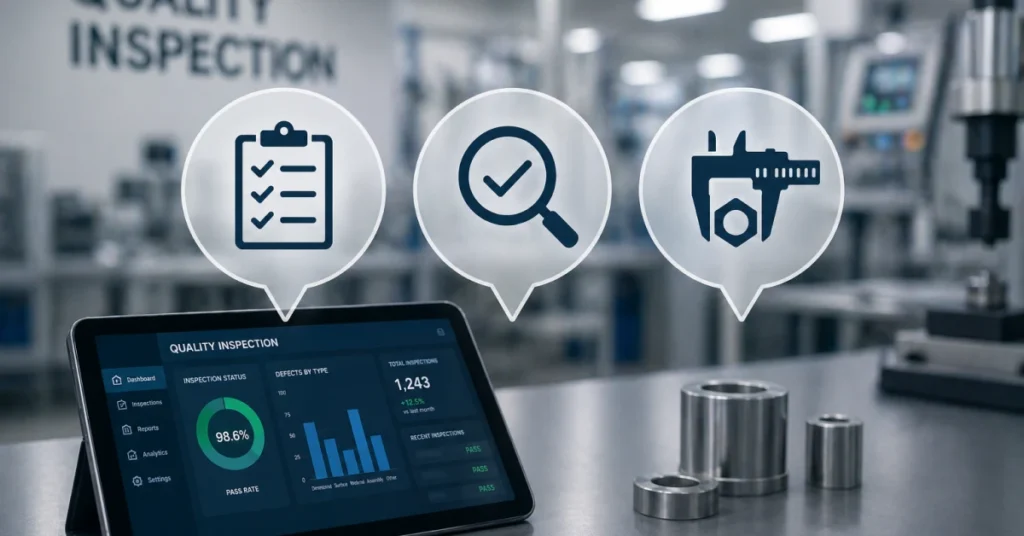
Quality inspection is the systematic examination of a product, component, or process against predefined specifications to determine conformance. Inspectors measure, test, and observe items at defined production stages, then accept or reject them based on documented criteria — preventing defective goods from reaching customers.
What Is Quality Inspection and Why Does It Matter?
In manufacturing, delivering defective products is not just a service issue — it creates significant financial and reputational risk. Quality inspection acts as a control point, ensuring that only products meeting defined specifications move forward in the supply chain.
Standards like ISO 2859 provide a structured and statistically reliable method for accepting or rejecting product lots, making inspections consistent and defensible.
At its core, effective quality inspection focuses on three essentials:
- Detection: identifying defects early
- Prevention: using data to eliminate root causes
- Documentation: maintaining traceable records
Companies that implement structured inspection processes reduce defects, lower rework costs, and improve supplier performance.
How Does Quality Inspection Differ From Quality Control and Quality Assurance?
These three terms are frequently used interchangeably, but they describe distinct activities with different scopes.
| Term | Scope | Timing | Focus |
|---|---|---|---|
| Quality Inspection | Individual product or lot | At defined production checkpoints | Conformance vs. specification |
| Quality Control | Entire production process | Ongoing, throughout manufacturing | Process stability and output consistency |
| Quality Assurance | Organization-wide systems | Proactive, before production | Preventing defects through system design |
Think of it this way: quality assurance designs the system, quality control monitors the process, and quality inspection verifies the output. All three functions are necessary — none replaces the other. A company that runs inspections without quality control upstream is essentially trying to inspect quality into a product rather than building it in from the start.
For teams looking to close the loop between field inspections and broader operational oversight, integrating inspection data into a centralized quality management platform ensures that findings translate into corrective actions rather than isolated reports.

What Are the 4 Main Types of Quality Inspection?
The timing of an inspection determines what it can realistically catch. As HQTS outlines in its inspection framework, there are four primary inspection types used across manufacturing and sourcing operations.
1. Pre-Production Inspection (PPI)
Before production starts. Verifies materials and components meet specifications.
2. During Production Inspection (DUPRO)
At 20–40% of production. Detects issues early before they affect the full batch.
3. Pre-Shipment Inspection (PSI)
When ~80% is complete. Uses AQL sampling to check quality, function, and packaging.
4. Container Loading Inspection (CLI)
During loading. Confirms correct products, quantities, and packaging.
What Are the Key Quality Inspection Methods?
Beyond timing, inspections also differ by methodology. The right method depends on the product type, production volume, and acceptable risk level.
- 100% Inspection: Every single unit is checked. Used for high-value, safety-critical, or low-volume products. Time-intensive and not cost-effective at scale.
- Sampling Inspection (AQL): A statistically representative sample is drawn from a lot. The AQL standard (ISO 2859 / ANSI/ASQ Z1.4) defines acceptable defect rates. Industry standard for most consumer goods manufacturing.
- Attribute Inspection: Each unit is classified as conforming or nonconforming (pass/fail). No measurement data is recorded.
- Variable Inspection: Quantitative measurements are taken (dimensions, weight, voltage). Provides richer data for process control and trend analysis.
- Functional Testing: The product is operated under normal or stressed conditions to verify performance meets specifications.
For manufacturing operations managing multiple product lines, building a standardized inspection checklist template for each method significantly reduces inspector variability and training time.
Quality Inspection Checklist: Key Steps
Use this checklist to ensure a consistent and reliable inspection process:
Pre-Inspection Setup
- Confirm product specs, samples, and tolerances
- Identify regulatory requirements
- Set AQL level and sample size
- Brief the inspection team
On-Site Inspection
- Select a random sample (not pre-selected)
- Check appearance and workmanship
- Verify key dimensions and perform functional tests
- Inspect packaging and labeling
- Confirm quantities against the order
- Check for safety risks and required certifications
Defect Classification & Reporting
- Classify defects (Critical, Major, Minor)
- Compare results with AQL limits
- Document findings with photos
- Issue Pass / Conditional Pass / Fail
- Share the report with stakeholders
💡 Tip
Most teams don’t need 20 checklist items — they need the right ones that focus on risk and impact.
How Is Defect Classification Used in Quality Inspection?
Not every defect carries the same weight. A scratch on the inside of a product and a missing safety label are fundamentally different problems. Professional quality control programs use a three-tier classification system:
| Defect Class | Definition | AQL Tolerance |
|---|---|---|
| Critical | Poses a safety or regulatory risk; renders the product unusable or dangerous | 0% (zero tolerance) |
| Major | Likely to cause customer dissatisfaction or product failure under normal use | Typically 2.5% |
| Minor | Cosmetic or minor deviations unlikely to affect function or customer perception | Typically 4.0% |
This classification directly informs the AQL decision: a lot can pass with a small number of minor defects but must be rejected if any critical defect is found. Establishing a written defect classification list — agreed upon by the buyer, the company, and the supplier before production begins — eliminates subjective disputes during inspections.
What Challenges Do Companies Face in Quality Inspection?
Even strong inspection programs face common challenges:
- Inspector subjectivity
Inconsistent standards lead to different defect evaluations. - Siloed and manual data
Reports in spreadsheets or PDFs limit visibility and trend analysis. - Late detection
Issues found too late increase costs and rework. - Supply chain complexity
Multiple suppliers and locations make coordination difficult.
Digital tools help standardize inspections, centralize data, and track issues in real time — improving consistency and reducing manual effort.
Quality Inspection in Manufacturing: Industry-Specific Standards
Different industries operate under different regulatory frameworks, and quality inspection programs must align with the applicable standard for the target market.
| Industry | Key Standard/Regulation | Inspection Focus |
|---|---|---|
| Consumer Electronics | IEC 62368-1, FCC Part 15 | Safety, EMC, labeling |
| Apparel & Textiles | ASTM F963, REACH | Flammability, chemical content, workmanship |
| Food & Beverage | FDA 21 CFR, HACCP, FSMA | Contamination, labeling, temperature control |
| Medical Devices | ISO 13485, FDA 21 CFR Part 820 | Sterility, traceability, design validation |
| Automotive | IATF 16949, PPAP | Dimensional accuracy, material certification |
| General Manufacturing | ISO 9001:2015 | Process conformance, management review |
Understanding which standards govern your product is non-negotiable. Inspecting to the wrong specification — or missing a mandatory test — can result in import refusals, recalls, or regulatory penalties. For companies exporting to multiple markets, building a compliance documentation library within your quality management system ensures inspectors always work from the current, market-specific specification.
What Is the Role of AQL in Quality Inspection?
Acceptable Quality Level (AQL) defines the maximum number of defects allowed in a sample while still accepting a product lot. It is the foundation of sampling-based inspections.
The most common standard is ISO 2859-1, which helps determine:
- sample size
- defect limits
- accept/reject decisions
Inspectors check a sample and compare defect counts against AQL thresholds to decide whether the lot passes or fails.
This approach enables consistent and efficient quality control without inspecting every unit.
Supplier Quality Management: Extending Inspection Beyond Your Own Walls
A significant portion of quality risk comes from suppliers. Defects in materials or components can create costly issues later in production.
To reduce this risk, companies extend inspection processes into the supply chain by:
- conducting supplier qualification audits
- performing First Article Inspection (FAI) before full production
- tracking supplier performance with scorecards
- defining escalation rules for quality issues
According to Arena Solutions’ quality management resources, connecting inspection data with product lifecycle systems helps teams detect issues earlier and make better sourcing decisions — instead of discovering problems at the pre-shipment stage.
For companies managing multiple suppliers, digital platforms standardize inspections and provide visibility across all locations.

Frequently Asked Questions (FAQ)
What is the difference between quality inspection and quality audit?
A quality inspection checks if products meet specifications, while a quality audit evaluates processes and systems. Inspections focus on output; audits focus on how work is done.
How often should a company conduct quality inspections?
It depends on supplier reliability and product risk. New or high-risk suppliers require more frequent inspections, while trusted suppliers may need fewer checks.
What is the AQL standard used in quality inspection?
AQL (Acceptable Quality Level) defines sampling and defect limits. The most common standard is ISO 2859-1, with AQL 2.5 widely used for major defects.
Conclusion
A strong quality inspection program is a strategic asset, not overhead. Companies that implement structured inspections reduce defects, avoid costly recalls, and improve overall product quality.
The real difference comes from execution. Digital tools replace manual processes with real-time visibility and automated tracking — helping teams detect issues earlier, resolve them faster, and prevent them from recurring.