



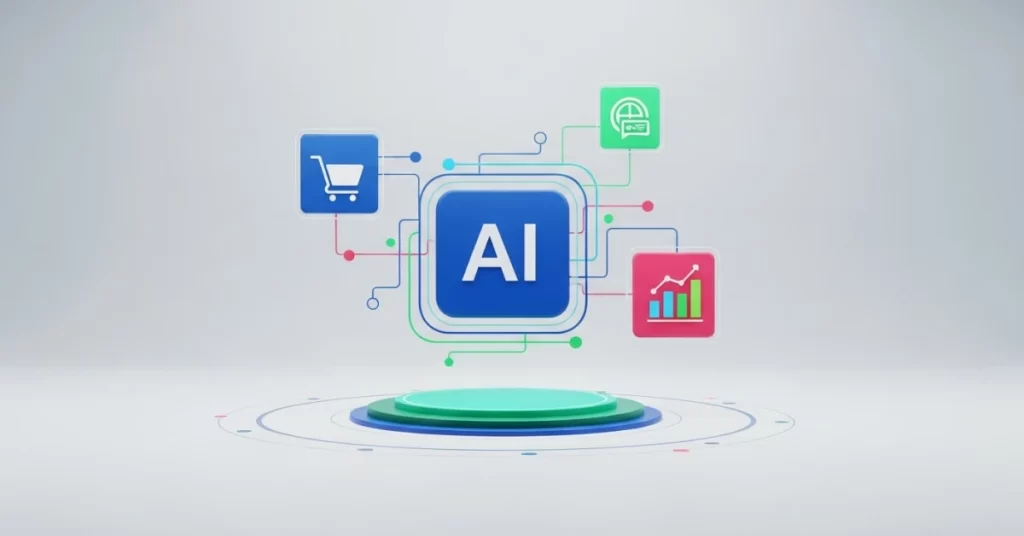
Increasing sales with AI means using artificial intelligence tools — including predictive analytics, automated outreach, conversational agents, and CRM integration — to identify high-value prospects faster, personalize buyer interactions at scale, and close deals with less manual effort. Done right, it compounds revenue growth without proportionally expanding headcount.
What Is AI for Sales — and Why Does It Matter Right Now?
The window for competitive advantage is closing fast. According to Gartner’s research on AI in sales, organizations that embed AI into their revenue workflows are outpacing competitors on quota attainment, forecast accuracy, and pipeline velocity — often by double-digit margins.
The reason is structural. Sales professionals spend, on average, less than 35% of their time actually selling. The rest goes to data entry, scheduling, research, and reporting. AI reclaims that time.
Three forces are converging in 2026:
- Generative AI drafts personalized outreach at scale
- Predictive scoring surfaces the accounts most likely to convert
- AI agents handle routine interactions autonomously, 24/7
Organizations that treat these tools as optional accessories are already falling behind those that treat them as core infrastructure.
How Does AI Actually Work Inside a Sales Process?

AI in sales operates across four functional layers:
Layer 1 — Data Ingestion and Signal Detection
AI pulls signals from CRM activity logs, web behavior, firmographic data, and third-party intent feeds. It identifies patterns human reps miss — like a prospect visiting your pricing page three times in 48 hours.
Layer 2 — Scoring and Prioritization
Machine learning models rank leads and accounts by conversion probability. Your reps stop guessing which calls to make first. According to IBM’s analysis of AI for sales, AI-driven sales teams are measurably more likely to outperform those relying on manual prioritization because decision-making accelerates dramatically.
Layer 3 — Engagement Automation
AI agents manage initial outreach, follow-up sequences, meeting scheduling, and objection-handling scripts. They maintain consistent interactions across every touchpoint without rep fatigue.
Layer 4 — Coaching and Forecasting
AI analyzes call recordings, email threads, and CRM data to give sales professionals real-time feedback and accurate pipeline forecasts — removing the guesswork from revenue planning.

What Are the Highest-Impact Use Cases to Increase Sales with AI?
1. AI-Powered Lead Scoring
Traditional lead scoring relies on static rules. AI-powered scoring updates dynamically based on behavioral signals, engagement depth, and account fit. Organizations using machine learning lead scoring report 20–30% improvements in conversion rates, according to Creatio’s 2026 guide on AI for sales.
Sales professionals no longer waste cycles on low-probability accounts. Your team focuses energy where it compounds.
2. Intelligent CRM Enrichment
Manual CRM hygiene is one of the top reasons reps disengage from the tools their organizations invest in. AI auto-populates contact records, logs activity from email and calendar, and flags stale opportunities. A clean CRM feeds better AI outputs — it’s a flywheel.
If your team is still manually updating CRM fields after every call, you’re losing hours per rep per week. Connecting AI enrichment to your CRM is one of the fastest ROI moves available.
3. Conversational AI and AI Agents
AI agents now conduct initial qualification conversations via chat, email, and SMS — at any hour, without rep involvement. They triage inbound interest, answer product questions, and book meetings directly onto rep calendars. The best agents hand off to human reps with full context, so interactions feel seamless rather than disjointed.
For field sales teams managing large territories, tools like FieldPie integrate AI-driven scheduling and route optimization so your team spends more time in front of buyers and less time in transit.
4. Personalized Outreach at Scale
Generic email blasts are dead. AI analyzes a prospect’s industry, role, recent company news, and behavioral history to generate hyper-relevant messaging. Reps review and send — they don’t write from scratch. Response rates climb. Pipeline velocity increases.
5. Sales Coaching and Call Intelligence
AI listens to every sales call, scores rep performance against winning patterns, and surfaces specific coaching moments. Sales managers no longer need to manually review recordings. The system flags calls where a rep talked too much, missed a key objection, or failed to advance next steps.
6. Predictive Revenue Forecasting
Gartner consistently notes that forecast accuracy is one of the most cited pain points for sales leaders. AI models trained on historical CRM data, deal stage progression, and external market signals produce forecasts that are materially more accurate than spreadsheet-based estimates. Organizations gain confidence to invest ahead of demand rather than react to it.
AI Sales Tools by Category: A Practical Comparison
| Category | Primary Function | Key Benefit for Reps | Integration Point |
|---|---|---|---|
| Lead Scoring AI | Rank prospects by conversion probability | Focus on highest-value accounts | CRM |
| Conversational AI Agents | Qualify and nurture leads autonomously | 24/7 coverage without headcount | Website, email, SMS |
| Call Intelligence | Analyze sales conversations | Targeted coaching, not guesswork | Dialers, Zoom, Teams |
| CRM Enrichment AI | Auto-update contact and account data | Cleaner pipeline, better forecasts | CRM |
| Outreach Personalization | Generate tailored messaging at scale | Higher reply rates, faster pipeline | Email, LinkedIn |
| Revenue Forecasting AI | Predict deal outcomes and pipeline gaps | Accurate planning, fewer surprises | CRM, ERP |
What Obstacles Do Organizations Face During AI Adoption?

Adoption is where most AI initiatives stall. The technology is rarely the problem. The friction is human and organizational.
Common blockers:
- Data quality: AI is only as good as the data it trains on. A fragmented or inconsistently maintained CRM produces unreliable outputs. Fix data hygiene before scaling AI.
- Rep resistance: Sales professionals often fear AI will expose underperformance or replace their roles. Effective change management reframes AI as a personal productivity multiplier, not a surveillance tool.
- Tool sprawl: Organizations that layer AI tools on top of disconnected systems create more complexity, not less. Integration architecture matters as much as tool selection.
- Lack of defined KPIs: Without clear metrics — pipeline coverage, conversion rate, average deal duration, ramp time — adoption success is unmeasurable.
According to Gartner, organizations with the highest AI adoption rates share one trait: executive sponsorship combined with rep-level incentives tied to AI tool usage.
How Should Sales Professionals Measure AI ROI?
ROI measurement requires pairing leading and lagging indicators. Tracking only revenue will leave your team flying blind during implementation.
Leading indicators (measure weekly):
- Number of AI-qualified leads handed to reps
- Reply rate on AI-assisted outreach
- Meeting booking rate from AI agents
- CRM data completeness score
Lagging indicators (measure monthly/quarterly):
- Pipeline-to-quota coverage ratio
- Average deal duration (target: reduction)
- Win rate by lead source
- Forecast accuracy variance
- Revenue per rep
Organizations that track both categories can isolate exactly where AI is accelerating the funnel — and where gaps remain. Sales professionals who bring this data to leadership reviews build the internal case for expanded investment.
For field-based organizations, understanding how AI improves territory planning and rep routing is essential to capturing the full ROI picture.
How Do AI Agents Fit Into a Modern B2B Sales Motion?

AI agents represent the most significant structural shift in sales since the introduction of CRM. Unlike automation scripts that execute fixed sequences, true AI agents reason over context, adapt their responses, and escalate intelligently to human reps when the situation demands it.
In a modern B2B motion, AI agents handle:
- Top-of-funnel qualification — asking discovery questions, scoring responses, routing to the right rep
- Mid-funnel nurture — sending relevant case studies, answering technical questions, scheduling demos
- Post-sale interactions — onboarding check-ins, upsell triggers, renewal reminders
The critical design principle: agents should enhance human interactions, not replace the high-value relationship moments that close complex deals. Your team’s judgment and empathy remain the decisive factor at the final stage.
Gartner projects that by 2028, a majority of B2B sales interactions will involve at least one AI agent in the workflow — making adoption now a matter of competitive positioning, not experimentation.

Frequently Asked Questions (FAQ)
How long does it take to see results from AI sales tools?
Early improvements (reply rates, meetings, data quality) appear in 30–60 days. Revenue impact (win rate, deal cycle) typically follows within 90–120 days.
Do AI agents replace sales reps?
No. AI handles repetitive tasks like outreach and scheduling, while reps focus on relationships and closing deals. It’s about support, not replacement.
Which sales teams benefit most from AI?
Both inside and field teams benefit. Inside teams improve outreach, while field teams gain from territory planning and scheduling. Hybrid teams see the most overall value.
Conclusion
The organizations winning in 2026 are not the ones with the largest sales teams — they’re the ones that have made every rep measurably more effective through intelligent tooling. Increasing sales with AI is no longer a future-state aspiration; it’s a present-day operational standard.
The path forward is clear: fix your CRM data, deploy AI agents on your highest-volume touchpoints, instrument your team’s interactions with call intelligence, and measure relentlessly. Sales professionals who master these tools will outperform peers who don’t — and the gap widens every quarter.