


Quality inspection is the systematic examination of products, materials, or processes at defined production stages to verify conformance with predetermined specifications. It catches defects before they reach the customer, reduces rework costs, and protects brand reputation — typically covering visual checks, dimensional testing, and functional verification.
What Are the Main Types of Quality Inspection?
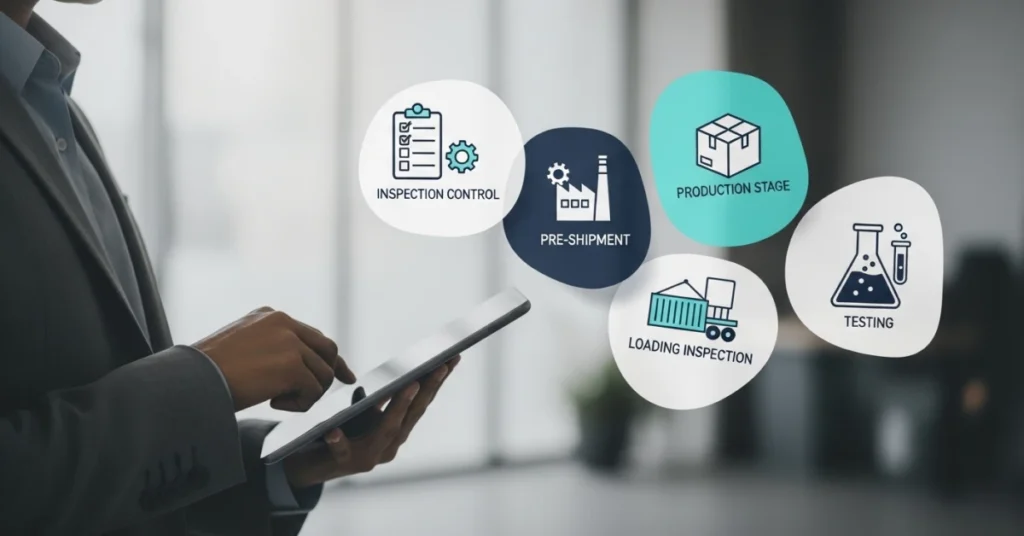
The types of quality inspection used across manufacturing and sourcing fall into five core categories, each tied to a specific point in the supply chain. According to HQTS’s quality inspection framework, the stage at which you inspect determines how much corrective leverage you retain — the earlier the intervention, the lower the cost of a defect.
Here is a quick-reference comparison of all five types:
| Inspection Type | Timing | Primary Goal | Best For |
|---|---|---|---|
| Pre-Production Inspection (PPI) | Before manufacturing starts | Verify raw materials & setup | New supplier, new product |
| During Production Inspection (DUPRO) | At 20–80% production completion | Catch in-process defects | High-volume or complex orders |
| Pre-Shipment Inspection (PSI) | After 100% production, before loading | Final conformance check | All shipments |
| Container Loading Inspection (CLI) | During container loading | Verify quantity & packing | High-value or fragile cargo |
| Lab Testing | Any stage | Measure against regulatory standards | Compliance-driven categories |
How Does Pre-Production Inspection Work?
Pre-Production Inspection (PPI) takes place before a single finished unit is made. Inspectors visit the supplier facility to assess raw materials, components, machinery calibration, and worker training levels.
What PPI covers:
- Raw material quality and certifications
- Machine readiness and calibration records
- Operator training and work instruction clarity
- First-article samples against approved specifications
PPI is especially critical when onboarding a new supplier or launching a product with tight tolerances. A single undetected material substitution at this stage can invalidate an entire production run. For teams managing complex supplier networks, integrating supplier qualification workflows into your quality management system adds a measurable layer of control.

What Is During Production Inspection (DUPRO)?
DUPRO — also called mid-production or in-process inspection — is conducted when 20% to 80% of an order is finished. It is the only inspection type that lets you intervene while production is still running.
Core DUPRO checks:
- Workmanship and assembly consistency
- Dimensional measurements vs. approved samples
- Packaging materials and labeling accuracy
- Defect rate trending against AQL (Acceptable Quality Limit) thresholds
DUPRO is particularly valuable for high-volume orders where a systemic defect introduced early in the run can affect thousands of units. As QIMA’s inspection methodology notes, catching a defect at 30% production is far less costly than discovering it post-shipment.
The Six Sigma community consistently reinforces this point: processes that lack in-line monitoring accumulate variation silently, and by the time a pre-shipment check reveals the problem, rework or destruction of finished goods is the only option. This is a core principle behind six sigma’s emphasis on process control rather than end-of-line detection.
What Is a Pre-Shipment Inspection (PSI) and Why Is It the Most Common?
Pre-Shipment Inspection is conducted after 100% of goods are produced and at least 80% are packed — but before container loading begins. It is the most widely used of all types of quality inspection because it provides a final, comprehensive gate before goods leave the supplier’s facility.
PSI standard checks:
- Random sampling per AQL 2.5 (the global benchmark for consumer goods)
- Visual and workmanship defects (critical, major, minor classification)
- Barcode and label verification
- Carton drop and compression testing
- Product functionality and safety testing
PSI uses statistical sampling rather than 100% inspection, making it cost-effective at scale. The AQL standard — governed by ISO 2859-1 — defines acceptable defect rates and sample sizes. A 10,000-unit order under AQL 2.5 requires inspecting roughly 200 units. If the defect count exceeds the acceptance number, the shipment is held for rework or re-inspection.
For teams running multiple supplier relationships simultaneously, automating your PSI scheduling and reporting through a field operations platform eliminates manual coordination delays and provides real-time audit trails.
How Does Container Loading Inspection Protect Your Shipment?
Container loading inspection (CLI) — sometimes called container loading supervision (CLS) — involves a third-party inspector present on-site during the physical loading of goods into the shipping container.
What container loading inspection verifies:
- Container condition (no moisture, damage, or contamination)
- Correct product, quantity, and SKU loaded
- Proper stacking and securing to prevent transit damage
- Seal number recorded and matched to shipping documents
Container loading inspection is not redundant with PSI. PSI checks product quality; container loading inspection checks the integrity of the shipment itself. A passed PSI means nothing if wrong SKUs are loaded or cartons are stacked incorrectly and crush during a 30-day ocean voyage.
According to TradeAider’s guide on inspection types, container loading supervision is especially critical for fragile goods, electronics, and high-value shipments where transit damage claims are frequent and difficult to resolve without documented loading evidence.
What Role Does Lab Testing Play in Quality Inspection?
Lab testing sits alongside field inspections rather than replacing them. While inspections are observational, testing is empirical — it produces quantifiable data against regulatory thresholds.
Common lab testing categories:
- Chemical compliance (REACH, RoHS, CPSC regulations)
- Mechanical and physical performance (tensile strength, flammability)
- Electrical safety (IEC standards, UL certification)
- Microbiological testing (food-contact materials, textiles)
Lab testing is mandatory in regulated categories. Toys sold in the US must comply with ASTM F963 and CPSC requirements. Electronics entering the EU require CE marking backed by test reports. Apparel exported to California may trigger Prop 65 testing obligations.
The six sigma methodology treats lab testing as a critical measurement system validation activity — ensuring that the gauges and test methods themselves are capable before trusting the data they produce. Many organizations embed six sigma measurement system analysis (MSA) into their testing protocols to quantify instrument error.
How Do Quality Management Frameworks Like Six Sigma Shape Inspection Strategy?
Inspection alone does not build quality — it detects the absence of it. This is why modern quality management frameworks position inspection as a detection tool within a broader prevention strategy.
Six sigma’s DMAIC cycle (Define, Measure, Analyze, Improve, Control) treats defect data from inspections as input into root-cause analysis. A supplier repeatedly failing DUPRO checks on dimensional tolerances signals a process capability problem — not just a quality problem. The six sigma response is to calculate the process Cp and Cpk indices, identify the variation source, and implement process controls rather than simply increasing inspection frequency.
ISO 9001:2015 takes a similar stance: organizations must demonstrate risk-based thinking, meaning that inspection intensity should scale with the risk profile of each product and supplier — not be applied uniformly. This drives smarter resource allocation across quality management programs.
Training is also a significant lever. AMREP Inspect’s quality control methodology highlights that supplier training programs directly reduce defect rates at the source, reducing dependence on downstream inspections. Organizations that invest in supplier training reduce their cost-of-quality metrics measurably over 12–18 months.
For quality managers looking to operationalize these frameworks across distributed supplier networks, building a centralized dashboard for inspection KPIs and supplier scorecards provides the visibility needed to act on data rather than react to failures.
What Are the Most Common Mistakes in Quality Inspection Programs?
Even well-resourced quality teams make systematic errors that undermine inspection effectiveness.
1. Relying exclusively on pre-shipment inspection PSI is valuable, but it only catches defects after they are made. Without DUPRO or PPI, the supplier has no incentive to fix the underlying process.
2. Using inconsistent AQL standards across suppliers Applying AQL 4.0 with one supplier and AQL 2.5 with another creates a double standard that distorts supplier performance comparisons.
3. Failing to document container loading Skipping container loading inspection leaves no evidence trail when transit damage disputes arise with freight forwarders or insurers.
4. Inspecting without a feedback loop Inspection reports that sit in inboxes rather than feeding into supplier corrective action requests (CARs) and training programs produce no improvement.
5. Neglecting measurement system validation Testing results are only as reliable as the instruments producing them. Calibration logs and gauge R&R studies are non-negotiable in any credible quality management program.

Frequently Asked Questions (FAQ)
What are the 5 types of quality inspection?
The five core types are: Pre-Production Inspection (PPI), During Production Inspection (DUPRO), Pre-Shipment Inspection (PSI), Container Loading Inspection (CLI), and Lab Testing. Each addresses a different stage of the supply chain, and most robust quality programs combine at least three of these for critical product categories.
What is the difference between quality inspection and quality testing?
Inspection is visual and checks products against standards. Testing measures performance under controlled conditions. Both serve different roles in quality management.
When should a company use container loading inspection?
Use it for high-value or fragile goods, multiple SKUs, packing risks, or first-time shipments to ensure accuracy and proper handling.
Conclusion
Understanding the types of quality inspection — and using each at the right stage — is key to effective quality management. PPI prevents issues early, DUPRO enables mid-process control, PSI verifies final quality, and loading inspections secure shipments.
Top-performing organizations don’t inspect more — they inspect smarter, using data to improve processes and reduce risk. If your current approach relies on limited checkpoints or static reports, it’s time to reassess and close the gaps.