



Construction compliance is the process of ensuring that all construction activities conform to applicable laws, regulations, building codes, safety standards, and permit requirements. It covers health safety protocols, environmental rules, fire protection mandates, and documentation obligations — protecting workers, communities, and project timelines.
Why Does Construction Compliance Matter in 2026?
Non-compliance is expensive. OSHA penalties in 2025 reached up to $16,550 per serious violation and $165,514 per willful or repeated violation. Beyond fines, non-compliant projects face stop-work orders, litigation, and reputational damage that can shutter companies entirely.
As research shows, failure to comply with construction regulations can significantly impact a company’s ability to operate — affecting bonding capacity, insurance premiums, and eligibility for future contracts.
Three macro forces are intensifying compliance pressure in 2026:
- Stricter building codes — The 2024 International Building Code (IBC) cycle introduced updated fire resistance and structural load requirements.
- Expanded OSHA enforcement — The agency added 100 new inspectors in 2024, targeting residential and commercial work sites.
- ESG reporting mandates — Institutional owners increasingly require environmental and social governance reporting from their contractors.
What Are the Main Types of Construction Compliance Requirements?
Compliance construction obligations fall into six distinct categories. Understanding each one prevents gaps that regulators and auditors consistently exploit.
1. Health Safety Compliance
Health safety is the most scrutinized area on any job site. The Occupational Safety and Health Administration (OSHA) sets legally enforceable standards under 29 CFR Part 1926 for the construction industry. Key requirements include:
- Fall protection at heights of 6 feet or more (29 CFR 1926.502)
- Hazard communication (HazCom) and Safety Data Sheets (SDS)
- Scaffolding load ratings and guardrail specifications
- Personal Protective Equipment (PPE) selection and training
- Confined space entry procedures
OSHA’s fatal four — falls, struck-by, electrocution, and caught-in/between — account for more than 60% of construction fatalities annually. Robust health safety programs directly reduce this exposure.
2. Building Code Compliance
Building codes govern structural integrity, accessibility, energy efficiency, and occupancy. In the US, most jurisdictions adopt versions of:
- IBC (International Building Code) — structural and occupancy standards
- IRC (International Residential Code) — one- and two-family dwellings
- IFC (International Fire Code) — fire prevention and protection
- IECC (International Energy Conservation Code) — energy performance
Local amendments frequently modify these model codes, so companies must verify the adopted version in every jurisdiction where they work.
3. Fire Safety Compliance
Fire protection obligations span design, installation, and ongoing inspection. The National Fire Protection Association (NFPA) publishes more than 300 codes and standards. NFPA 101 (Life Safety Code) and NFPA 13 (sprinkler systems) are most frequently cited in construction projects.
Fire-rated assemblies, fire door specifications, passive fire protection, and suppression system commissioning all require documented inspection records. As detailed by Bolster Systems, fire compliance documentation must be maintained throughout the asset’s lifecycle — not just at project closeout.
4. Environmental Compliance
The Environmental Protection Agency (EPA) enforces several laws directly affecting construction sites:
- Clean Water Act (CWA) — Stormwater discharge requires a Construction General Permit (CGP) for sites disturbing one or more acres.
- Clean Air Act (CAA) — Dust, diesel emissions, and demolition debris (especially asbestos) trigger notification and control requirements.
- RCRA — Hazardous waste generated on site must be properly labeled, stored, and disposed of.
Failure to file a Notice of Intent (NOI) under the CGP before breaking ground is among the most common — and most preventable — environmental violations.
5. Labor and Employment Compliance
Federal and state laws regulate wages, classification, and workforce documentation on construction projects:
- Davis-Bacon Act — Prevailing wage requirements on federally funded projects
- Fair Labor Standards Act (FLSA) — Overtime and minimum wage rules
- I-9 verification — Employment eligibility documentation for every hire
- EEOC regulations — Anti-discrimination requirements in hiring and promotion
Misclassifying workers as independent contractors instead of employees remains a top enforcement target for the Department of Labor.
6. Documentation and Permitting Compliance
No project can legally proceed without the correct permits. Documentation requirements include:
- Building, electrical, plumbing, and mechanical permits
- Site safety plans and emergency response plans
- Inspection records and certificates of occupancy
- Subcontractor prequalification and insurance certificates
- Daily logs, incident reports, and near-miss reporting
Documentation is the proof layer that transforms on-the-ground compliance into a defensible legal record.

What Laws and Regulations Govern Construction Compliance in the US?
| Regulation / Standard | Governing Body | Scope |
|---|---|---|
| 29 CFR Part 1926 | OSHA | Construction health safety |
| International Building Code (IBC) | ICC | Structural, fire, occupancy |
| NFPA 101 / NFPA 13 | NFPA | Fire life safety, sprinklers |
| Clean Water Act (CWA) | EPA | Stormwater, wetlands |
| Davis-Bacon Act | DOL | Prevailing wages, federal projects |
| ADA / ABA Standards | DOJ / USAB | Accessibility |
| IECC | ICC | Energy conservation |
| OSHA 300 Log | OSHA | Injury and illness reporting |
State-level agencies — such as Cal/OSHA in California and the Texas Department of Licensing and Regulation (TDLR) — layer additional requirements on top of federal laws. Companies operating across multiple states must maintain jurisdiction-specific compliance matrices.
What Are the Biggest Construction Compliance Risks?
According to CMiC Global’s analysis of regulatory compliance in construction, the most consequential risks cluster around four failure modes:
1. Documentation gaps — Missing permits, expired certifications, or incomplete inspection records create immediate legal exposure during audits and litigation.
2. Inadequate training — Workers who haven’t received documented, role-specific training represent both a safety liability and a regulatory violation. OSHA requires training in a language and vocabulary workers understand.
3. Subcontractor non-compliance — General contractors bear vicarious liability for subcontractor violations on their sites. Weak prequalification and oversight systems transfer risk upward.
4. Change order drift — Scope changes that alter structural systems, fire-rated assemblies, or egress paths often require revised permits and re-inspection. Skipping this step is a leading cause of certificate-of-occupancy delays.
How to Build a Construction Compliance Program: Step-by-Step
A structured compliance program turns reactive fire-fighting into proactive risk management. Here’s how leading companies build one:
Step 1: Conduct a Compliance Inventory
Map every applicable federal, state, and local requirement for each project type and geography. Use a jurisdiction-specific checklist that covers health safety, fire, environmental, labor, and building code obligations.
Step 2: Assign Compliance Ownership
Designate a Compliance Officer or Safety Director with explicit authority and accountability. On larger projects, embed compliance roles within the project management structure. For companies managing field teams across multiple sites, centralized workforce compliance tracking ensures no site falls through the cracks.
Step 3: Implement a Training Program
Training must be:
- Role-specific — A scaffold erector needs different training than an equipment operator.
- Documented — Sign-in sheets, digital completion records, and assessment scores create defensible proof.
- Refreshed regularly — Annual refresher training is the minimum; quarterly is better for high-hazard tasks.
- Multilingual — OSHA explicitly requires training in a language workers understand.
Step 4: Establish Permit and Inspection Workflows
Create a permit tracking system that flags expiration dates, required inspections, and re-inspection triggers. Never begin work in a new phase without confirming permit status. Permit management integrated with your project schedule prevents costly stop-work orders.
Step 5: Standardize Documentation Systems
All compliance documentation — permits, inspection reports, training records, incident logs — should live in a centralized, searchable system. Paper binders stored in a site trailer are not a documentation system; they’re a liability. Digital systems enable real-time reporting and audit-ready retrieval.
Step 6: Conduct Regular Internal Audits
Monthly site audits using standardized checklists catch violations before regulators do. As highlighted by StruxHub’s best practices guide, companies that conduct proactive internal inspections reduce OSHA recordable incidents by measurable margins compared to those that rely solely on external enforcement.
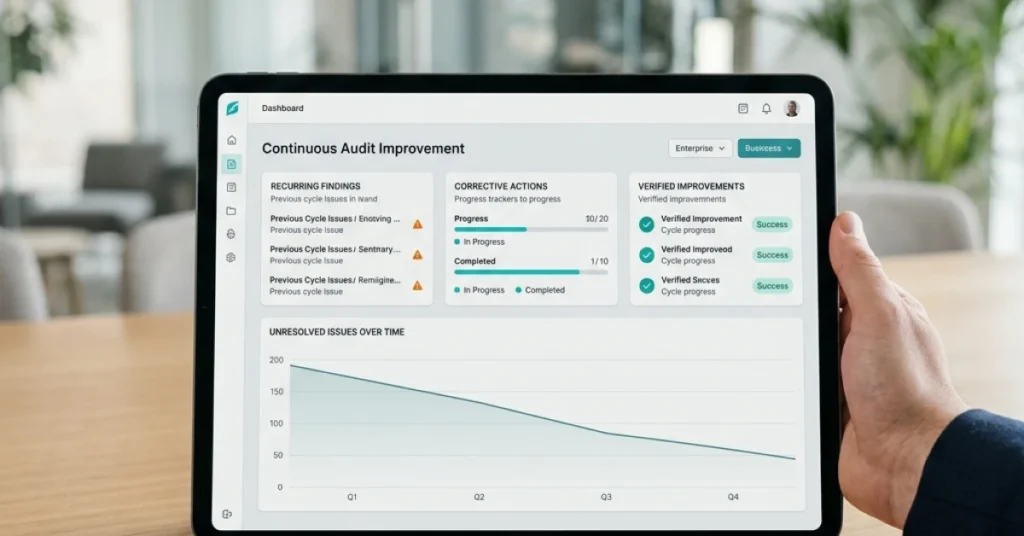
Step 7: Build a Corrective Action System
Every audit finding must generate a corrective action item with an owner, a due date, and a verification step. Closed-loop corrective action is what separates compliant companies from those that cycle through the same violations year after year.
How Should Companies Approach Health Safety Training for Compliance?
Health safety training is both a regulatory requirement and a risk reduction tool. OSHA mandates specific training for dozens of construction hazards, including:
- 10-Hour and 30-Hour OSHA Construction courses (required on many public projects by state law)
- Competent Person training for excavation, scaffolding, and fall protection
- First aid and CPR certification for designated personnel
- Silica exposure awareness and medical surveillance (29 CFR 1926.1153)
- Asbestos awareness for renovation and demolition work
Training programs should be integrated with your compliance software so that expiration dates trigger automatic alerts. If a worker’s confined space entry certification expires on a Tuesday, the system — not a supervisor’s memory — should catch it on Monday.
For companies looking to build a scalable safety training program, the key is linking training records directly to task assignments, so no worker is assigned to a hazard they haven’t been trained to manage.
What Role Does Documentation Play in Construction Compliance?
Documentation is the backbone of every compliance construction program. It serves three functions:
- Regulatory proof — Demonstrates to OSHA, EPA, and local AHJs that required actions were taken.
- Legal defense — In litigation, documented compliance is often the difference between liability and indemnification.
- Operational intelligence — Trend analysis of inspection findings and incident reporting data identifies systemic issues before they become violations.
The documentation systems that work best share three characteristics: they’re digital, they’re centralized, and they’re updated in real time from the field. Paper-based systems fail on all three counts.
Effective documentation for a typical construction project includes:
- Permit applications and approvals
- Inspection reports (daily, phased, and final)
- Training completion records
- Safety meeting sign-in sheets
- Incident and near-miss reports
- Corrective action logs
- Subcontractor compliance files
- Environmental monitoring records
For companies managing multiple projects simultaneously, integrated document management for construction sites is the only scalable approach to maintaining audit-ready records across the portfolio.

How Do Fire Safety Requirements Affect Construction Compliance?
Fire safety obligations begin at design and continue through occupancy. During construction, fire hazards are acute — combustible materials, temporary power, hot work, and incomplete suppression systems create conditions that don’t exist in occupied buildings.
Key fire compliance obligations during construction include:
- Hot work permits — Required for welding, cutting, and grinding near combustible materials
- Temporary fire suppression — Required by IFC in buildings under construction above certain heights
- Fire watch — Mandatory during and after hot work in high-risk areas
- Fire door installation records — Each fire door must be documented with its rating, installation date, and inspector sign-off
- Passive fire protection documentation — Firestopping around penetrations must be inspected and recorded
NFPA 241 (Standard for Safeguarding Construction, Alteration, and Demolition Operations) provides the comprehensive framework for fire safety during the construction phase. Companies that integrate fire compliance into their planning, site operations, and daily inspection routines significantly reduce fire risk, protect workers and assets, and ensure continuous compliance with regulatory requirements throughout the project lifecycle.
Conclusion
Construction compliance is not a one-time requirement — it is a continuous, system-driven process that touches every stage of a project. From safety and building codes to environmental and documentation obligations, success depends on consistency, visibility, and accountability across teams.
The companies that stay compliant are those that treat compliance as an operational discipline, not a checklist. With structured workflows, ongoing training, and centralized documentation, compliance shifts from a reactive burden to a proactive risk management advantage.