


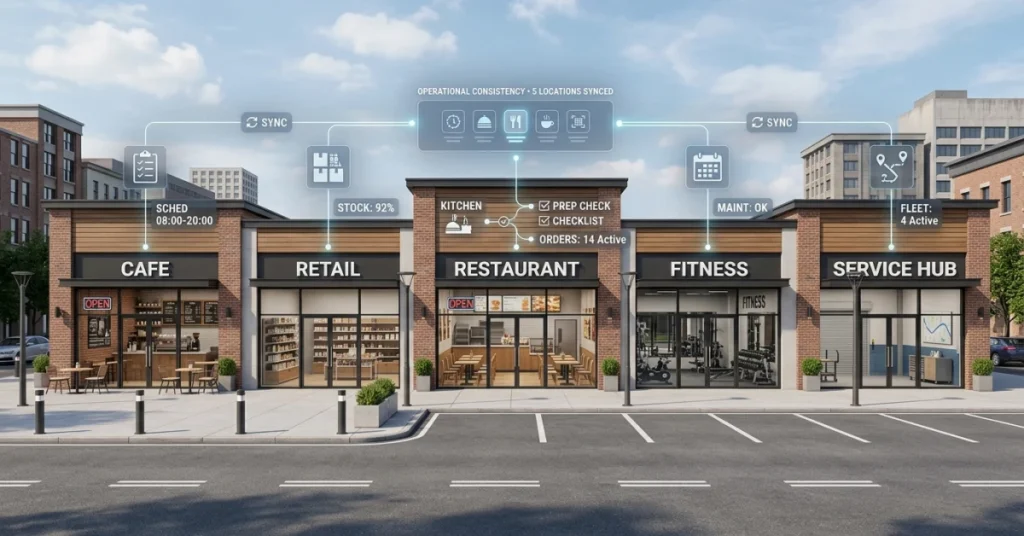
Automating franchise operations means using software, AI, and workflow tools to eliminate manual, repetitive tasks—such as reporting, scheduling, compliance audits, and lead follow-up—across multiple franchise locations. Done right, automation drives brand consistency, reduces overhead costs, and enables franchisors to scale without proportional headcount increases.
What Is Franchise Operations Automation and Why Does It Matter in 2026?
Franchise networks face a structural challenge that independent businesses don’t: every process must work consistently across dozens—sometimes hundreds—of locations, managed by franchisees with varying skill levels and resources. Manual coordination breaks down fast.
According to industry research from The Franchise CTO, adoption of franchise management software is projected to reach 75% across franchise networks, signaling that automation is no longer optional—it’s a competitive baseline.
The payoff is real:
- Reduced labor costs from eliminating repetitive manual tasks
- Faster franchisee onboarding with standardized digital workflows
- Real-time visibility into franchise operations across all locations
- Consistent customer experience regardless of which location a customer visits
- Faster, data-driven decisions for franchisors and franchisees alike
What Are the Core Areas of Franchise Operations You Can Automate?
How to automate franchise operations starts with identifying which processes consume the most time and carry the highest risk of human error. The six core automation categories are:
1. Franchisee Onboarding and Training
Manual onboarding is slow and inconsistent. A learning management system (LMS) integrated with your franchise software delivers standardized training modules, tracks completion rates, and issues certifications automatically. New franchisees can be productive weeks faster.
2. CRM and Lead Management
A franchise CRM automates lead capture from web forms, paid ads, and social channels, then routes each prospect to the right franchisee or development team member. Automated follow-up sequences—text, email, and call reminders—ensure no lead goes cold. ClientTether’s analysis of franchise software automation shows that CRM-driven automation directly shortens the sales cycle and improves close rates across franchise development teams.
3. Reporting and Financial Reconciliation
Daily sales reports, royalty calculations, and P&L summaries are prime candidates for automation. Instead of franchisees manually submitting spreadsheets, your system pulls data directly from POS integrations and generates reports on a set schedule. Franchisors get real-time dashboards; franchisees spend less time on admin.
4. Compliance and Field Audits
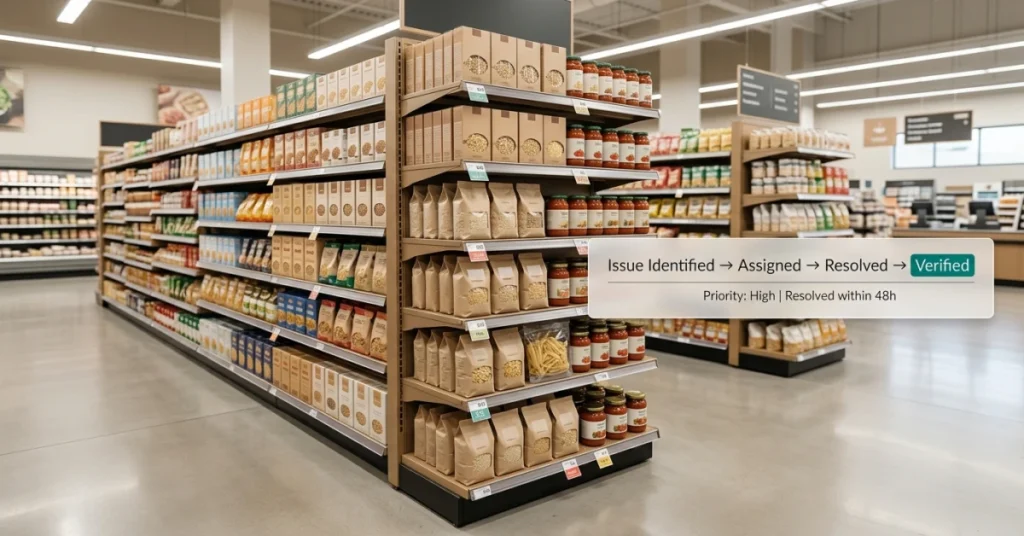
Automated audit checklists sent on a recurring schedule, with digital sign-off and photo documentation, replace paper-based inspections. Non-compliance flags trigger instant alerts to the relevant support teams and area representatives. This keeps standards high without requiring constant on-site visits.
5. Marketing and Social Media
Franchisors can push brand-approved marketing assets to franchisees through a centralized portal. Automated social media scheduling tools allow local franchisees to post brand-compliant content without the risk of off-brand messaging. According to Pica9’s research on franchise marketing automation, maintaining brand consistency across locations is one of the top drivers of automation investment among franchisors.
6. Scheduling and Task Management
Workforce scheduling software eliminates manual shift planning. Automated task management systems assign daily, weekly, and monthly operational tasks to the right teams, send reminders, and track completion—giving franchisors a real-time view of operational health across the network.
Step-by-Step: How to Build a Franchise Automation System
The following process applies whether you’re automating a 10-unit network or a 500-unit system.
Step 1: Audit your current processes. Document every recurring task performed by franchisors, franchisees, and their teams. Categorize each by frequency, time cost, and error rate.
Step 2: Identify your highest-ROI automation targets. Prioritize tasks that are high-frequency, rule-based, and currently prone to inconsistency. Royalty reporting, lead follow-up, and compliance checklists typically top this list.
Step 3: Select an integrated franchise software platform. Avoid point solutions that don’t communicate with each other. Look for a platform that combines CRM, reporting, task management, LMS, and communication tools in a single system.
Step 4: Configure workflows before you launch. Map every automated trigger and action in writing before going live. Define who receives alerts, what thresholds trigger escalations, and how franchisees interact with the system.
Step 5: Train franchisees and internal teams simultaneously. Automation fails when adoption is inconsistent. Run parallel training for both the franchisor’s support teams and franchisees. Assign a dedicated implementation contact for each franchisee group.
Step 6: Measure, refine, and expand. Set KPIs for each automated workflow—response time, completion rate, error rate. Review monthly for the first quarter, then quarterly thereafter. Expand automation to new areas as the system matures.
Which Franchise Software Tools Should You Consider?
The table below maps key automation categories to the tool types that address them—and the primary users who benefit.
| Automation Category | Tool Type | Primary Beneficiary | Key Metric Improved |
|---|---|---|---|
| Lead management | Franchise CRM | Franchisors, franchisees | Lead response time, close rate |
| Training & onboarding | LMS | Franchisees, new staff | Time-to-productivity |
| Compliance audits | Field audit software | Franchisors, area reps | Audit pass rate, issue resolution time |
| Financial reporting | POS + reporting integration | Franchisors, franchisees | Royalty accuracy, reporting time |
| Marketing execution | Brand management platform | Franchisees, marketing teams | Brand compliance rate, local engagement |
| Task management | Operations management system | Franchisees, location teams | Task completion rate, SLA adherence |
| Social media | Social scheduling tools | Franchisees, marketing teams | Posting consistency, engagement rate |
| Customer support | AI chatbot + ticketing | Customers, support teams | First-response time, resolution rate |
What Are the Most Common Mistakes When Automating Franchise Operations?
Automating broken processes
Automation amplifies what already exists. If your royalty reporting process is inaccurate manually, automating it produces inaccurate results faster. Fix the process logic before you automate it.
Choosing disconnected point solutions
Using separate tools for CRM, reporting, task management, and communication creates integration debt and data silos. Franchisors end up managing the integrations instead of managing the business. Prioritize platforms with native connections across all core functions.
Underinvesting in franchisee adoption
The most sophisticated franchise software delivers zero value if franchisees don’t use it. Allocate at least 20% of your implementation budget to training, change management, and ongoing support. Franchisees who understand the “why” behind automation tools adopt them far more consistently.
Ignoring AI readiness
AI-driven features in franchise management platforms require clean, connected data to function accurately. Before deploying AI forecasting or CRM scoring, ensure your data pipelines are standardized across all locations. As Autymate’s research on automation transformation highlights, franchises that invest in data infrastructure before AI deployment see significantly stronger outcomes than those that bolt AI onto messy legacy systems.
Failing to set governance rules
Automation without governance creates new risks. Define clearly which settings franchisees can customize locally and which are locked at the franchisor level. This is especially critical for social media posting, pricing workflows, and customer communication sequences.
How Should Franchisors Measure the ROI of Automation?
Track these KPIs at 30, 90, and 180 days post-implementation:
- Time saved per franchisee per week on administrative tasks
- Lead response time before and after CRM automation
- Royalty reporting accuracy rate (target: 99%+)
- Audit pass rate across the network
- Franchisee satisfaction score with operational support
- New franchisee time-to-productivity (weeks from signing to first sale)
- Customer review volume and average rating post-automation of review request workflows
For tracking multi-location franchise performance metrics, establish a baseline measurement period of at least 60 days before launching automation tools so you have clean comparative data.
Frequently Asked Questions (FAQ)
What is the best software to automate franchise operations?
There is no single best tool—the right stack depends on your franchise model. Most networks need at minimum a franchise CRM, a reporting/royalty system, an LMS for training, and a compliance audit tool. Platforms that combine these functions natively—such as FieldPie for field-based franchises—reduce integration complexity and improve data quality across the network.
How much does it cost to automate a franchise operation?
Costs vary significantly by network size and tool selection. Entry-level franchise management software typically starts at $200–$500 per month for small networks. Enterprise platforms serving 50+ locations commonly range from $2,000 to $10,000+ per month. The ROI calculation should factor in hours saved per franchisee per week multiplied across the entire network—for most brands, payback periods are under 12 months.
How do I get franchisees to adopt new automation tools?
Adoption is driven by three factors: simplicity, relevance, and support. Choose tools with intuitive interfaces, demonstrate how automation reduces each franchisee’s workload (not just the franchisor’s), and provide dedicated onboarding support for the first 90 days. Franchisees who see a direct personal benefit—less admin time, faster lead follow-up, clearer performance data—adopt automation tools at significantly higher rates than those who perceive it as a compliance requirement.
Conclusion
How to automate franchise operations is ultimately a question of systems design, not just software selection. The franchises that scale efficiently in 2026 and beyond will be those that treat automation as a strategic discipline: mapping their processes before automating them, selecting integrated franchise software over disconnected point solutions, and investing as seriously in franchisee adoption as they do in the technology itself.