



Retail merchandising is the strategic process of selecting, pricing, displaying, and promoting products in a retail environment to maximize sales and enhance the customer shopping experience. It covers every decision — from planogram design and signage placement to inventory assortment and promotional pricing — that influences how a customer interacts with merchandise at the point of sale.
What Exactly Is Retail Merchandising?
At its core, retail merchandising is the bridge between a product and a purchase. It answers one fundamental question: How do you present merchandise so that customers can’t walk past it?
According to Investopedia’s definition of merchandising, the practice encompasses all promotional, pricing, and display activities that retailers use to influence buying decisions — both in-store and online.
Retail merchandising is not a single tactic. It is a discipline that spans:
- Product assortment planning — selecting which items to stock and in what quantities
- Pricing strategy — positioning merchandise at competitive or value-driven price points
- Visual presentation — arranging products and store layouts to guide the customer journey
- Promotional execution — deploying signage, end caps, and seasonal displays that drive urgency
When executed correctly, merchandising does not just move product. It builds brand equity and creates a repeatable, predictable customer experience.
Why Does Retail Merchandising Matter in 2026?
The retail industry has never been more competitive. Consumers now move fluidly between physical stores and digital channels, and they bring sky-high expectations to every touchpoint. A poorly executed display or an out-of-stock shelf does not just cost one sale — it costs customer loyalty.
Consider these realities:
- Impulse purchases account for roughly 40–80% of all retail buying decisions, according to consumer behavior research. Effective in-store merchandising is a primary driver of those unplanned purchases.
- Retailers who invest in structured visual merchandising programs consistently report higher basket sizes and improved sell-through rates.
- Brand perception is formed within seconds of a customer entering a store. Signage, lighting, and product placement are not decorative — they are performance levers.
The bottom line: merchandising is not a support function. It is a revenue function.

What Are the Core Types of Retail Merchandising?

Understanding the different forms of merchandising helps teams allocate effort and budget where they will generate the greatest return.
| Type | Definition | Primary Tool |
|---|---|---|
| Visual Merchandising | Using display, lighting, color, and spatial design to attract and guide customers | Planograms, window displays |
| Product Merchandising | Curating the right assortment, depth, and facings for each category | Assortment plans, POG compliance |
| Digital Merchandising | Replicating in-store presentation logic in e-commerce environments | On-site search, product page layout |
| Promotional Merchandising | Driving urgency through temporary price changes, signage, and featured placements | End caps, floor displays, POS signage |
| Omnichannel Merchandising | Aligning the in-store and online customer experience into a single cohesive brand journey | Unified inventory systems, consistent visual standards |
Each type demands its own execution plan, but they all share one goal: making it as easy as possible for a customer to find, want, and buy a product.
How Does Visual Merchandising Drive Customer Behavior?
Visual merchandising is the most visible — and most immediately impactful — form of retail merchandising. It operates on the premise that the human brain processes visual information far faster than text, meaning a well-designed display communicates value before a customer reads a single word.
Key principles of effective visual merchandising include:
- The Rule of Three: Grouping merchandise in odd numbers creates a more visually dynamic display and draws the customer’s eye more effectively than even groupings.
- Color blocking: Arranging products by color palette creates a cohesive visual flow that slows customer movement and increases dwell time.
- Focal points: Every display needs a hero product — the item that anchors the visual story and drives the customer’s attention to the full assortment.
- Signage clarity: Effective signage communicates price, benefit, or urgency in seven words or fewer. Cluttered signage creates friction, not sales.
- Traffic flow design: Store layouts should guide customers through high-margin categories before reaching destination products. The classic decompression zone at store entry is a proven technique for this.
According to retail merchandising research, visual execution at the store level is where strategy either succeeds or fails — a plan that looks perfect in a corporate deck means nothing if the display is not set correctly in 500 locations.
What Are the Key Roles in a Retail Merchandising Team?
Retail merchandising involves a cross-functional team. Each role has a distinct scope, and performance gaps in any one of them will undermine the entire plan.
- Merchandise Manager / Buyer: Owns assortment strategy, vendor relationships, and open-to-buy budgets. Decides what to sell.
- Visual Merchandiser: Translates brand and product strategy into physical display standards. Decides how to present merchandise.
- Category Manager: Optimizes product mix, shelf space allocation, and pricing within a specific category. Bridges buying and visual execution.
- Field Merchandiser / Rep: Executes planograms, builds displays, audits compliance, and replenishes stock at individual store locations. The frontline of execution.
- Retail Operations Manager: Oversees performance metrics, store compliance scores, and the overall execution cadence across the network.
The field merchandiser role is often underestimated. This person is the direct link between the corporate merchandising plan and the actual customer experience. Poor execution at this level — a misplaced display, missing signage, or incorrect product facings — directly erodes sales performance and brand standards.
How Is a Retail Merchandising Strategy Built?
A merchandising strategy is not built in isolation. It requires alignment between buying, marketing, operations, and field teams. Here is how high-performing retailers approach it:
Step 1: Define the Assortment Plan
Start with data. Analyze sales velocity, margin contribution, and customer demand signals by category. Identify which products belong in the core range, which are seasonal, and which should be phased out. The assortment plan forms the foundation of every downstream merchandising decision.
Step 2: Develop Planograms and Display Standards
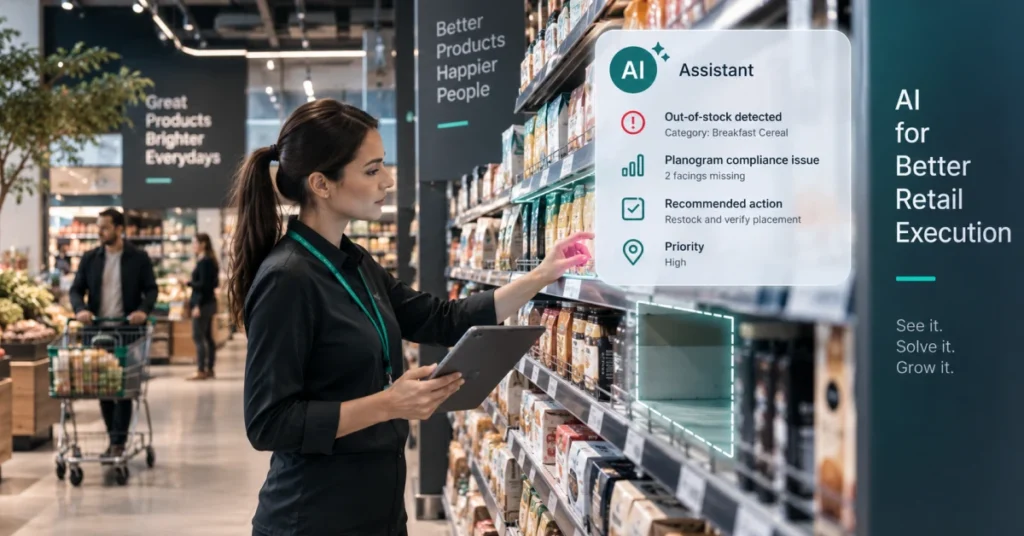
A planogram (POG) is a visual schematic that specifies exactly how merchandise should be placed on shelves — which products go where, how many facings each receives, and at what height. Planograms are not suggestions. They are operational standards that directly influence sales and customer navigation.
Step 3: Set Pricing and Promotional Cadence
Pricing decisions must reflect the brand’s competitive positioning. Promotional events — seasonal sales, new product launches, clearance — need to be planned months in advance so that signage, inventory, and field execution are all synchronized.
Step 4: Create Signage and Visual Assets
Every display needs supporting visual materials: price cards, promotional banners, shelf talkers, and brand imagery. These assets must be consistent with brand standards and produced in sufficient quantity for every store location.
Step 5: Execute and Audit in the Field
This is where most strategies break down. Field execution requires clear communication of standards, a reliable rollout timeline, and a systematic audit process to verify compliance. Without structured execution, even the best merchandising plan fails to deliver its projected return.
Step 6: Measure Performance and Iterate
Track KPIs including sell-through rate, inventory turn, compliance scores, and sales lift from promotional displays. Use this data to refine the next plan cycle.
What Key Performance Indicators Should Retailers Track?
Effective retail merchandising is measurable. These are the KPIs that matter most:
| KPI | What It Measures | Why It Matters |
|---|---|---|
| Planogram Compliance Rate | % of SKUs placed per POG standard | Execution accuracy directly correlates with sales lift |
| Sell-Through Rate | % of inventory sold within a period | Indicates assortment and pricing effectiveness |
| Out-of-Stock Rate | % of time a SKU is unavailable | Lost sales and customer satisfaction risk |
| Display Compliance Score | % of promotional displays built to standard | Promotional ROI depends on correct execution |
| Average Transaction Value | Revenue per customer transaction | Measures cross-sell and upsell effectiveness |
| Inventory Turn | How quickly stock sells through and is replenished | Signals assortment health and demand accuracy |
| Dwell Time | Time a customer spends in a category or display zone | Indicates visual merchandising effectiveness |

How Does Retail Merchandising Differ Online vs. In-Store?
The principles of merchandising translate directly to digital retail, but the execution mechanisms are different.
In-store merchandising relies on physical space, human behavior, and sensory cues — lighting, product placement, signage, and the tactile experience of handling merchandise.
Digital merchandising replicates these principles through:
- On-site search and navigation: The digital equivalent of store layout. Poor navigation is the online equivalent of a confusing floor plan.
- Product page design: Images, copy, and reviews are the digital version of visual display and signage.
- Personalization algorithms: Replace the trained eye of a visual merchandiser with data-driven product recommendations.
- Promotional banners and featured placements: The digital equivalent of an end cap or window display.
Omnichannel retailers must ensure that the brand experience — the visual language, the promotional cadence, the product presentation standards — is consistent whether the customer encounters it in a physical store or on a screen. Inconsistency between channels erodes brand trust and confuses the customer.
Conclusion
Retail merchandising is not a creative exercise. It is a revenue-generating discipline that requires strategic planning, rigorous execution, and continuous performance measurement. From the planogram on the shelf to the signage directing the customer’s eye, every element of the merchandising mix is a decision with a measurable outcome.
The brands that win in 2026 will be those that close the gap between the strategy designed in the corporate office and the execution delivered on the sales floor. That requires the right processes, the right people — and the right technology to give every level of the organization real-time visibility into what is actually happening in their stores.
Whether you are building a merchandising program from scratch or auditing an existing one, start with the checklist above, measure what matters, and invest in tools that make execution consistent at scale.