


✦ Key Takeaways
Companies using mystery shopping audits catch 3x more compliance failures than those relying on self-reported store checks.
- → Audits evaluate staff behavior, product placement, and brand compliance simultaneously.
- → Digital software cuts audit reporting time by up to 70%.
- → Tracking the right KPIs turns raw audit data into revenue-driving decisions.
In this article:
- What Is a Mystery Shopping Audit?
- What Is Evaluated in a Mystery Shopping Audit?
- How Digital Mystery Shopping Software Improves Audits
- Most Important Mystery Shopping Audit KPIs
- Conclusion
Key takeaway: Mystery shopping audits are the sharpest tool for exposing the gap between brand promise and reality.
What Is a Mystery Shopping Audit?
Most brands assume their service standards survive contact with real customers — mystery shopping audits prove that assumption wrong at scale. A mystery shopping audit deploys trained evaluators as ordinary customers to measure the gap between policy and actual practice.
The global mystery shopping services market is valued at over $1.5 billion (Fortunebusinessinsights), which signals how urgently businesses need objective, ground-level intelligence. That investment only pays off when the audit functions as a living calibration instrument — not a static checklist frozen at launch.
The real danger isn’t a failed audit — it’s an audit that passes while customer expectations have already moved on. What gets measured, and whether those KPIs still reflect actual customer decision moments, determines whether a secret shopper audit produces competitive advantage or just paperwork.
How Mystery Shopping Audits Work
Evaluators receive a specific scenario — a purchase, a complaint, a service inquiry — and execute it without revealing their identity. Every interaction is scored against predefined criteria, from greeting time to upsell compliance, using mystery shopping software tools that standardize data capture across locations.
The scored data flows into a report that exposes execution gaps invisible to internal managers. Without digital infrastructure, those reports become noise rather than signal.
Why Businesses Use Mystery Shopping Programs
A customer experience audit answers the question no internal review can: what actually happens when no one is watching? Datamatics identifies compliance verification, employee performance benchmarking, and competitor benchmarking as the three core drivers behind brand audit mystery shopping programs.
Businesses that treat these programs as periodic snapshots consistently underperform those that run continuous, KPI-refreshed audit cycles. The cadence and the criteria matter as much as the evaluation itself.
Industries That Use Mystery Shopping Audits
Retail, hospitality, financial services, healthcare, and quick-service restaurants rely most heavily on mystery shopping audits to enforce brand standards across distributed locations. Any industry where frontline behavior directly shapes revenue and retention has a measurable stake in audit accuracy.
The question every multi-location operator must answer next is deceptively specific: exactly which behaviors, moments, and metrics are your evaluators actually scoring?
What Is Evaluated in a Mystery Shopping Audit?
Calibration only works if you’re measuring the right things — and most audit frameworks lock their KPIs to a checklist written at launch, not to how customers actually make decisions today. A mystery shopping audit that hasn’t been updated in 18 months is measuring a business that no longer exists.
The categories below aren’t static boxes to check. They’re the live pressure points where brand promise either holds or breaks — which is why mystery shopping software matters for keeping them current.
Customer Service and Employee Behavior
Employee behavior is the single highest-weighted category in most customer experience audits — and the hardest to standardize across locations. Shoppers evaluate greeting speed, product knowledge, upsell attempts, and complaint handling in real time.
Over 70% of customers cite staff attitude as the primary driver of brand loyalty or defection (Wifitalents). That number alone justifies treating this category as a continuous signal, not an annual snapshot.
Store Cleanliness and Brand Standards
A secret shopper audit scores physical environment against brand-defined standards — signage placement, fixture condition, restroom cleanliness, and lighting compliance. These are binary pass/fail criteria that reveal whether field managers are enforcing brand standards or ignoring them.
Cleanliness scores correlate directly with perceived product quality, even when the product itself hasn’t changed. This is a brand audit mystery shopping category that demands frequency, not just depth.
Product Availability and Merchandising
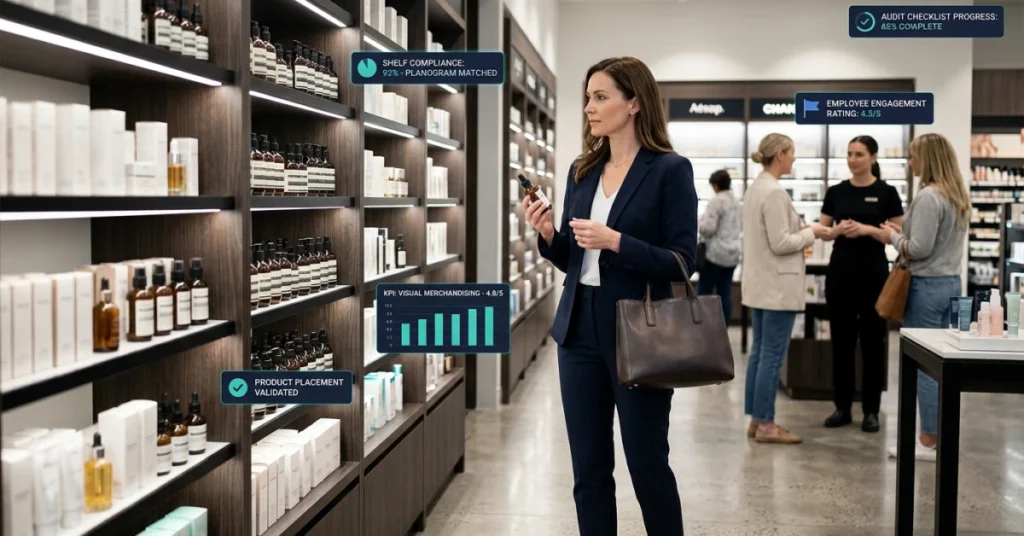
Shoppers verify that promoted SKUs are in stock, correctly priced, and positioned per planogram. A gap here means marketing spend is driving traffic to a shelf that can’t convert.
According to reporting by Goaudits, merchandising compliance failures are among the most frequently flagged issues in mystery shopping services — yet they’re often the last category operators choose to fix. That disconnect is exactly what a well-structured audit exposes.
Sales and Checkout Experience
The checkout phase captures whether the sales process closes with the same quality it opens with — wait times, payment accuracy, receipt delivery, and loyalty program enrollment. This is where revenue leaks are easiest to quantify and hardest to see without a structured audit.
Friction at checkout is the last impression a customer carries out the door. A mystery shopping audit that doesn’t score this phase is leaving its most actionable data uncollected.
📊 By the Numbers
70%+ of customers name staff behavior as the top factor in brand loyalty decisions (Wifitalents).
The real question isn’t what to evaluate — it’s whether your current tools can capture, compare, and act on that data fast enough to matter.

How Digital Mystery Shopping Software Improves Audits
Capturing live pressure points means nothing if the data arrives late, incomplete, or locked in a spreadsheet no one updates. Digital platforms transform a mystery shopping audit from a periodic snapshot into a continuously calibrated signal — one that sharpens with every visit cycle.
Over 74% of brands using digital tools report faster corrective action compared to paper-based programs (Qdegrees). Speed matters because customer expectations shift faster than any static checklist can track.
The real competitive edge isn’t the software itself — it’s the discipline of treating every evaluation cycle as a recalibration, not a report card. Secretshopper confirms that blending quantitative scores with qualitative shopper narratives produces the richest, most actionable customer experience data.
Mobile Audit Checklists
Field shoppers complete structured evaluations in real time — no memory lag, no transcription errors. Dynamic checklists adapt question sets based on location type, daypart, or prior visit scores.
This is especially critical for hotel mystery audit programs, where service variables shift dramatically by shift and season.
Photo and Video Documentation
Visual evidence eliminates disputes between field findings and management assumptions. Timestamped photos anchor every brand evaluation finding to an exact moment and condition.
Documentation also creates a longitudinal record — showing whether a location is improving, plateauing, or quietly degrading between visits.
Real-Time Reporting and Scorecards
Managers receive scorecard alerts within hours of a completed visit — not weeks later when context is gone. Instant visibility converts a secret shopper assessment from a compliance exercise into a live performance lever.
Scorecards that auto-benchmark against peer locations create healthy internal competition and surface systemic failures faster than regional review meetings ever could.
GPS and Visit Verification
GPS check-in confirms the evaluator visited the correct location at the scheduled time — no guesswork, no fraud risk. Verified visit data protects the integrity of every customer experience program at scale.
Location-stamped visits also allow brands to correlate scores with trade area demographics, foot traffic patterns, and competitive proximity.
Corrective Action Tracking
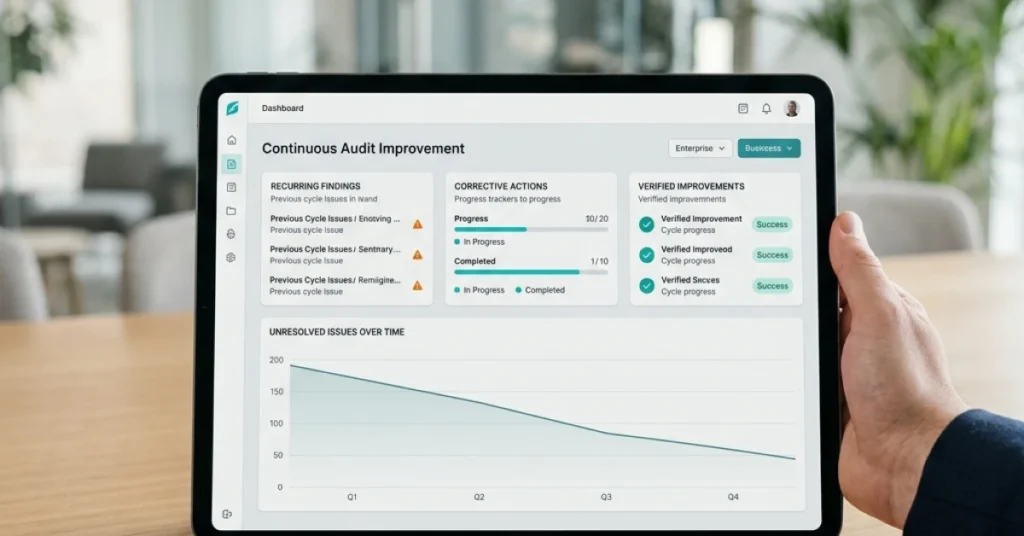
Flagging a problem is worthless without a closed-loop system that assigns ownership and tracks resolution. Digital platforms push corrective tasks directly to store managers and escalate unresolved items automatically.
This is where the process stops being a report and starts being a management system — the difference between insight and actual operational change.
📊 By the Numbers
Brands using digital mystery shopping tools resolve evaluation findings 3x faster than those using manual reporting processes.
The software infrastructure is only as powerful as the metrics it measures — which raises the question every multi-location brand eventually has to answer: which KPIs actually predict customer loyalty, and which ones just measure compliance?

Most Important Mystery Shopping Audit KPIs
Real-time signals only create advantage when you’re measuring the metrics that actually drive customer decisions.
- Compliance Rate: Tracks how consistently staff follow brand standards across every location and shift.
- First Interaction Score: Measures the quality of the customer’s very first touchpoint — the moment that sets purchase intent.
- Issue Resolution Rate: Captures how effectively employees handle complaints or service failures in real time.
- Upsell and Offer Execution: Reveals whether promotional scripts and upsell prompts are actually being delivered at the counter.
- Brand Consistency Index: Scores how uniformly the brand experience is delivered across locations — a core hotel mystery audit metric with direct revenue implications.
Customer Satisfaction Scores
Satisfaction data captured through evaluator visits reflects perceived experience — not just procedural compliance. Brands that realign these benchmarks quarterly to shifting expectations consistently outperform those locked to a static launch-day rubric.
These figures lose predictive value fast — over 60% of customers change their service expectations within 12 months (Aba Co). Any evaluation framework that skips annual recalibration is measuring yesterday’s standard.
Employee Performance Ratings
Staff performance ratings expose the gap between training investment and floor-level execution. Individual scores, aggregated across visits, reveal systemic coaching failures that isolated observations never surface.
These ratings only compound in value when tracked longitudinally — a single evaluation cycle produces a data point, not a pattern. Patterns are what drive corrective action that actually sticks.
Audit Compliance Scores
Compliance scores are the backbone of any structured brand evaluation program — they quantify how closely reality matches established standards. The Fortunebusinessinsights mystery shopping services market report projects the industry reaching $3.2 billion by 2032, driven largely by demand for measurable compliance data.
These figures become dangerous when treated as a finish line rather than a calibration input. A location scoring 94% on a checklist written three years ago may be perfectly executing an outdated standard.
Service and Response Times
Response time is one of the few tracked indicators with a direct, measurable link to revenue loss. Customers who wait more than 3 minutes for initial acknowledgment convert at significantly lower rates across retail and hospitality sectors.
Timing data must be benchmarked against current competitor baselines — not internal historical averages. Speed expectations shift with the market, not with your last reporting cycle.
The question isn’t whether these KPIs are being tracked — it’s whether the entire evaluation framework is built to act on what they reveal before the window to compete closes.
Conclusion
Those KPIs only create competitive advantage when they’re treated as a living system — not a checklist frozen at launch. A mystery shopping audit that never updates its evaluation criteria becomes a compliance ritual, not a calibration tool.
Brands that realign audit KPIs continuously outperform those running static programs — and the gap compounds over time. The mystery shopping industry generates over $2 billion annually (according to Wifitalents), yet most of that spend produces reports, not decisions.
Most multi-location brands can’t verify their customer experience strategy is actually executing at the human level — that’s the exact gap a secret shopper audit is built to close. FieldPie captures audit data through customizable forms, photo evidence, and real-time reporting, so every field observation ties directly to a trackable KPI.
Teams that standardize this process see measurable execution improvements — Hsbrands reports that structured mystery shopping programs drive customer satisfaction scores up by as much as 30%. Start your audit program with FieldPie today.