


A structural inspection construction process is a systematic, engineer-led evaluation of a building’s load-bearing systems — including its foundation, framing, beams, and connections — to verify safety, code compliance, and long-term integrity. It applies to both residential and commercial projects at multiple stages of construction and occupancy.
What Is Structural Inspection in Construction?
Structural inspection in construction is the formal assessment of a building’s structural components by a licensed structural engineer or qualified inspector. Unlike a standard home inspection, it goes beyond cosmetic evaluation to analyze whether the structure can safely carry its designed loads under current and future conditions.
According to Criterium-Bennett Engineers, a structural inspection examines the skeleton of a building — every element responsible for holding the structure up and keeping it stable under gravity, wind, seismic, and environmental loads.
Key components evaluated include:
- Foundation systems (slab, pier, crawl space)
- Structural framing (wood, steel, concrete)
- Load-bearing walls and columns
- Roof trusses and floor systems
- Connections, fasteners, and welds
- Signs of settlement, cracking, or moisture damage
Why Does Structural Inspection Construction Matter in 2026?
Construction defects and deferred maintenance cost U.S. property owners billions annually. The International Building Code (IBC), enforced across most U.S. jurisdictions, mandates specific inspection milestones during construction — and many states layer additional requirements on top.
For commercial properties, the stakes are even higher. A failed structural inspection can halt a project, void insurance coverage, or trigger costly litigation under statutes like Texas’s Residential Construction Liability Act (RCLA).
Three reasons structural inspection is non-negotiable in 2026:
- Code enforcement is tightening. Post-pandemic construction backlogs led to corners being cut. Municipalities are auditing completed projects more aggressively.
- Climate exposure is rising. Seismic activity, hurricane-force winds, and flooding are stressing structures that were never designed for today’s conditions.
- Insurance carriers are demanding it. Many commercial property insurers now require a current structural inspection report before binding or renewing coverage.
As Saunders Seismic notes, commercial real estate brokers and property owners are increasingly requesting seismic assessments as a standard part of due diligence — not just in high-risk zones.

When Do You Need a Structural Inspection?
What Are the Mandatory Trigger Points During Construction?
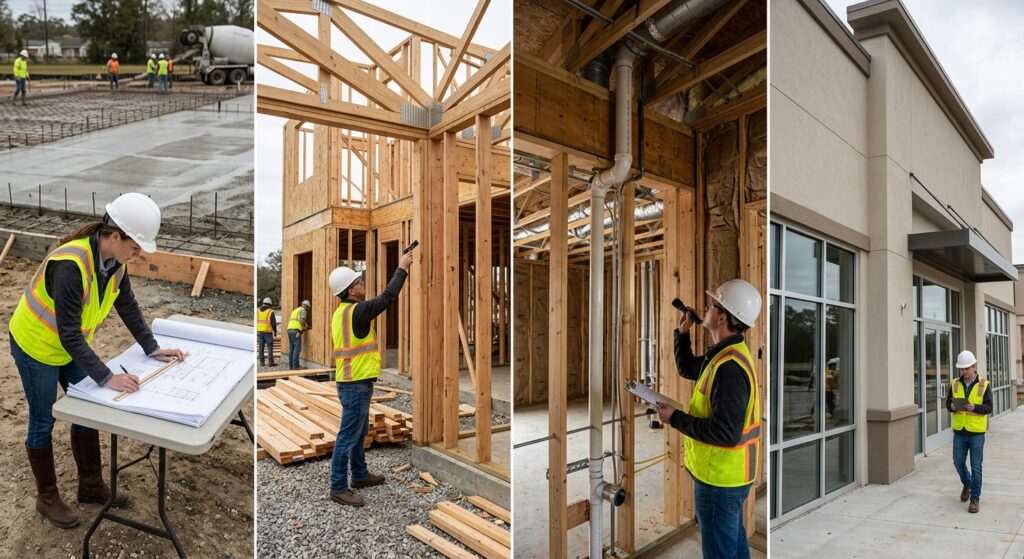
The IBC and most local building departments require structural inspections at the following construction milestones:
| Inspection Stage | What the Engineer Reviews |
|---|---|
| Foundation/Footing | Soil bearing, rebar placement, formwork before concrete pour |
| Framing | Load path continuity, connections, shear walls |
| Rough-In (Pre-Drywall) | Structural penetrations, notching, blocking |
| Seismic/Wind Bracing | Holddowns, anchor bolts, lateral bracing completeness |
| Final Inspection | Overall structural compliance before certificate of occupancy |
When Should You Commission a Structural Inspection Outside of New Construction?
Beyond mandatory construction checkpoints, a structural engineer should evaluate any building in the following situations:
- Before purchasing a home or commercial property (especially structures over 20 years old)
- After a seismic event, even if visible damage appears minor — seismic forces often compromise connections that aren’t visible to the naked eye
- Following storm or flood damage — water infiltration can degrade a foundation or wood framing within months
- Before a major renovation — adding a second story or removing a wall requires confirmation that the existing structure can handle new loads
- When cracks appear in the foundation, walls, or ceilings — not all cracks are equal, but a structural engineer must determine which are symptomatic of structural movement
- For aging commercial buildings — ASTM E2018 recommends a Property Condition Assessment (PCA) for any commercial asset changing hands
Who Can Perform a Structural Inspection?
Only a licensed Professional Engineer (PE) with a structural engineering specialization — or a licensed Structural Engineer (SE) in states that issue a separate SE license — is qualified to perform and stamp a structural inspection report.
A general home inspector is not a substitute. Home inspectors follow ASHI or InterNACHI standards, which are visual-only and explicitly exclude structural engineering analysis.
The distinction matters legally and practically:
- A PE or SE can certify findings to building departments, lenders, and courts
- A PE or SE carries Errors & Omissions (E&O) insurance specific to engineering judgments
- Only a licensed engineer can design remediation when a deficiency is found
For high-risk commercial assets, firms like RSH Engineering and Construction offer both forensic inspection and remediation design under one roof — reducing the coordination gap between identifying a problem and fixing it.
What Does a Structural Engineer Inspect? The 10 Core Elements
A qualified structural engineer follows a systematic protocol on every site visit. While scope varies by project type, these ten elements appear in virtually every structural inspection:
- Foundation condition — settlement, cracking, hydrostatic pressure, and bearing capacity
- Basement and crawl space — moisture intrusion, wood rot, and lateral wall movement
- Floor system — deflection, joist sizing, and point load transfer
- Load-bearing walls — proper continuity from roof to foundation
- Roof structure — rafter or truss sizing, ridge beam condition, uplift connections
- Connections and fasteners — bolt sizing, weld quality, and hardware corrosion
- Seismic and lateral systems — shear walls, moment frames, diaphragm continuity
- Columns and beams — buckling risk, section loss from corrosion or notching
- Building envelope — water intrusion points that can accelerate structural damage
- Site conditions — drainage, slope stability, and proximity to excavation or adjacent construction
As GBC Engineers detail in their structural engineer inspection guide, each of these elements feeds into a holistic risk picture — no single component can be evaluated in isolation.
Residential vs. Commercial Structural Inspection: What’s Different?
How Does a Residential Structural Inspection Differ from a Commercial One?
The core engineering principles are the same, but scope, complexity, and regulatory requirements diverge significantly.
Residential structural inspection:
- Governed primarily by the International Residential Code (IRC)
- Typically covers single-family homes, townhomes, and small multifamily buildings
- Focuses heavily on foundation condition, framing, and roof structure
- Average inspection duration: 2–4 hours
- Common triggers: home purchase, storm damage, renovation planning
Commercial structural inspection:
- Governed by the IBC, ASCE 7, and applicable ASTM standards
- Covers office buildings, retail centers, warehouses, industrial facilities, and multifamily high-rises
- Requires analysis of more complex systems: moment frames, post-tensioned slabs, curtain walls
- May require seismic assessment under ASCE 41 or a Probable Maximum Loss (PML) study
- Average inspection duration: 1–3 days depending on building size
- Common triggers: acquisition due diligence, lease renewals, insurance underwriting, permit applications
For any commercial asset in a seismic zone, Bustamante Engineers recommend commissioning a structural inspection as a baseline condition document — not waiting for a triggering event.
The Complete Structural Inspection Construction Checklist
Use this checklist to prepare for — and evaluate the quality of — any structural inspection construction engagement.
Pre-Inspection Preparation
- Confirm the inspector holds a current PE or SE license in your state
- Obtain original construction drawings and any prior inspection reports
- Identify known deficiencies or previous repairs to disclose upfront
- Ensure all areas are accessible: crawl space, attic, mechanical rooms, roof
- Confirm the inspector carries E&O and general liability insurance
During the Inspection
- Engineer physically accesses foundation, crawl space, and attic — not just visual from access hatch
- All visible structural connections are documented with photographs
- Cracks are measured, mapped, and characterized (structural vs. cosmetic)
- Moisture readings taken at suspect areas
- Seismic and lateral bracing systems verified against permit drawings
- Any site drainage issues adjacent to the foundation noted
- Beam and column conditions checked for corrosion, notching, or damage
Post-Inspection Deliverables
- Written report on engineer’s letterhead with PE/SE stamp
- Photographs keyed to a building plan or narrative
- Clear distinction between “life-safety” deficiencies and maintenance items
- Prioritized remediation recommendations with estimated scope
- Statement of code compliance (or non-compliance) relative to applicable IBC/IRC edition
Common Structural Deficiencies Found During Construction Inspections
Understanding what engineers actually find helps owners and contractors prioritize. The most frequently cited deficiencies in residential and commercial structural inspections include:
Foundation issues:
- Differential settlement exceeding 1 inch across a bearing wall
- Foundation cracks wider than 1/4 inch or displaying horizontal displacement
- Evidence of hydrostatic uplift or undermining in flood-prone zones
Framing deficiencies:
- Notched or bored joists and rafters that violate IRC Section R802 or R502 limits
- Missing or incorrectly installed hurricane ties and holddown anchors
- Improper load path continuity — loads not transferring cleanly from roof to foundation
Seismic and lateral deficiencies:
- Inadequate shear wall length relative to ASCE 7 wind/seismic demand
- Missing or undersized anchor bolts at mudsill connections
- Soft-story conditions in older commercial buildings (a leading cause of seismic collapse)
Connection and fastener problems:
- Undersized or missing structural screws at critical connections
- Corroded hardware in coastal or high-humidity environments
- Weld defects in steel-frame commercial construction
Soft-story buildings — a condition common in pre-1980 commercial wood-frame construction — represent one of the highest-risk seismic vulnerabilities in U.S. cities. Many municipalities, including Los Angeles and San Francisco, now mandate seismic retrofit programs targeting exactly this condition.
How Much Does a Structural Inspection Cost?
Cost varies by project type, geographic market, and scope of work:
| Inspection Type | Typical Cost Range (U.S.) |
|---|---|
| Residential (single-family home) | $300 – $700 |
| Residential (foundation-specific) | $500 – $1,500 |
| Small commercial building (<10,000 SF) | $1,000 – $3,500 |
| Large commercial building (>50,000 SF) | $5,000 – $25,000+ |
| Seismic/PML assessment (commercial) | $3,500 – $15,000 |
| Construction phase inspections (per visit) | $200 – $800 per site visit |
These figures represent engineer time and report preparation only. If the inspection reveals deficiencies requiring remediation design, additional engineering fees apply.
The cost of skipping a structural inspection is almost always higher. A missed foundation defect discovered post-closing on a commercial property can easily run $50,000–$500,000 to remediate — far exceeding the cost of a pre-purchase inspection.

Structural Inspection Construction: Regulatory and Standards Framework
Understanding the applicable standards positions owners, contractors, and engineers to communicate with precision:
- IBC (International Building Code): Primary model code governing structural design and construction inspection requirements in most U.S. jurisdictions
- IRC (International Residential Code): Governs one- and two-family dwellings and townhomes up to three stories
- ASCE 7: Minimum design loads and associated criteria for buildings — the load standard referenced by IBC
- ASCE 41: Standard for seismic evaluation and retrofit of existing buildings
- ASTM E2018: Standard guide for property condition assessments — the benchmark for commercial due diligence inspections
- ACI 318: Building code requirements for structural concrete — referenced for foundation and concrete frame inspections
- AISC 360: Specification for structural steel buildings — governs steel frame inspection criteria
Engineers conducting inspections on site must reference the code edition adopted by the local jurisdiction, which may lag the current published edition by one or two cycles.
How to Select the Right Structural Engineer for Your Project
Not all structural engineers specialize in the same building types or inspection scenarios. Use these criteria when vetting candidates:
- License verification: Confirm active PE or SE licensure through your state engineering board’s public database
- Relevant project experience: A residential foundation specialist may not be the right choice for a seismic assessment of a mid-rise commercial building
- Report quality: Request a sample redacted report — it should include photographs, code references, and clear remediation priorities
- Turnaround time: For time-sensitive transactions, confirm the engineer can deliver a stamped report within your due diligence window
- Insurance: Minimum $1M E&O and $1M general liability coverage is standard for commercial engagements
For construction phase inspections, the engineer should have direct experience with the construction type (wood frame, steel, concrete, masonry) and familiarity with the local building department’s inspection protocols. Firms that combine structural engineering with construction management expertise can provide continuity from inspection findings through remediation completion.