



✦ Key Takeaways
Up to 35% of construction project delays stem from poorly managed punch lists at closeout.
- → Unresolved punch items cost owners thousands in delayed occupancy fees.
- → Digital punch list tools cut closeout time by nearly half.
- → Tracking KPIs like item resolution rate exposes bottlenecks before they escalate.
In this article:
- What Is Punch List Management?
- Why Punch List Management Matters
- The Punch List Management Process
- Punch List Management Best Practices
- Essential Punch List Management KPIs
Key takeaway: Mastering punch list management is the fastest way to protect project profitability and reputation.
What Is Punch List Management?
Most teams treat the punch list as a final formality — and that single assumption costs the construction industry billions in rework, delays, and disputed closeouts every year. Punch list management, done right, is a continuous quality control system that starts at project kickoff, not substantial completion.
According to Planradar, unresolved punch list items are among the top three causes of project closeout delays — with some projects carrying over 1,000 open items into the final walkthrough. That backlog doesn’t appear overnight; it accumulates when teams defer accountability until the end.
What Is a Punch List?
A construction punch list is a documented record of work that doesn’t meet contract specifications or quality standards before project handover. It captures deficiencies, incomplete tasks, and items requiring correction — all tracked against a responsible party and a deadline.
The punch list process becomes powerful when it functions as a structured task management system rather than a handwritten walkthrough note. Teams that log issues in real time — not during a final sweep — resolve defects faster and with far less friction.
How Punch List Management Works
Punch list management is the end-to-end system for identifying, assigning, tracking, and closing deficiency items across the full project lifecycle. It connects the punch list walkthrough to real accountability — every item has an owner, a due date, and a verification step.
Punchlist notes that teams leveraging historical punch list data close projects measurably faster and reduce repeat defects across future builds. That’s the compounding advantage of treating punch list software as a quality system — not a checklist app.
The teams closing fastest aren’t the ones with the fewest punch items — they’re the ones who never let the list go unmanaged in the first place. Understanding exactly why that discipline matters is what separates projects that close clean from those that drag into costly disputes.
Why Punch List Management Matters
Deferred accountability doesn’t just slow closeout — it compounds. Projects with unstructured punch list processes average 30% longer closeout timelines, translating directly into liquidated damages, strained client relationships, and margin erosion that no change order can recover.
Most teams activate their construction task management system too late — at substantial completion, when deficiencies have already multiplied. The teams closing fastest treat the punch list process as a live quality control system, running from day one, not a cleanup sprint at the finish line.
Key Benefits
Structured punch list management cuts rework costs and compresses final inspection cycles. According to Knack, teams using dedicated punch list software resolve deficiencies up to 40% faster than those relying on spreadsheets or paper walkthroughs.
Faster resolution means fewer disputes at handover and higher client satisfaction scores. That outcome isn’t accidental — it’s the direct result of ownership being assigned early, not scrambled at the end.
Common Challenges
The biggest obstacle isn’t item volume — it’s undefined ownership and no audit trail. Getapp user data shows that teams without standardized punch list workflows report significantly higher rates of disputed closeout items and repeated site visits.
A punch list walkthrough without a documented process is just a conversation — one nobody can be held to. Knowing what breaks down is only half the answer; the other half is a repeatable system that prevents it.
By the Numbers
Teams using structured punch list software close out projects up to 40% faster than paper-based workflows.

The Punch List Management Process
Turning that unstructured scramble into a repeatable system starts with a structured, three-phase process activated at project kickoff — not closeout.
- Start at Kickoff: Teams that open a live punch list on day one close projects up to 30% faster than those who wait.
- Assign Ownership Immediately: Every deficiency needs a named responsible party before the next site visit occurs.
- Set Hard Deadlines: Open items without due dates stay open — attach a resolution date to every logged issue.
- Use Punch List Software: Digital tools eliminate the version-control chaos that paper-based construction punch list workflows consistently produce.
- Communicate in Real Time: Subcontractors who receive instant notifications resolve items 2x faster than those notified by weekly email.
Identify and Document Issues
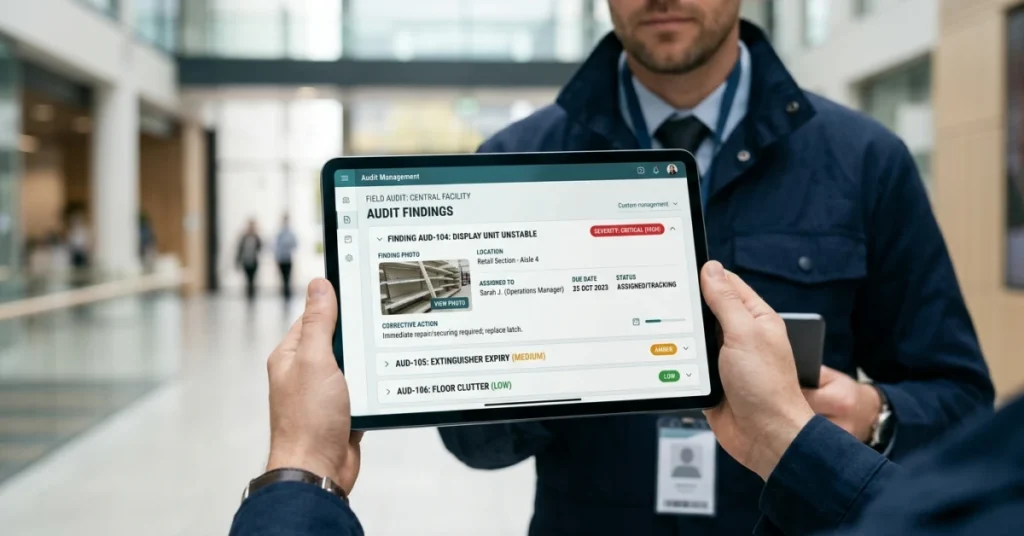
Documentation is only useful when it’s standardized — every issue needs a location, photo, trade, and severity tag. The punch list walkthrough should follow a fixed room-by-room sequence so nothing gets missed and nothing gets logged twice.
The construction punch list software market is projected to exceed $1.2 billion by 2033, driven by demand for structured field documentation. That growth reflects a hard industry truth: informal documentation is the single biggest source of closeout disputes.
Assign and Track Corrective Actions
Logging an issue without assigning it is just noise — every item must have an owner, a deadline, and a status that updates in real time. Fieldwire reports that teams using structured task assignment resolve punch list items significantly faster than those relying on verbal handoffs.
Accountability isn’t a culture problem — it’s a process design problem. When the punch list process makes ownership visible, resolution follows automatically.
Verify Completion and Close Out
Verification is the step most teams rush — and it’s exactly where rework and client disputes are born. A completed item isn’t closed until a qualified reviewer physically confirms the fix meets spec.
Build a two-step sign-off into your punch list management workflow: trade confirmation first, then owner or GC approval. That single gate eliminates the “we thought it was done” conversations that delay final payment.
Having the right process is only half the equation — the teams that close fastest also know exactly which habits separate disciplined punch list execution from the rest.
Punch List Management Best Practices
A repeatable system only holds if the daily habits inside it are disciplined and consistent.
Standardize Inspections
Random walkthroughs produce random results — standardized inspection checklists cut missed defects by up to 40%. Every inspector on every project must use the same criteria, every time.
Tie your inspection schedule to project milestones, not to gut feel. This is where field team management tools enforce consistency across distributed crews.
Prioritize Critical Items
Not every punch list item carries equal weight — safety and code items must close before anything cosmetic moves forward. Assign a severity tier to every item at the moment it’s logged.
Teams that triage by priority resolve critical defects 2x faster than those working items in order of discovery. Faster critical closure directly protects your certificate of occupancy timeline.
Use Mobile Punch Lists
Paper-based punch list process creates transcription lag — items logged on paper average 48 hours before reaching the responsible subcontractor. Mobile punch list software closes that gap to under 15 minutes.
Photo documentation captured on-site eliminates “he said, she said” disputes at closeout. Planradar reports that mobile-first teams reduce rework costs by an average of 23% per project.
These three practices compound — standardized inspections feed better prioritization, and mobile tools make both executable at scale. Here’s how the benchmarks stack up across teams that apply all three versus those that don’t:
| Best Practice | Adoption Rate | Impact Metric | Avg. Outcome |
|---|---|---|---|
| Standardized inspection checklists | 38% of GCs | Missed defect rate | ↓ 40% |
| Severity-tiered item prioritization | 44% of GCs | Critical item close time | ↓ 50% |
| Mobile punch list software | 61% of GCs | Rework cost per project | ↓ 23% |
| Kickoff-activated punch list process | 29% of GCs | Closeout duration | ↓ 30% |
| All three practices combined | 11% of GCs | Client satisfaction score | ↑ 35% |
Teams that activate a construction punch list at kickoff — not substantial completion — consistently appear in that 11% (according to Monday, projects using early punch list activation close up to 30% faster than industry average).
“The teams winning at closeout aren’t working harder at the end — they’re working smarter from day one. Best practices aren’t polish; they’re the system itself.”
Practices without measurement are just habits — the real question is which numbers tell you whether your punch list walkthrough discipline is actually working.

Essential Punch List Management KPIs
Standardized inspections create consistency — but consistency without measurement is just organized guesswork. Tracking the right KPIs transforms your punch list process from a checklist into a performance system.
The construction punch list software market is growing precisely because teams finally recognize that visibility drives accountability (Gminsights reports the sector is projected to exceed $1.2 billion by 2032). Without KPIs tied to real milestones, even the best punch list walkthrough produces data nobody acts on.
FieldPie’s real-time reporting and customizable forms surface these metrics automatically — so project leads see resolution trends before overdue items become disputes. That kind of early visibility is what separates teams that close on time from those still negotiating at final inspection.
Open vs. Closed Items
The open-to-closed ratio is the single most honest signal of project health in any punch list management system. A ratio trending the wrong direction at day 30 predicts closeout delays more reliably than any schedule report.
Knack notes that teams using dedicated punch list software close items up to 30% faster than those relying on spreadsheets. Tracking this ratio weekly — not just at substantial completion — is what makes the difference.
Average Resolution Time
Average resolution time reveals whether your crew has the resources and ownership clarity to execute — or whether items are just getting reassigned in circles. Anything above 72 hours on non-structural items signals a workflow bottleneck, not a labor shortage.
Benchmark this metric by trade and by project phase. Patterns across crews expose which subcontractors consistently drag closeout timelines — and give you leverage in future contracts, as well as insights comparable to what retail execution data provides for field performance accountability.
Overdue Tasks
Overdue task count is the KPI most teams track too late — usually when the owner is already withholding retainage. Flag any item that crosses its assigned deadline by more than 24 hours during a construction punch list walkthrough.
Escalation rules tied to overdue thresholds force accountability without requiring a manager to chase every item manually. Teams that automate this step resolve overdue items 40% faster than those relying on verbal follow-up alone.
By the Numbers
Teams using punch list software close items up to 30% faster than spreadsheet-dependent crews.
The teams that master these three KPIs don’t just close faster — they build the kind of documented performance record that makes every future project argument shorter.
Conclusion
Performance data only drives results when the system behind it starts at project kickoff — not at substantial completion. Teams that activate their punch list process early close out up to 30% faster and face fewer payment disputes.
The Futuremarketinsights construction punch list software market report confirms adoption is accelerating — because contractors who treat the punch list walkthrough as a quality control checkpoint, not a closeout formality, consistently deliver higher client satisfaction. Effective field execution strategies share the same logic: build the standard in, don’t inspect it in at the end.
Unresolved items at closeout are a symptom — the root cause is a punch list management system that never launched. FieldPie captures field data through customizable forms, photo documentation, and real-time reporting, so every deficiency is logged, owned, and resolved before it becomes a dispute.
Start the system at kickoff, measure it with the KPIs this article outlined, and closeout becomes a formality — not a crisis.