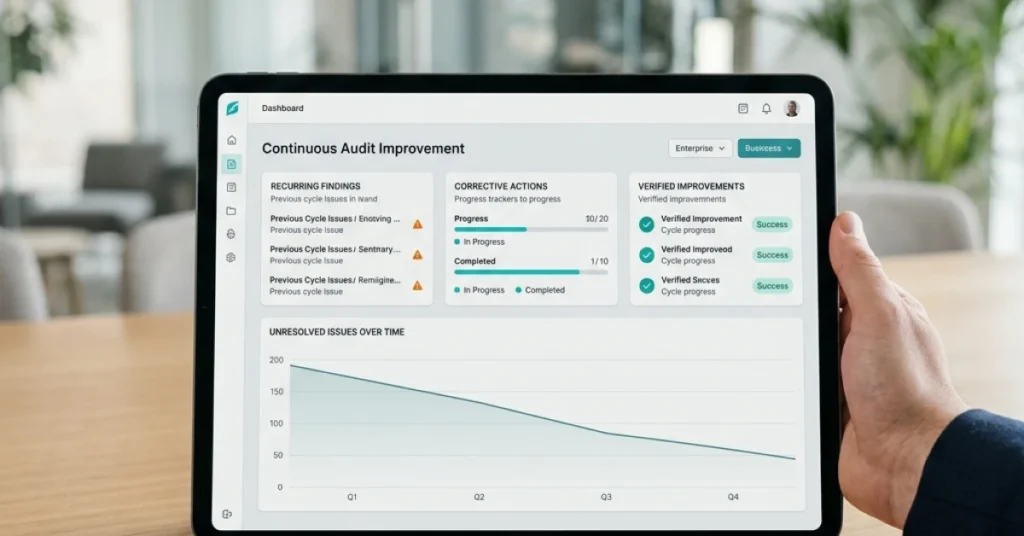




A Quality Management System (QMS) is a formalized framework of documented policies, processes, and procedures that an organization uses to achieve and consistently deliver products or services that meet customer and regulatory requirements. It aligns operations, reduces defects, and drives continuous improvement across all business functions.
What Is a Quality Management System?
A Quality Management System is a structured set of business processes focused on consistently meeting customer requirements and enhancing satisfaction. Governed primarily by the ISO 9001 standard — maintained by the International Organization for Standardization — a QMS provides organizations with the operational backbone to deliver quality outputs, manage risk, and sustain competitive advantage.
According to the American Society for Quality, a QMS integrates the activities necessary to demonstrate that an organization can consistently provide products and services that meet applicable statutory and regulatory requirements. This isn’t a theoretical exercise — it’s a measurable, auditable business discipline.
Why Does a Quality Management System Matter in 2026?
Global supply chains have grown more complex, regulatory scrutiny has intensified, and customer expectations continue to rise. Organizations without a structured quality framework increasingly struggle to remain competitive across markets. Specific drivers include:
- Regulatory compliance: Industries like medical devices (FDA 21 CFR Part 820), aerospace (AS9100), and food safety (ISO 22000) mandate formalized quality systems.
- Market access: Many enterprise buyers and government contracts require ISO 9001 certification as a baseline supplier qualification.
- Cost reduction: The American Society for Quality estimates that poor quality costs U.S. manufacturers between 5% and 30% of gross sales.
- Safety assurance: A well-implemented QMS directly reduces safety incidents by standardizing processes and eliminating variance.
How Does a Quality Management System Work?
A QMS operates on the Plan-Do-Check-Act (PDCA) cycle — a four-stage iterative model that drives continuous improvement. Every major QMS standard, including ISO 9001:2015, is structured around this logic.
| Stage | Activity | QMS Element |
|---|---|---|
| Plan | Identify objectives, risks, and processes | Quality policy, risk register, process maps |
| Do | Execute processes per documented procedures | SOPs, work instructions, training records |
| Check | Monitor, measure, and audit performance | Internal audits, KPIs, customer feedback |
| Act | Correct deviations and drive improvement | CAPAs, management reviews, process updates |
What Are the Core Elements of a QMS?
According to ISO 9001:2015, a conforming Quality Management System must address seven quality management principles:
- Customer focus — All processes orient toward meeting and exceeding customer requirements.
- Leadership — Top management actively drives quality culture and resource allocation.
- Engagement of people — Competent, empowered employees are essential at every level.
- Process approach — Activities are managed as interrelated processes within a system.
- Improvement — Continual improvement is a permanent organizational objective.
- Evidence-based decision making — Decisions rely on data analysis, not intuition.
- Relationship management — Supplier and partner relationships are managed strategically.
These principles aren’t aspirational — they map directly to auditable clauses in the standard. Organizations pursuing certification must demonstrate compliance with each.

What Are the Most Common QMS Standards?
Different industries operate under different regulatory frameworks. Understanding which standard applies to your sector is the first step in building a compliant system.
| Standard | Industry | Governing Body |
|---|---|---|
| ISO 9001:2015 | General (all industries) | ISO |
| ISO 13485 | Medical devices | ISO |
| AS9100 Rev D | Aerospace & defense | IAQG |
| IATF 16949 | Automotive | IATF |
| ISO 22000 | Food safety | ISO |
| GMP (21 CFR Parts 210/211) | Pharmaceuticals | FDA |
| TL 9000 | Telecommunications | QuEST Forum |
ISO 9001 remains the most widely adopted standard globally, with over 1 million certificates issued across more than 170 countries as of the most recent ISO survey. Sector-specific standards typically incorporate ISO 9001 as their foundation and layer additional requirements on top.
If your organization operates across multiple verticals, selecting a QMS software platform capable of managing requirements from different standards simultaneously is critical to maintaining a competitive posture without duplicating effort.
How Do You Implement a Quality Management System? Step-by-Step
Implementation is where most organizations stumble. A phased, structured approach reduces disruption and accelerates certification timelines. Here’s a proven roadmap:
Step 1: Conduct a Gap Analysis
Before building anything new, assess where your current operations stand against the target standard. Document which requirements you already meet, which are partially addressed, and which are absent entirely. This baseline informs your project scope and resource requirements.
Step 2: Define Scope and Quality Policy
Determine which products, services, sites, and processes fall within the QMS boundary. Draft a quality policy that reflects your organization’s commitment — it must be appropriate to your context, include a commitment to continual improvement, and be communicated across the organization.
Step 3: Map and Document Core Processes
ISO 9001:2015 requires documented information sufficient to support process operation. This includes:
- Process maps and flowcharts
- Standard Operating Procedures (SOPs)
- Work instructions for critical tasks
- Forms and records for evidence capture
Keep documentation lean and useful. Overly complex documentation that no one reads defeats the purpose of a QMS.
Step 4: Implement Risk-Based Thinking
ISO 9001:2015 replaced the older “preventive action” clause with a broader requirement for risk-based thinking. Organizations must identify risks and opportunities that could affect their ability to deliver conforming products or services, then take proportionate action. Maintain a risk register and review it during management reviews.
Step 5: Train Personnel
Competence is a hard requirement under ISO 9001 Clause 7.2. Document the required competencies for each role, assess current capability gaps, and deliver targeted training. Retain records of all training activities — these are among the first documents an auditor will request.
Step 6: Run Internal Audits
Before any external certification audit, conduct at least one full internal audit cycle covering all QMS clauses. Internal audits identify nonconformities early, allowing you to close them before they become formal findings.
Step 7: Conduct a Management Review
ISO 9001 requires top management to review the QMS at planned intervals. The review must cover customer satisfaction data, audit results, process performance, and any changes that could affect the system. Outputs must include decisions on improvement opportunities and resource needs.
Step 8: Select and Engage a Certification Body
Choose an accredited certification body (CB) recognized by your national accreditation body — for example, ANAB in the United States or UKAS in the United Kingdom. The CB will conduct a Stage 1 (document review) and Stage 2 (on-site assessment) audit. Typical certification duration from initial engagement to certificate issuance ranges from three to six months for a prepared organization.
Step 9: Address Nonconformities and Achieve Certification
Close any nonconformities raised during the Stage 2 audit with documented corrective actions. Once the CB accepts your responses, they issue the certificate. Certificates are typically valid for three years, with annual surveillance audits to verify ongoing compliance.
How Does a QMS Differ Across Industries?
The core PDCA logic applies universally, but the specific requirements vary significantly by sector. A few illustrative examples:
Manufacturing: Quality control at the production line level — statistical process control (SPC), incoming inspection, first article inspection (FAI). The QMS must integrate with ERP and MES systems to capture production data in real time.
Healthcare and Medical Devices: ISO 13485 adds requirements for sterile product controls, complaint handling tied to adverse event reporting, and design history files. The FDA’s Quality System Regulation (21 CFR Part 820) is currently being harmonized with ISO 13485, a change that significantly affects U.S. medical device manufacturers.
Field Services: Organizations providing on-site maintenance, inspection, or installation services face the challenge of capturing quality evidence away from a central facility. Standardized digital inspection forms for field technicians ensure that data collected across geographically dispersed jobs meets the evidentiary standards required by the QMS.
Food and Beverage: ISO 22000 and FSMA (Food Safety Modernization Act) require hazard analysis and preventive controls. Safety records must demonstrate that critical control points were monitored at the correct intervals and that deviations triggered documented responses.
How Do You Measure QMS Effectiveness?
A QMS that isn’t measured isn’t managed. Key performance indicators should span all four PDCA stages:
| KPI Category | Example Metrics |
|---|---|
| Customer Satisfaction | NPS score, complaint rate, return/warranty rate |
| Process Performance | First-pass yield, defect rate, on-time delivery % |
| Audit Performance | Open nonconformities, CAPA closure rate, repeat findings |
| Supplier Quality | Supplier defect rate, on-time delivery from suppliers |
| Safety & Compliance | Incident rate, regulatory findings, safety observations |
Review these metrics at least quarterly. Trend data is more valuable than point-in-time snapshots — a rising CAPA closure rate over six months tells a fundamentally different story than a single month’s data. For organizations operating across multiple sites, consolidating quality KPIs into a single performance dashboard eliminates the manual aggregation work that typically delays management reviews.
What Are the Benefits of a Certified QMS?
Certification under ISO 9001 or a sector-specific standard delivers measurable returns that extend well beyond the certificate on the wall:
- Market access: Certification is a prerequisite for supplier qualification in automotive, aerospace, defense, and many government procurement programs.
- Reduced audit burden: Many customers accept ISO 9001 certification in lieu of their own supplier audits, reducing the time and cost of second-party assessments.
- Operational efficiency: Organizations that have implemented ISO 9001 report average reductions in defect rates of 30–50% within the first two years of certification.
- Employee engagement: Clear processes and defined responsibilities reduce ambiguity, which is a primary driver of workplace frustration and turnover.
- Insurance and liability: Documented safety and quality controls reduce liability exposure and can lower insurance premiums in regulated industries.
As Wikipedia’s overview of quality management systems notes, the evolution of QMS frameworks from inspection-based models to process-based systems represents one of the most significant shifts in modern management practice.
Frequently Asked Questions (FAQ)
What is the difference between a QMS and ISO 9001?
ISO 9001 is the international standard that specifies requirements for a Quality Management System — it defines what a QMS must accomplish. A QMS is the actual system an organization builds and operates. You can have a QMS without ISO 9001 certification, but you cannot be ISO 9001 certified without implementing a conforming QMS.
How long does it take to implement a QMS and achieve ISO 9001 certification?
The implementation duration depends on organizational size, complexity, and existing process maturity. A small-to-medium organization starting from scratch typically requires 6–12 months to reach certification readiness. Larger organizations or those with complex, multi-site operations may require 12–24 months. Engaging an experienced consultant and using purpose-built QMS software can compress this timeline significantly.
Do small businesses need a Quality Management System?
Yes — though the scale and formality should match the organization’s size and risk profile. ISO 9001:2015 was specifically designed to be scalable, with explicit provisions for small organizations. Even without formal certification, a documented QMS reduces rework costs, improves customer satisfaction, and creates the operational consistency needed to grow. Many small businesses find that implementing a lightweight QMS is the single highest-ROI operational investment they can make.
Conclusion
A well-implemented Quality Management System is more than a compliance requirement — it’s a framework for operational consistency, risk reduction, and long-term business growth. As regulations tighten and customer expectations rise, organizations that standardize processes, measure performance, and drive continuous improvement gain a clear competitive advantage.
Whether you’re pursuing ISO 9001 certification or simply improving internal operations, building a scalable QMS helps reduce errors, strengthen accountability, and improve customer trust across every part of the business.