


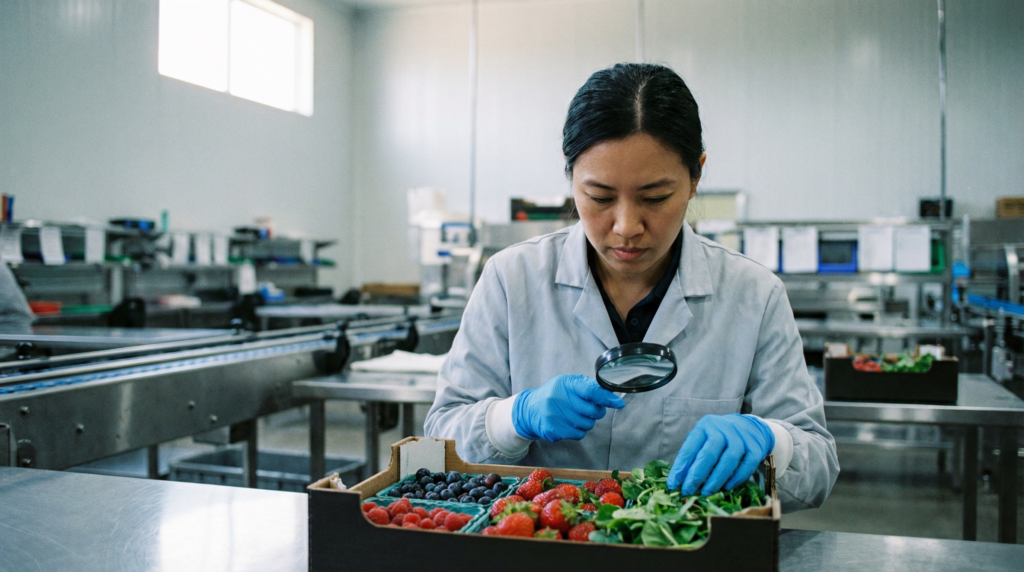
Food quality and control is the set of systematic procedures, inspections, testing protocols, and regulatory frameworks that food businesses use to ensure their products meet defined safety, nutritional, and sensory standards — from raw material sourcing through final distribution.
What Is Food Quality and Control — and Why Does It Matter in 2026?
Consumer expectations are rising. Regulatory bodies are tightening enforcement. And the cost of a single recall can exceed $10 million. According to research published by ScienceDirect, food companies already dedicate up to 2% of their annual revenue to quality control activities — yet the global food safety testing market continues to grow at roughly 12% annually, signaling that compliance gaps remain widespread.
The stakes are straightforward: inadequate food quality and control programs expose your business to product liability, regulatory fines, market bans, and irreversible brand damage. Getting this right isn’t optional — it’s a core business function.
How Do Food Quality Assurance and Quality Control Differ?
These two terms are often conflated, but they serve distinct functions.
| Dimension | Quality Assurance (QA) | Quality Control (QC) |
|---|---|---|
| Focus | Process-oriented | Product-oriented |
| Timing | Proactive (before production) | Reactive (during/after production) |
| Goal | Prevent defects | Detect and correct defects |
| Tools | SOPs, HACCP plans, audits | Testing, inspections, sampling |
| Responsibility | Entire organization | QC team and lab staff |
| Output | Compliant processes | Compliant products |
In practice, these functions must operate together. Your QA policy sets the standards; your QC program verifies that food products actually meet them.

What Are the Core Regulatory Frameworks You Must Know?
No food business operates in a vacuum. Compliance with established regulatory standards is non-negotiable, and these frameworks vary by market.
United States: FDA and USDA
The U.S. Food and Drug Administration (FDA) enforces the Food Safety Modernization Act (FSMA), which shifts the regulatory model from response to prevention. Key FSMA rules include:
- Preventive Controls for Human Food (21 CFR Part 117) — requires written food safety plans for facilities
- Foreign Supplier Verification Programs (FSVP) — mandates importers to verify that international suppliers meet U.S. safety standards
- Produce Safety Rule — sets enforceable standards for growing, harvesting, and packing fresh produce
The USDA’s Food Safety and Inspection Service (FSIS) separately governs meat, poultry, and egg products, requiring continuous inspection at processing facilities.
International Standards
For businesses trading across borders, international compliance is equally critical. The FAO’s Manual of Food Quality Control outlines the internationally recognized approach to imported food inspection — a framework that remains foundational for customs authorities and national food control administrations worldwide.
Key international standards include:
- Codex Alimentarius — the joint FAO/WHO food standards program, setting international benchmarks for food safety, quality, and labeling
- ISO 22000:2018 — specifies requirements for a food safety management system applicable to any organization in the food chain
- BRCGS (British Retail Consortium Global Standard) — widely required by UK and EU retailers
- SQF (Safe Quality Food) Code — a GFSI-recognized scheme common in North American retail supply chains
If your products cross international borders, your compliance program must map to the applicable standards in each destination market. This may require separate documentation, testing protocols, and staff training for each jurisdiction.
What Does a Complete Food Quality Control System Include?

A robust system covers five operational layers. Each layer depends on the one before it.
1. Supplier Qualification and Incoming Inspection
Quality starts before raw materials enter your facility. Every supplier should undergo documented qualification, including:
- Completed supplier questionnaires and third-party audit reports
- Certificate of Analysis (CoA) review for each incoming lot
- Physical inspections of incoming shipments against defined specifications
- Microbiological and chemical testing of high-risk ingredients
For international suppliers, your administration team must also verify that their food products comply with your country’s import regulations — a requirement the FAO explicitly addresses in its guidance on imported food inspection.
2. In-Process Controls and HACCP
Hazard Analysis and Critical Control Points (HACCP) is the backbone of in-process quality management. A compliant HACCP plan requires:
- Documented hazard analysis (biological, chemical, physical)
- Identification of Critical Control Points (CCPs) with defined critical limits
- Monitoring procedures and corrective action protocols
- Verification activities and record-keeping
Staff at every CCP must be trained to monitor parameters, recognize deviations, and execute corrective actions without delay.
3. Laboratory Testing and Product Verification
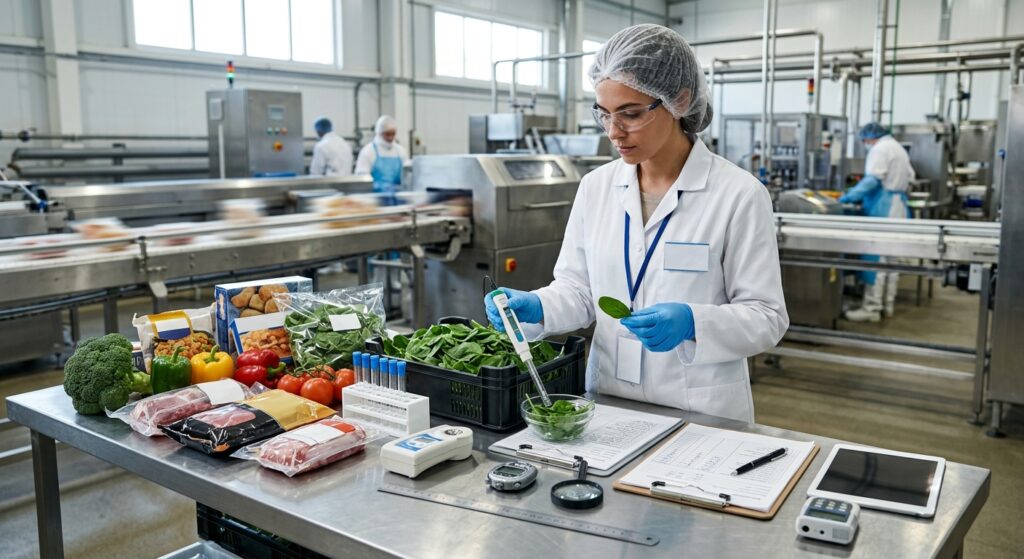
Testing validates that your food products meet specification before they reach consumers. Standard testing categories include:
| Test Category | What It Measures | Common Methods |
|---|---|---|
| Microbiological | Pathogens, spoilage organisms, indicator bacteria | Plate counts, PCR, ELISA |
| Chemical | Pesticide residues, heavy metals, allergens, additives | HPLC, ICP-MS, lateral flow |
| Physical | Foreign material, weight, dimensions, fill level | X-ray, metal detection, checkweighing |
| Sensory | Taste, texture, color, odor | Trained panel evaluation |
| Nutritional | Macro/micronutrient content | Proximate analysis, AOAC methods |
Testing frequency should be defined in your quality policy and aligned with risk — high-risk products and ingredients require more frequent verification.
4. Inspections and Audits
Regular inspections are the operational heartbeat of any quality program. These include:
- Internal audits — scheduled reviews of your own systems against your quality policy and applicable standards
- Second-party audits — customer or retailer audits of your facility
- Third-party audits — independent certification body inspections for schemes like SQF, BRCGS, or ISO 22000
- Regulatory inspections — unannounced or scheduled inspections by FDA, USDA, or equivalent international authorities
Inspections should produce documented findings, corrective action assignments, and verification of closure. Facilities that treat inspections as a compliance exercise rather than a continuous improvement tool consistently underperform on repeat audits.
5. Traceability and Recall Readiness
Every product must be traceable — one step back (supplier) and one step forward (customer) at minimum. A tested recall program requires:
- Lot coding and batch records for all food products
- A documented recall procedure with defined roles and timelines
- Mock recall exercises at least annually, targeting 100% traceability within 4 hours
- Communication templates for regulators, customers, and consumers

How Do You Build a Food Quality Policy That Actually Works?
A quality policy is not a wall poster — it’s an operational commitment that drives every procedure, training program, and corrective action in your system. An effective food quality policy includes:
- A clear scope statement — which products, processes, and facilities are covered
- Defined quality objectives — measurable targets (e.g., <1% customer complaint rate, 100% on-time internal audit completion)
- Regulatory commitment — explicit reference to the specific regulations and standards your products must meet
- Roles and responsibilities — who owns QA, QC, supplier management, and regulatory compliance
- Review cadence — the policy must be reviewed at least annually and updated when regulations, products, or processes change
Your staff must understand the policy — not just have access to it. Annual policy training with documented acknowledgment is a minimum expectation in most certification schemes.
When building or updating your food safety program, a structured food safety policy template can accelerate the process and ensure you don’t miss critical regulatory requirements.
Conclusion
Food quality and control is not just compliance — it protects your customers, brand, and market access. In 2026, rising regulations and complexity make a structured, technology-driven approach essential.
Standards like FSMA, Codex, ISO 22000, and HACCP are clear. What matters is execution: trained teams, verified suppliers, real-time inspections, and effective corrective actions.
Start with your checklist, identify gaps, and take action. If you’re still managing quality on paper, it’s time to modernize.
Ready to digitize your food quality inspections and audit program?
Book a free FieldPie demo and see how leading food manufacturers are cutting audit preparation time, eliminating paper-based compliance gaps, and staying ahead of regulatory inspections — all from a single platform.