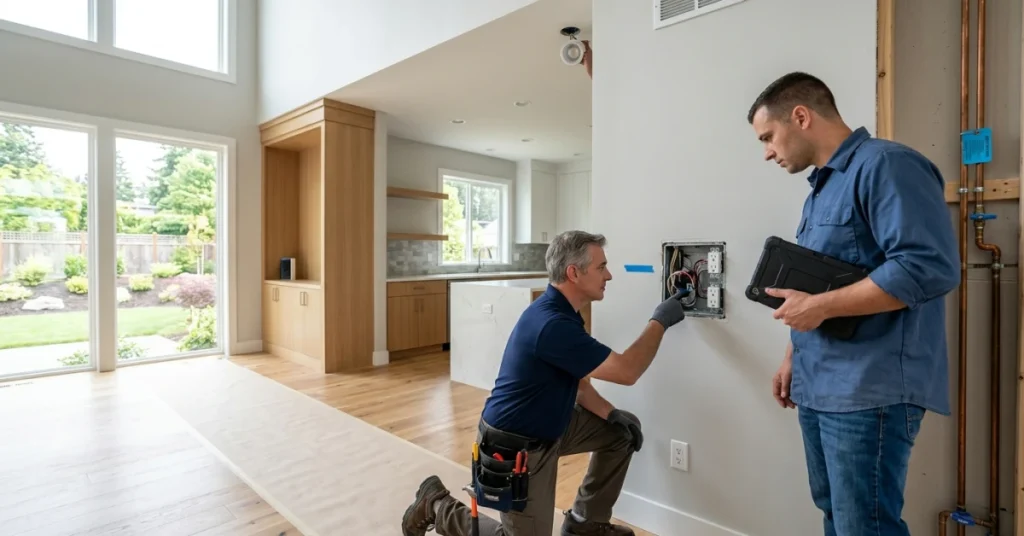




✦ Key Takeaways
Up to 80% of new construction defects go undetected without a formal pre-handover inspection process.
- → Skipped inspections cost owners thousands in post-occupancy repairs.
- → Structural, mechanical, and finish defects each require separate verification steps.
- → Digital checklists cut inspection time by half and eliminate missed items.
In this article:
- What Is a Pre-Handover Inspection?
- What Should Be Checked During a Pre-Handover Inspection?
- Pre-Handover Inspection Workflow
- Pre-Handover Inspection Checklist
- Managing Pre-Handover Inspections Digitally
Key takeaway: A rigorous pre-handover inspection is the last line of defense before ownership transfers.
What Is a Pre-Handover Inspection?
Most buyers accept their keys believing a quick walk-through was enough — studies show up to 85% of new builds contain defects that go undetected at handover, costing owners thousands in post-settlement repairs.
A pre-handover inspection — also called a practical completion inspection or PCI inspection — is a formal, documented assessment of a property conducted before ownership transfers. It is the last legal moment a buyer holds leverage over the builder, and that leverage vanishes the instant keys are accepted without signed, itemized defect evidence.
Unlike a casual walk-through, a building handover inspection evaluates structural integrity, mechanical systems, waterproofing, and code compliance — not just paint and finishes. The building inspection services market is projected to exceed $14 billion by 2033 (Factmr), reflecting how seriously the industry now treats what buyers still routinely underestimate.
Why it is critical before project handover
Once you accept handover, defect liability shifts — builders are no longer legally obligated to fix issues you failed to document before settlement. A new home handover inspection is not a courtesy; it is a contractual checkpoint with direct financial consequences.
The difference between a pre-occupancy inspection process and a standard walk-through is documentation — signed, timestamped, and specific enough to hold up in a dispute. According to Ibisworld, the U.S. building inspection industry employs over 15,000 businesses, yet most residential buyers still rely on the builder’s own representative to conduct the final review.
Who participates in the inspection process
A credible building handover inspection involves an independent licensed inspector, the buyer or project manager, and ideally a builder’s
What Should Be Checked During a Pre-Handover Inspection?
That leverage — the kind that forces a builder to fix defects at their cost — only exists if you know exactly what to inspect before you sign anything. A pre-handover inspection isn’t a casual walk-through; it’s a structured audit covering construction defects, live system performance, and legal compliance documentation simultaneously.
Buyers who treat the pre-occupancy inspection process as a visual check miss the defects that cost the most — hidden in MEP systems, waterproofing, and fire compliance records. Over 86% of new homes contain at least one defect at handover, according to Gitnux — most of which go undocumented because no one was looking in the right places.
📊 By the Numbers
86% of new homes have at least one defect at handover — most go undocumented without a structured PCI inspection.
Construction defects and incomplete work
Surface finishes are the distraction — cracks in render, uneven tiling, and paint defects are visible but rarely expensive. The costly defects hide in structural connections, waterproofing membranes, and subfloor framing that no one checks without a defined scope.
A thorough building handover inspection documents every incomplete item with photos, GPS tags, and timestamps — creating a signed defect register the builder cannot dispute after keys change hands.
MEP systems and functional testing
Mechanical, electrical, and plumbing systems must be tested under load — not just visually confirmed as installed. Inspectors should cycle HVAC, run all fixtures simultaneously, test every circuit breaker, and verify hot water delivery times against specification.
Wall rendering failures alone account for a significant share of post-handover disputes, as documented by Researchgate — most traceable to moisture ingress that functional MEP testing would have flagged early.
Safety, compliance, and documentation requirements
A practical completion inspection isn’t finished until you hold signed copies of the occupancy certificate, fire safety schedule, electrical compliance certificate, and waterproofing warranty. Missing a single document can void insurance coverage and block legal remedies after settlement.
The new home handover inspection ends the moment you accept keys — which means the checklist you use determines the legal ground you stand on for years afterward. A repeatable, enforceable process doesn’t happen by accident, and that’s exactly what a defined workflow delivers.

Pre-Handover Inspection Workflow
That leverage — the kind that forces a builder to fix MEP failures and waterproofing defects before you sign — only holds if your inspection follows a defined, repeatable workflow. Without one, you’re improvising under pressure on the most consequential day of the project.
A structured pre-handover inspection workflow converts a single walk-through into a documented legal record. That record is the difference between a builder’s verbal promise and an enforceable corrective action with a deadline.
Planning and preparing inspection checklists
A checklist built the morning of the inspection is not a checklist — it’s a liability. Your quality inspection process must be standardized before anyone sets foot on site.
Separate your checklist by trade: structural, MEP, finishes, and compliance documentation. This prevents inspectors from defaulting to visible surfaces while missing concealed defects.
Identifying and documenting defects
Every defect needs a photo, a location reference, and a severity rating — logged in real time, not reconstructed from memory later. Undocumented defects are legally invisible after keys are accepted.
Builders routinely dispute verbal defect reports. Timestamped, geotagged photographic evidence during the practical completion inspection is the only record courts and contracts recognize.
Assigning corrective actions and deadlines
Each documented defect must be assigned to a responsible party with a specific remediation deadline — not a vague “we’ll sort it” commitment. Without deadlines, defect lists become wish lists.
A building handover inspection that produces a signed corrective action register shifts the burden of proof permanently onto the builder. That signature is your enforcement mechanism.
Verifying completed work before handover
Corrective actions require a formal re-inspection — not a builder’s self-certification that the work is done. Skipping verification is how defects get buried under fresh paint and signed off anyway.
Inspectors find defects in over 86% of new home handover inspections (Windycityhome), which means re-inspection isn’t a formality — it’s statistically necessary. Accepting keys before verification closes your last window of leverage.
📊 By the Numbers
According to Rimkus, over 33% of building defect disputes stem from incomplete or undocumented PCI inspection records at handover.
The workflow is only as strong as the checklist driving it — and what goes on that checklist determines everything you catch, and everything you miss.
Pre-Handover Inspection Checklist
A structured checklist is what converts that leverage into documented, enforceable evidence before keys change hands.
- Start with a signed scope agreement: Confirm in writing exactly which areas and systems fall within the pre-occupancy inspection scope before the walkthrough begins.
- Photograph every defect immediately: Timestamped photos create irrefutable evidence that defects existed before handover acceptance.
- Log defects with location codes: Reference each item to a room or grid coordinate so contractors cannot dispute which element requires rectification.
- Assign a rectification deadline per item: Open-ended defect lists give builders legal wiggle room; dated deadlines remove it entirely.
- Require sign-off on each closed item: A defect marked “complete” without a countersignature is legally meaningless in most jurisdictions.
- Never accept keys before the list is cleared: Accepting handover with outstanding items documented but unresolved shifts liability to the buyer immediately.
Interior and exterior finishes
Surface defects account for the majority of PCI inspection disputes — yet most are missed because inspectors move too fast. A disciplined checklist slows that process down deliberately.
Check paintwork under raking light, inspect grout lines at tile junctions, and confirm all joinery gaps fall within tolerance. Cosmetic items left undocumented at practical completion inspection become the buyer’s problem within 48 hours.
Mechanical, electrical, and plumbing systems
Roughly 35% of post-handover defect claims involve MEP systems that passed a visual check but failed under operational load (Upcommons Upc, building defect research). Every circuit, valve, and fixture must be tested — not just visually confirmed present.
Run every tap, flush every toilet, test every switch, and verify HVAC output at diffusers. A building handover inspection that skips operational testing is incomplete by definition.
Safety equipment and compliance checks
Smoke detectors, fire exits, balustrade heights, and electrical safety switches are non-negotiable items — not optional additions to a new home handover inspection checklist.
A single missing safety item can void an occupancy certificate and expose the builder to significant liability. The Ibisworld building inspectors industry report notes the sector generates over $1.2 billion annually — driven largely by compliance verification demand.
Handover documents and approvals
The physical inspection is only half the pre-handover inspection — the document package is the other half, and it carries equal legal weight.
Confirm you receive the occupancy certificate, as-built drawings, warranty documents, and all subcontractor sign-offs before accepting keys. Missing paperwork at handover is not an administrative inconvenience — it is an unenforceable contract.
A checklist executed on paper still depends entirely on one person’s memory and availability — which raises an obvious question about what happens when neither can be relied upon.

Managing Pre-Handover Inspections Digitally
That documented evidence only holds legal weight if it’s captured, organized, and retrievable — which paper checklists and email threads consistently fail to deliver. Digital inspection platforms reduce defect resolution time by up to 40% by centralizing every photo, note, and sign-off in one auditable record.
FieldPie enables field teams to run a structured building safety inspection workflow with customizable forms, real-time photo capture, and digital signatures — so every defect is timestamped and attributed before keys change hands.
Mobile inspection checklists
A standardized mobile checklist eliminates the improvised walk-through that makes every pre-handover inspection outcome inspector-dependent. Teams complete the same structured sequence on-site, regardless of who’s holding the device.
According to Mdpi, digitized inspection checklists reduce missed defect items by approximately 35% compared to paper-based methods on construction handover projects.
Defect and punch list management
A PCI inspection without a tracked punch list is just a walk — defects need owners, deadlines, and status updates to become enforceable obligations. Digital punch list tools assign each item to a responsible party the moment it’s logged.
Unresolved defects discovered after practical completion acceptance shift liability entirely to the buyer — making real-time punch list tracking a financial protection tool, not just a project management convenience.
Photo documentation and reporting
Photos without metadata are nearly useless in a dispute — timestamped, geotagged images tied to specific checklist items are what courts and contracts recognize. Every new home handover inspection should produce a report that stands on its own as legal evidence.
Gitnux reports that over 86% of home inspections uncover at least one defect — yet most buyers never receive a photo-documented report they could use to enforce repairs post-handover.
📊 By the Numbers
Digital punch list tools cut building handover inspection defect resolution time by up to 40% versus paper processes.
The inspection report you leave with determines every negotiation, repair claim, and legal position you’ll have — which means the format and completeness of that document matters as much as the inspection itself.
Conclusion
That timestamped, signed digital record isn’t just good practice — it’s the last enforceable leverage a buyer holds before keys change hands and liability shifts permanently. According to Nar, buyers who document defects before settlement recover an average of $4,000–$14,000 in builder concessions that undocumented buyers forfeit entirely.
A Rimkus analysis confirms that defects identified during a formal pre-handover inspection — not discovered post-occupancy — are resolved at the builder’s cost over 90% of the time. Once you accept keys without signed, itemized evidence, that number collapses.
Most buyers lose that leverage not from ignorance, but from an improvised PCI inspection with no repeatable standard behind it. FieldPie replaces that improvisation with customizable digital checklists, real-time photo capture, and timestamped sign-off workflows built for building handover inspections — so every defect is documented before it becomes your problem.
Teams using structured digital inspection management close new home handover inspections faster, with fewer disputes, and with an auditable record that holds up when it matters most — see how FieldPie works.