


✦ Key Takeaways
Over 40% of new homes contain defects that a residential construction inspection could have caught before move-in.
- → Missed defects cost homeowners an average of $4,000 in post-move-in repairs.
- → Pre-handover inspections catch structural issues before legal liability shifts to buyers.
- → Digital inspection tools reduce documentation errors by up to 60% on job sites.
In this article:
- What Is a Residential Construction Inspection?
- Residential Construction Inspection Checklist
- Pre-Handover vs Residential Construction Inspections
- How to Document and Track Inspection Findings
- Digital Residential Construction Inspections
What Is a Residential Construction Inspection?
Most construction defects aren’t discovered at final walkthrough — they’re buried inside walls, slabs, and framing that passed a cursory glance months earlier. The building inspection industry generates over $5 billion annually (according to Ibisworld), yet most homeowners still treat inspections as a single checkbox rather than a layered accountability system.
Residential construction inspections are formal evaluations of a home’s structural, mechanical, and code-compliance status at defined stages of a build. They exist to catch failures before they’re concealed — but only when tied to a documentation system that tracks findings to resolution.
Purpose and Timing
Inspections aren’t a single event — they’re triggered at critical milestones: foundation, framing, rough-in MEP, insulation, and final. Missing even one stage can void warranty protections and expose owners to undetected structural risk.
Understanding construction site inspection basics makes clear why timing is everything — a finding at rough-in costs hundreds to fix, while the same defect at closeout costs tens of thousands.
Who Performs the Inspection
Two distinct roles govern residential building inspections: the municipal inspector enforcing DOB inspection requirements, and the third-party inspector protecting the owner’s interests. Bls data shows over 107,000 construction and building inspectors are employed nationally — yet their findings only create value when documented and tracked.
The inspector’s visit is the easy part. What separates a protected build from an expensive dispute is the accountability infrastructure that captures, assigns, and closes every finding before the next phase begins.
That accountability infrastructure starts with knowing exactly what gets checked — and in what order.
Residential Construction Inspection Checklist
Layered accountability — not the walkthrough itself — is what separates a protected build from a costly dispute.
- Foundation and Structure: Inspectors flag settlement cracks, rebar placement, and concrete pour consistency before slabs are poured.
- Roofing and Exterior: Flashing gaps and improper drainage slopes cause over 40% of water intrusion claims in new builds.
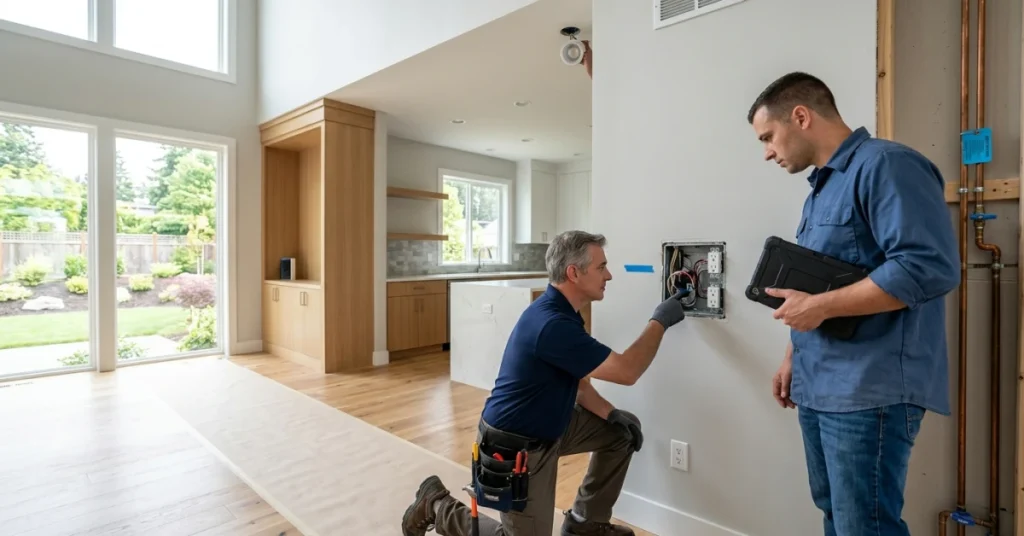
- Electrical Systems: Panel labeling, grounding continuity, and AFCI breaker installation must be verified before drywall closes walls.
- Plumbing Systems: Pressure tests at rough-in stage catch leaks that finished surfaces would otherwise hide for years.
- HVAC Systems: Duct sealing, equipment sizing, and refrigerant charge all require stage-based verification records to confirm compliance.
- Interior Finishes: Drywall fastening patterns, paint adhesion, and trim gaps signal rushed work that compounds into warranty claims.
Foundation and structure
Soil bearing capacity and footing depth must be confirmed before any concrete is placed. Errors at this stage are the most expensive to correct — often exceeding $30,000 in remediation.
Residential code mandates independent third-party verification for structural concrete and masonry. Without timestamped documentation, those verifications are legally unenforceable.
Roofing and exterior
Ice-and-water shield placement, valley flashing, and soffit ventilation ratios are routinely missed on single-event walkthroughs. Each overlooked item creates a latent defect that surfaces years after closing.
Coverage at the roofing stage must occur before shingles are laid — not after. A photo-documented record at that point is your only evidence if a dispute arises.
Electrical systems
DOB requirements mandate rough-in electrical sign-off before insulation is installed. Skipping this sequence doesn’t just risk a failed review — it risks a full re-open of finished walls.
Bypassing the rough-in stage means missing 60–70% of electrical defects entirely. Those defects don’t disappear — they become warranty claims or fire hazards.
Plumbing systems
Drain slope, vent stack height, and water supply pressure all require verification at rough-in — not at final walkthrough. Water damage from undetected failures averages $11,000 per residential claim (Census tracks related new construction cost data annually).
A pressure test log with timestamps is the difference between a defensible record and a contractor dispute. Without it, liability is ambiguous and resolution is expensive.
HVAC systems
Manual J load calculations must match installed equipment — an oversized system cycles too fast and fails prematurely. Skipping this check leaves homeowners with comfort complaints and voided warranties.
Duct leakage testing at rough-in catches installation errors before ceilings close. That single test can prevent 20–30% energy loss that persists for the life of the building.
Interior finishes
Final walkthroughs are where most buyers focus — and where the least consequential defects actually live. Propertyinspectionauthority data shows cosmetic defects account for the majority of buyer complaints, yet structural and mechanical issues drive the highest repair costs.
Paint, trim, and flooring flaws are visible and easy to negotiate. The dangerous problems were already buried — which is exactly why stage-based documentation matters more than any end-of-build review.

Pre-Handover vs Residential Construction Inspections
That documentation trail only holds up when you understand which assessment type created it — and why each serves a completely different legal and quality function.
Key Differences
Stage-based residential construction checks happen during the build — before walls close and defects become invisible. Pre-handover walkthroughs occur at completion, when correcting structural issues costs 3–5× more than mid-build fixes.
The confusion between these two evaluation types is where most accountability gaps originate. Treating a pre-handover walkthrough as a substitute for stage-based construction meetings leaves critical structural phases completely undocumented.
When Each Is Required
DOB requirements mandate phase reviews at defined milestones — foundation, framing, rough-in, and insulation — before work can legally proceed. Pre-handover assessments are buyer-driven, not code-driven, and carry no authority to halt construction.
Specialized testing that residential projects require — such as soil compaction and concrete strength verification — is also phase-specific, not an end-of-build event. Scheduling those evaluations at handover is not just ineffective; it’s non-compliant.
| Inspection Type | Timing | Authority / Trigger | Avg. Defect Correction Cost |
|---|---|---|---|
| Foundation Stage Inspection | Pre-pour | DOB / Code-mandated | $800–$2,500 |
| Framing Inspection | Pre-sheathing | DOB / Code-mandated | $1,200–$4,000 |
| Rough-In (MEP) Inspection | Pre-drywall | DOB / Code-mandated | $600–$3,200 |
| New Construction Home Inspection | Pre-closing | Buyer-initiated | $3,500–$18,000+ |
| Pre-Handover Walkthrough | Completion | Contractual / Voluntary | $5,000–$25,000+ |
New construction home evaluations catch cosmetic and system-level issues — but 62% of structural defects found at handover trace back to missed phase reviews, not poor finishing work (according to NAHB).
Phase-level reviews are the only mechanism that catches defects while correction is still cost-effective.
How to Document and Track Inspection Findings
Once you understand the difference between stage-based and pre-handover inspections, the next failure point is almost always the same: findings get recorded, then disappear. Over 60% of construction defect disputes trace back not to missed inspections but to undocumented or untracked findings that no one followed through on.
A finding without a corrective action deadline is just a note. Structured documentation transforms construction safety inspection records into enforceable accountability — the difference between a protected build and a six-figure dispute.
📊 By the Numbers
Residential construction inspections generate an average of 12–18 trackable defect items per stage inspection on new builds.
Photo Documentation
Every finding needs a timestamped photo tied to a specific location — not a general album. According to TRERC TAMU, Texas alone issued over 180,000 residential building permits in a single recent year, meaning the volume of uninspected or poorly documented work is massive.
Photos without GPS coordinates or stage tags are nearly useless in a dispute. Geo-tagged images tied to inspection stage create an irrefutable visual record that holds subcontractors accountable.
Defect Tracking
Each defect needs a unique ID, severity rating, responsible party, and due date — not a line in a shared spreadsheet. IBISWorld reports the building inspection industry generates over $4 billion annually, yet most residential projects still track defects manually.
Manual tracking creates version-control chaos when multiple trades are involved. A centralized defect log with status fields — open, in-progress, verified closed — eliminates ambiguity entirely.
Corrective Actions
A corrective action isn’t complete until a re-inspection confirms the fix — not when the contractor says it’s done. Assign every corrective action a named owner, a hard deadline, and a verification step before marking it resolved.
Without that verification loop, the same defect reappears at handover — at three to five times the original repair cost. The question isn’t whether to track corrective actions; it’s whether your current system can prove they were completed.
Paper logs and email threads can’t produce that proof at scale — which is exactly why the shift to digital residential construction inspections isn’t optional anymore.

Digital Residential Construction Inspections
Structured tracking only works when the data it captures is time-stamped, searchable, and tied to a specific trade or phase — paper logs and email threads fail that test every time. Digital platforms convert raw field observations into enforceable records that hold up in disputes, lender reviews, and DOB audit requirements.
According to ASCE Library, construction defect claims resolved with digital documentation close 43% faster than those relying on handwritten site notes. That speed gap reflects accountability infrastructure in action — not verification frequency.
FieldPie closes this gap by capturing photo-based findings, digital signatures, and real-time status updates in one platform — turning every new-build walkthrough into a traceable, time-stamped record. Teams managing construction site coordination use it to eliminate the handoff failures that convert findings into forgotten line items.
📊 By the Numbers
Digital records reduce construction defect dispute resolution time by 43% compared to paper-based documentation.
Mobile Checklists
Static PDFs don’t adapt to phase-specific conditions — structured mobile forms tied to each stage of a build do. Crews complete these on-site, with mandatory photo fields that prevent skipped line items.
Conditional logic flags special verification requirements automatically when structural or MEP work triggers a hold point. No team member has to remember — the system enforces it.
Inspection Reporting
A finding without a timestamped report is an opinion — not evidence. Digital reporting converts field observations into formatted, shareable records within minutes of a site close.
The Census Bureau tracks over 1.4 million new residential construction starts annually — each one generating field data that, without structured reporting, becomes litigation risk. Automated report generation eliminates that exposure at the source.
Punch List Management
Punch lists fail when items lack an assigned owner, a due date, and a verification step — three fields most spreadsheet-based systems skip entirely. Digital tools enforce all three before any item can close.
Quality oversight only protects a build when every finding reaches resolution — not just when it gets logged. The difference between a protected project and an expensive dispute often comes down to whether that final step was tracked.
Conclusion
That accountability infrastructure — time-stamped records, traceable findings, enforced sign-offs — is what separates a protected build from a six-figure dispute. Roughly 86% of home inspections uncover at least one defect (according to RubyHome), yet most of those findings never trigger a documented corrective action.
Residential construction inspections only deliver value when the system behind them enforces follow-through — not when the inspector walks the site. Strong construction governance practices turn inspection findings into binding, trackable commitments rather than forgotten notes.
Missed stage inspections and undocumented defects are the root cause of most post-close disputes. NAHB data consistently shows new construction starts exceeding 1 million units annually, meaning the scale of exposure is enormous. FieldPie lets inspection teams capture photo evidence, digital signatures, and time-stamped findings in real time — directly closing the gap between what’s observed on-site and what’s enforceable in a dispute.
Teams that standardize this process across new construction home inspections reduce rework costs and enter every DOB inspection requirement with a complete, audit-ready record.