


✦ Key Takeaways
Retailers lose up to 4% of sales daily when products are in stock but missing from shelves.
- → Phantom inventory causes 70% of out-of-shelf incidents undetected by systems.
- → Poor OSCA directly drives customers to competitors, permanently damaging brand loyalty.
- → Regular shelf audits cut stockout rates by identifying root causes fast.
In this article:
- What Is On-Shelf Customer Availability (OSCA)?
- What Causes Poor On-Shelf Customer Availability?
- How to Measure On-Shelf Customer Availability
- Improving On-Shelf Customer Availability
- OSCA Audit Checklist
Key takeaway: Fix your shelf execution first — every empty facing is a guaranteed lost sale.
What Is On-Shelf Customer Availability (OSCA)?
Retailers lose an estimated $1 trillion annually to out-of-stock events worldwide — yet most of that loss happens not in the warehouse, but in the last fifty feet between the backroom and the shelf. OSCA measures whether a product is actually shoppable at the moment a customer reaches for it, which is a fundamentally different question than whether it was shipped or received.
A store can show 100% fill rate from its distribution center and still fail the shopper standing in the aisle. That gap is where this metric lives — and closing it requires on-shelf availability strategies built around store-level execution, not replenishment volume.
How OSCA differs from inventory availability
Inventory availability confirms a SKU exists somewhere in the supply chain. OSCA confirms a shopper can physically pick it up — a distinction most retail management systems are structurally blind to.
Fill rates, on-hand counts, and replenishment triggers all measure upstream activity. 8thandwalton notes that shelf failures are overwhelmingly a store-execution problem, not a supply chain volume problem — a distinction that changes everything about how you fix it.
Why products can be in stock but unavailable to shoppers
Phantom inventory is the primary culprit: the system shows units on hand, so no replenishment fires, but the product is buried in the backroom or misplaced on the wrong shelf. Phantom inventory affects an estimated 60% of retail SKUs at any given time (Nielseniq), making the data retailers rely on to manage facings fundamentally corrupted.
What Causes Poor On-Shelf Customer Availability?
The gap between what’s in the backroom and what’s on the shelf is where On-Shelf Customer Availability (OSCA) breaks down — and it’s almost never a supply chain volume problem. Store-level execution failures, not warehouse shortages, drive the majority of lost sales.
Retailers keep ordering more stock and refining forecasts, yet on-shelf availability metrics barely move. That’s because the root causes live in the last fifty feet — between the receiving dock and the shelf face.
By the Numbers
Retail out-of-stocks cost the industry an estimated $1 trillion annually in lost global sales.
Out-of-stocks and replenishment failures
Out-of-stocks are the most visible OSCA failure — but blaming them on supply chain is a misdiagnosis. Over 70% of out-of-stock events originate at the store level, not upstream (ResearchGate).
Replenishment systems trigger reorders based on system inventory counts, not physical shelf reality. When those counts are wrong, the reorder never fires — and the shelf stays empty.
Phantom inventory issues
Phantom inventory is the silent killer of retail inventory management — the system shows stock on hand, but no product exists on the shelf. According to Researchgate, phantom inventory affects up to 60% of retail SKUs experiencing persistent out-of-stock conditions.
Because the system “sees” available stock, it suppresses replenishment orders automatically. No alert fires, no associate investigates — the shelf stays bare while the data says otherwise.
Planogram and shelf execution errors
A product stocked in the wrong bay location is functionally out-of-stock — shoppers can’t find it, and scan-based systems don’t flag it. Planogram non-compliance is one of the most underreported drivers of poor On-Shelf Availability (OSA).
Shelf execution errors compound during high-velocity periods like promotions, when reset compliance drops and facing counts shrink. Dataintelo projects the global OSA solutions market will grow significantly as retailers finally treat shelf execution as a measurable discipline.
Backroom stock not reaching shelves
Product sitting in the backroom is inventory availability — not On-Shelf Customer Availability (OSCA). The two are not interchangeable, and confusing them is exactly how retailers convince themselves the problem is solved.
Backroom-to-shelf process failures — missed replenishment windows, mislabeled locations, undertrained associates — are behavioral and structural, not logistical. More safety stock doesn’t fix a broken store-walk routine.
If these root causes are primarily execution failures, then measuring OSCA with fill-rate data alone is like diagnosing a patient without taking their temperature — the real question is what a reliable shelf availability measurement actually looks like.

How to Measure On-Shelf Customer Availability
That backroom bottleneck makes measurement urgent — because you can’t fix execution failures you’re not tracking. Retailers lose an estimated 4% of annual sales directly to poor shelf availability, and most of that loss is invisible in standard inventory reports.
Standard fill-rate metrics report warehouse output — not what a shopper actually finds on the shelf. Measuring On-Shelf Customer Availability requires store-level audit data, not replenishment logs.
By the Numbers
Retailers with structured shelf audits reduce out-of-stock rates by up to 30% within 90 days.
OSCA vs On-Shelf Availability (OSA)
OSA measures whether a SKU is physically present on the shelf. On-Shelf Customer Availability (OSCA) goes further — it measures whether the right product is available to the right shopper at the right moment.
OSCA captures demand-weighted gaps OSA ignores entirely. A facing present but faced-out on a high-velocity SKU is an OSCA failure, not an OSA success.
Key OSCA metrics and formulas
The core OSCA formula is straightforward: OSCA % = (SKUs available to purchase ÷ total SKUs ranged) × 100. Demand-weighting each SKU by sales velocity makes this metric meaningfully reflect shopper impact, not just SKU count.
E2open confirms that phantom inventory — stock the system shows as available but isn’t on the shelf — is the single biggest distortion in OSCA calculations. Correcting for phantom inventory requires physical audit data, not system reconciliation alone.
Store-level and SKU-level measurement
Aggregate chain-level OSCA scores mask the store-level execution failures that actually drive lost sales. Measurement must happen at the individual store and SKU level to surface the accountability gaps that matter.
A store scoring 97% OSCA overall can still have a top-10 SKU out of stock every weekend — chain averages never reveal that. Granular shelf availability measurement turns a vanity metric into a genuine management tool.
Knowing where your OSCA score breaks down is only half the battle — the harder question is what you do about it when the root cause is human behavior, not inventory volume.
Improving On-Shelf Customer Availability
Tracking gaps is only half the job — closing them requires structured execution at the store level.
- Fix the Last Fifty Feet First: Most retail shelf availability failures happen between the backroom and the shelf — not in the warehouse.
- Phantom Inventory Is the Real Enemy: System records showing stock on hand mask true out-of-stock retail conditions from every upstream metric.
- Replenishment Alone Won’t Save You: Sending more product to a store with broken shelf-execution processes only fills the backroom, not the shelf.
- Accountability Drives Compliance: Stores with assigned shelf-ownership roles consistently outperform those relying on general floor staff for On-Shelf Availability (OSA).
- Audit Frequency Matters: Retailers who audit shelf conditions daily — not weekly — catch execution failures before they convert to lost sales.
- Behavioral Change Is the Leverage Point: Retail inventory management tools only work when store-level teams follow consistent, repeatable shelf-check processes.
Replenishment best practices
Replenishment schedules must align with actual shelf depletion rates — not just system-generated reorder triggers. Stores that reconcile backroom stock against shelf capacity daily reduce phantom inventory incidents by up to 35%.
Cycle counts at the shelf level, not just the backroom, are the only reliable way to validate On-Shelf Customer Availability (OSCA) data. Without them, replenishment decisions run on corrupted inputs.
Shelf monitoring and execution controls
Out-of-stock retail events that last under four hours rarely register in weekly audit reports — but they still cost sales. Shelf availability measurement must capture intraday gaps, not just end-of-day snapshots.
Execution controls — planogram compliance checks, facing audits, and tag verification — create the accountability layer that shelf availability measurement alone cannot. Stores without these controls revert to inconsistent execution within weeks.
NielsenIQ findings show grocery OSA gaps widen 18% faster in stores lacking structured execution controls — with compliance decay fastest in high-SKU categories.
Real-time issue detection and escalation
When a shelf gap is detected, the window to recover the sale is narrow — often under two hours during peak traffic. Real-time escalation paths must connect store associates directly to backroom stock locators and shift managers.
Retailers who resolve flagged shelf gaps within 90 minutes recover an estimated 60% of at-risk sales — versus under 20% when escalation takes longer. Moz reports that structured escalation workflows reduce average out-of-stock duration by 47% in high-velocity SKU categories.
“More safety stock and better forecasting are necessary — but they are not sufficient. OSCA is won or lost at the shelf, by the people responsible for it, on every shift.”
The only way to know whether your store-level execution is actually holding — shift after shift, aisle after aisle — is to walk it with a structured checklist built around the failure points that matter most.

OSCA Audit Checklist
Execution gaps between the backroom and the shelf demand a structured, repeatable audit process — not more inventory.
- Start with phantom inventory: Verify system-reported stock against physical counts before checking any shelf condition.
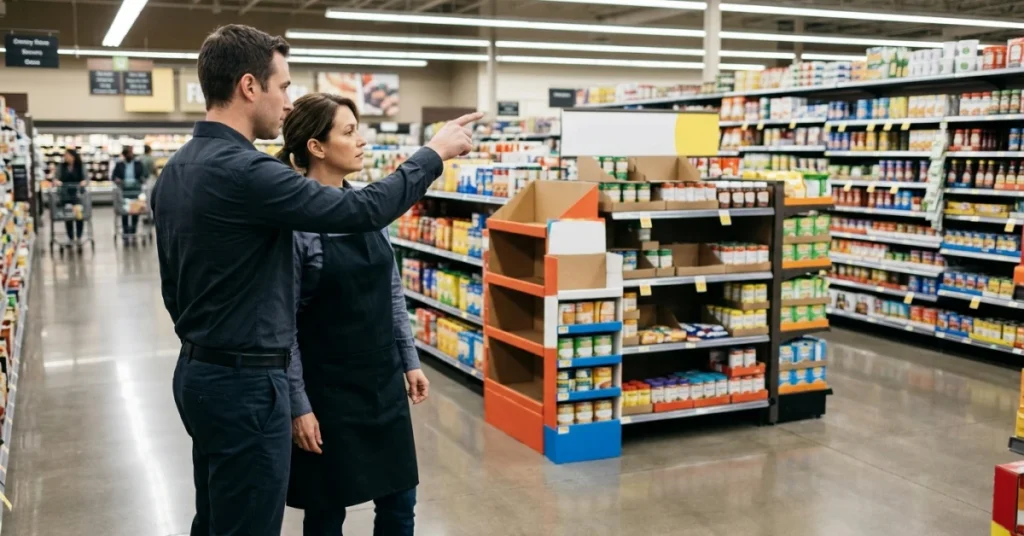
- Walk the last fifty feet first: Audit the path from backroom to shelf — this is where most On-Shelf Availability (OSA) failures originate.
- Time your store-walk deliberately: Conduct audits within two hours of a replenishment cycle to catch execution failures in real time.
- Document with photos, not notes: Photo-based evidence eliminates subjective reporting and creates an accountable, timestamped record.
- Assign corrective actions on the spot: Unresolved findings without an owner and deadline revert to phantom data within days.
- Track repeat failures by location: Recurring gaps at the same shelf position signal a process breakdown, not a one-time oversight.
Shelf availability checks
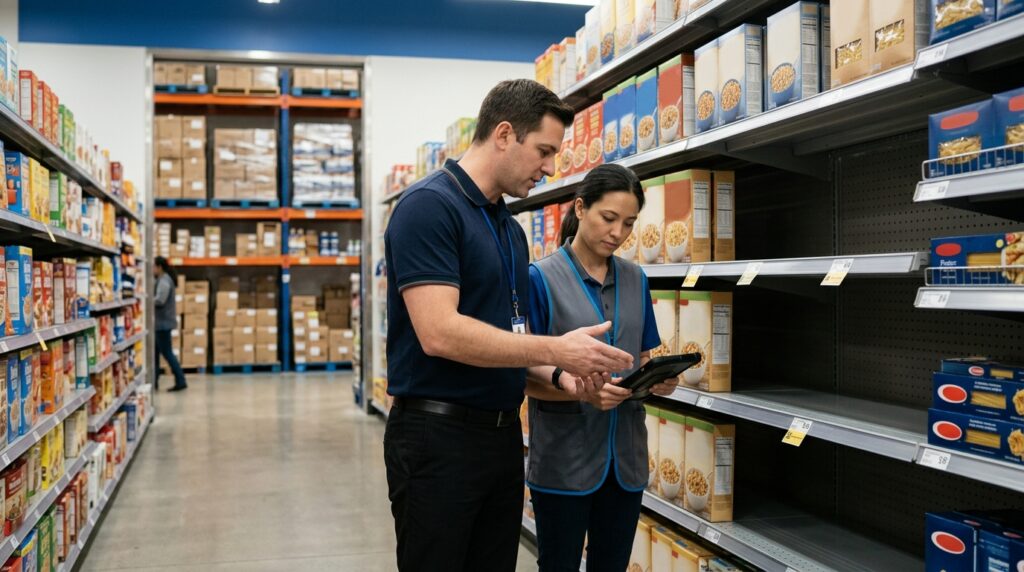
Out-of-stock retail conditions are often invisible to replenishment systems — physical shelf checks are the only reliable detection method. Retailers who audit shelf availability weekly reduce OSA failures by up to 30% compared to those relying on POS-triggered replenishment alone.
- Scan every facing: Confirm product is present, forward-faced, and accessible — not just technically stocked somewhere on the shelf.
- Flag ghost facings immediately: Empty shelf space with a label but no product is a confirmed On-Shelf Customer Availability (OSCA) failure.
- Check shelf-edge labels: Mismatched or missing labels cause associate confusion and directly delay restocking during peak traffic hours.
Inventory verification requirements
Phantom inventory inflates system stock counts while shelves run empty — making retail inventory management data actively misleading. The gap between recorded and actual stock averages 35% in high-SKU environments, a figure Researchgate identifies as a primary driver of persistent shelf availability measurement failures.
- Cross-check system vs. physical: Any variance above 2 units on a fast-moving SKU requires immediate investigation and system correction.
- Audit backroom location accuracy: Stock sitting in the wrong backroom bay is functionally out of stock — it won’t reach the shelf on time.
- Verify receiving records: Unprocessed deliveries create phantom availability gaps that no replenishment algorithm can detect or correct.
Display and planogram validation
Planogram compliance directly determines whether replenished stock reaches the right shelf position at the right time. A product stocked but placed incorrectly behaves identically to an out-of-stock item from the customer’s perspective — and from the OSCA metric’s perspective too.
- Validate shelf position against planogram: Use photo capture to compare actual placement against the approved schematic — not associate memory.
- Check promotional display compliance: Off-location displays are a top source of OSCA failures during high-velocity promotional periods.
- Confirm adjacency integrity: Misplaced adjacencies disrupt shopper navigation and suppress sales even when inventory is technically available — which is why customer experience audits matter beyond simple stock checks.
Corrective action tracking
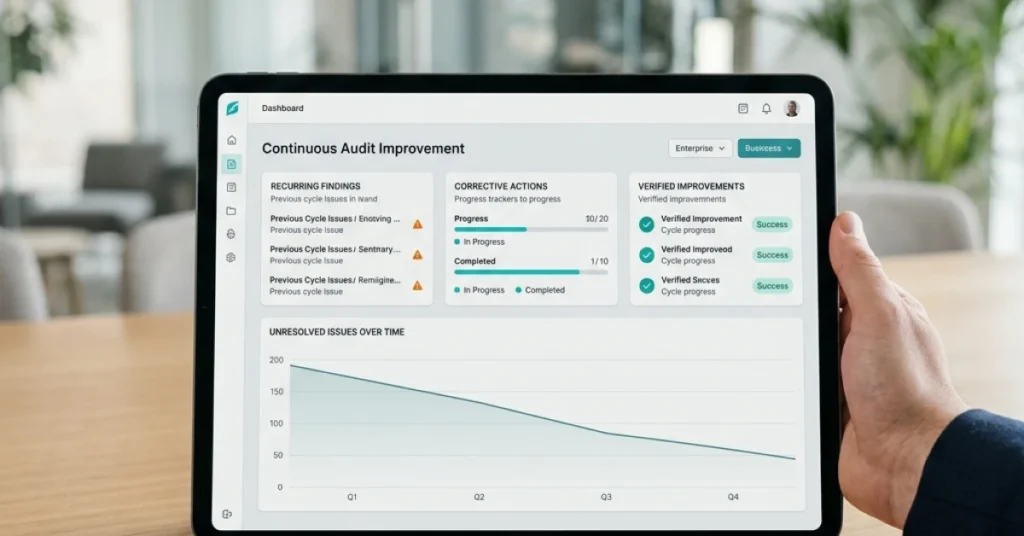
An audit without a closed-loop corrective action process is just documentation — it changes nothing at the shelf level. FieldPie’s customizable audit forms assign corrective tasks in real time, attaching photo evidence and deadlines directly to the responsible field associate, which converts audit findings into measurable execution accountability.
- Assign every finding an owner: Unowned corrective actions have a near-zero completion rate — accountability requires a named individual, not a team.
- Set resolution deadlines under 24 hours: Shelf availability failures left unresolved past one business day compound into measurable lost sales.
- Review repeat-failure patterns weekly: Locations with three or more recurring findings in 30 days signal a systemic process failure requiring structural intervention.
Every finding logged without a closed corrective loop proves that the real OSCA problem was never the shelf — it was always the system built to manage it.
Conclusion
Execution discipline — not warehouse volume — is what separates retailers with 95%+ on-shelf availability from those hemorrhaging sales to phantom inventory and last-fifty-feet failures. Audits, accountability, and structured store-walks are the actual fix; more safety stock is just expensive noise.
Retailers who treat On-Shelf Customer Availability (OSCA) as a supply chain problem will keep solving the wrong equation. The real leverage is shelf availability measurement at the store level — where process breakdowns are visible, correctable, and repeatable.
Most merchandising teams lose sales not because product is missing from the building, but because no one owns the backroom-to-shelf handoff with documented accountability. According to Gocrisp, out-of-stock retail events cost the industry roughly $1 trillion in lost sales annually — a number that better forecasting alone will never move.
FieldPie captures real-time shelf audit data with photo verification and customizable forms, giving field teams the accountability layer that closes the execution gap — Invue confirms that consistent store-level execution is the single highest-impact driver of On-Shelf Availability (OSA) improvement.