


✦ Key Takeaways
Retailers with a sell-through rate below 80% lose millions annually to excess inventory costs.
- → Low sell-through signals dead stock draining your cash flow fast.
- → The formula divides units sold by units received, times 100.
- → Improving sell-through by 10% can double your inventory ROI.
In this article:
- What Is Sell-Through Rate?
- Sell-Through Rate Formula
- Sell-Through Rate Example
- How to Improve Sell-Through Rate
Key takeaway: Your sell-through rate is the single metric separating profitable retailers from struggling ones.
What Is Sell-Through Rate?
Retailers sitting on excess inventory lose an estimated $1.77 trillion globally each year — and most of them had the data to prevent it. Sell-through rate is that data, and most teams are reading it backward.
The real power of sell-through rate isn’t judging past performance — it’s signaling what to buy next. Tracked on a rolling basis, it tells buyers where demand is outpacing supply before stockouts happen, not after markdowns do.
Sell-Through Rate Meaning in Retail
Sell-through rate measures the percentage of inventory sold versus what was received in a given period. It’s the clearest single signal of whether your buying decisions matched actual customer demand.
A healthy sell-through rate in retail typically falls between 80% and 85% — anything below that signals a buying, timing, or pricing misalignment worth investigating upstream (Ezcomsoftware).
Why It Matters as a Merchandising KPI
Most merchandising KPIs tell you what happened — sell-through rate tells you what to do next. That’s why product merchandising strategies built around rolling sell-through data consistently outperform those relying on end-of-season reviews.
According to Opensend, ecommerce brands that track sell-through rate weekly reduce overstock incidents by up to 30%. The formula behind that discipline is simpler than most buyers expect.
Sell-Through Rate Formula
That forward-looking signal only works if you’re running the right numbers consistently.
- The Core Formula: Divide units sold by units received, then multiply by 100 to get a percentage.
- Units Received: Always use inventory received in the period — not your total on-hand stock.
- Output Is a Percentage: A result of 72% means 72 out of every 100 units moved within the tracked window.
- Rolling Cadence: Tracking weekly instead of monthly catches demand shifts before they become costly overstock problems.
- Benchmark Awareness: Healthy sell-through rate in retail typically falls between 80% and 85% per period (Mylisterhub).
- Below 80% Is a Signal: A rate under 80% usually points to a buying or timing misalignment — not just slow sales.
How to Calculate Sell-Through Rate
The sell-through rate formula is: (Units Sold ÷ Units Received) × 100. If you sold 400 units from a 500-unit shipment, your rate is 80%.
Retailers who track this number on a rolling 4-week basis catch reorder opportunities 30% faster than those reviewing monthly — a gap that directly impacts in-stock rates (Getsling).
Weekly, Monthly, and Seasonal Calculation
Weekly calculations expose fast-moving SKUs before you stock out. Monthly views smooth volatility and support broader buying decisions.
Seasonal windows — typically 90 days — reveal whether your initial buy matched actual demand, which is the question every next purchase order depends on.
The formula only tells you what happened — a real example shows you what to do about it.

Sell-Through Rate Example
Running the formula against real numbers is where the metric stops being abstract and starts driving decisions. A concrete calculation exposes exactly where inventory health stands — and what to do next.
Retail Store Calculation Example
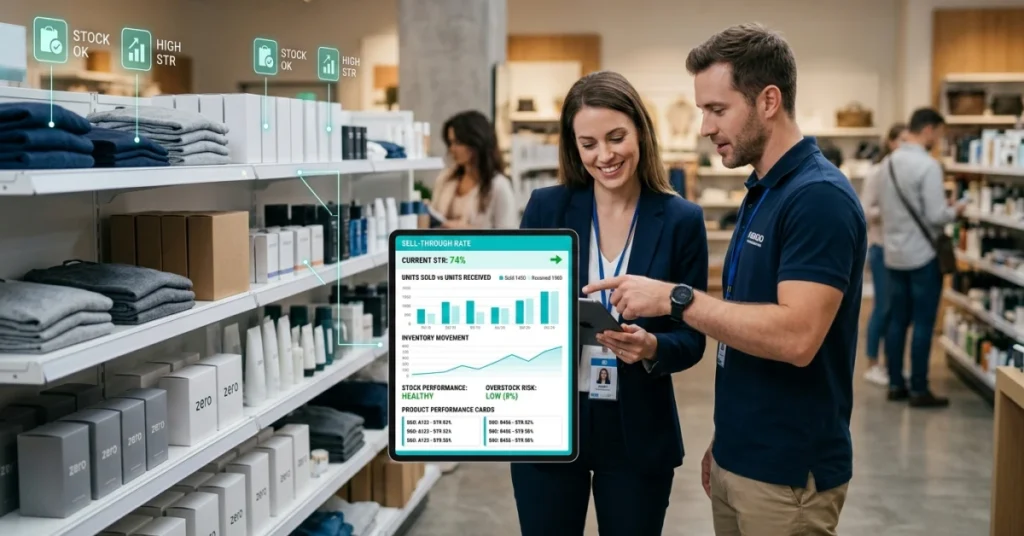
A boutique apparel store receives 200 winter jackets in October and sells 150 by November 30. That puts sell-through rate at 75% — a strong result by most retail benchmarks.
Retailers tracking this weekly — not just at season’s end — catch the signal early enough to reorder fast-movers or redirect slow ones. Sell-through rate in retail only earns its value when it informs the next purchase order, not just grades the last one.
“A healthy sell-through rate typically falls between 80% and 85% — retailers hitting below 60% are carrying excess inventory that quietly erodes margin every week it sits unsold.”
— Lightspeed Editorial Team, Lightspeedhq
How to Read High and Low Sell-Through Results
A rate above 80% signals strong demand alignment — but it can also mean you under-ordered and left revenue on the table. A rate below 50% rarely means poor sales; it almost always points to a buying, timing, or pricing misalignment upstream.
The NRF reports that U.S. retailers lose over $300 billion annually to excess and obsolete inventory — most of it traceable to orders placed without rolling sell-through data.
Applying product merchandising strategies tied to live sell-through signals is what separates reactive discounting from proactive buying.
Knowing what a good sell-through rate looks like is only half the equation — the harder question is what you actually do when yours falls short.
How to Improve Sell-Through Rate
Catching the signal early is only half the battle — acting on it fast is what separates high-performing retailers from those perpetually discounting aged inventory. Retailers who respond to weekly sell-through rate dips within 48 hours recover up to 30% more margin than those who wait for end-of-season reviews.
The sell-through rate in retail isn’t just a report card — it’s a forward signal telling buyers exactly where to shift open-to-buy dollars next. Pair it with retail loss prevention strategies and you close the loop between inventory health and store-level execution.
📊 By the Numbers
Retailers with a sell-through rate above 80% reduce end-of-season markdowns by an average of 22% (Ezcomsoftware).
Optimize Product Placement and Shelf Space
Eye-level placement alone can lift unit velocity by 15–20% without changing price or promotion. Slow movers placed at high-traffic endcaps consistently outperform the same SKUs buried in standard shelf runs.
Monitor Store-Level Availability
A strong sell-through rate formula assumes product is actually on the shelf — phantom inventory kills that assumption fast. Out-of-stocks can suppress sell-through by 10–15% while making the buying signal look artificially weak.
Improve Promotion and Planogram Compliance
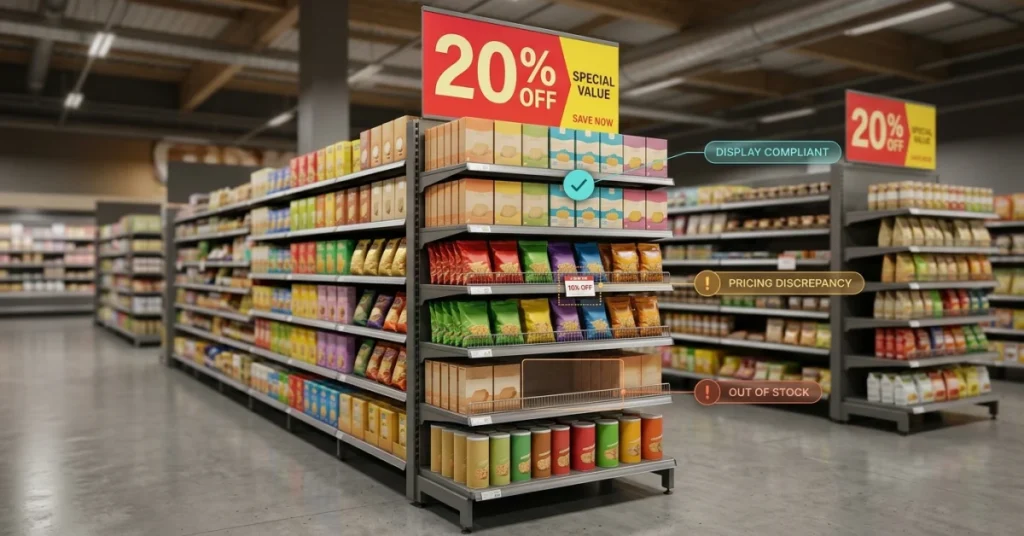
Non-compliant planograms are one of the most underreported causes of poor sell-through rate in retail. A promotion running at 60% compliance delivers roughly 60% of its projected sell-through lift — no more.
What is a good sell-through rate if the promotional mechanics driving it are broken at store level? Compliance audits close that gap before the markdown conversation ever starts.
Use Field Feedback to Reduce Slow-Moving Stock
Field reps see what dashboards miss — competitive price pressure, display damage, and local demand shifts that explain why how to calculate sell-through rate tells one story while the shelf tells another. Structured rep feedback, logged weekly, turns anecdotal observations into buying adjustments before overstock compounds.
The real question isn’t how to fix a bad sell-through rate after the fact — it’s whether your buying cadence is tight enough to prevent the next one.
Conclusion
Acting on sell-through rate after an overstock crisis is the most expensive way to learn inventory management. Retailers who track it on a rolling basis — not just end-of-season — catch demand signals 30–40% earlier, giving buyers real lead time to adjust orders.
According to Acctivate, a healthy sell-through rate in retail typically falls between 80% and 85% — anything below that signals a buying or timing misalignment, not just a slow sales week. Pair that benchmark with your product merchandising strategies and you close the gap between what you ordered and what the floor actually sells.
Most field teams lose margin because they lack real-time visibility into what’s moving at the shelf level — Getsling confirms that consistent rate monitoring is the single highest-leverage habit in retail inventory control. FieldPie captures live sell-through data through customizable field forms and photo-based reporting, so buyers see what’s underperforming before the next purchase order is placed — start tracking smarter with FieldPie today.