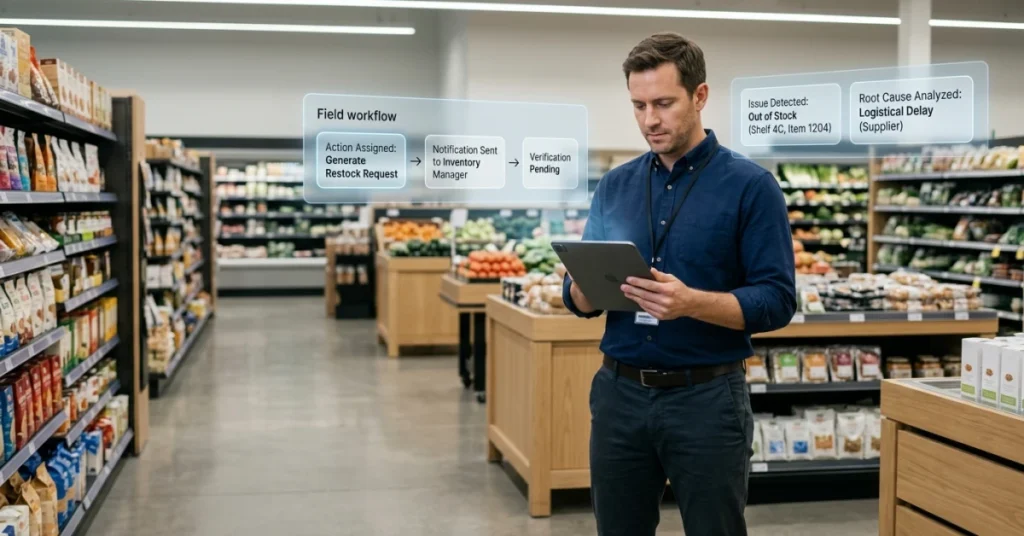




✦ Key Takeaways
Retailers lose up to 25% in potential sales when poor merchandising SLAs leave shelves unstocked or displays wrong.
→ No SLA means no accountability — execution gaps multiply fast.
→ Clear metrics expose which store locations consistently underperform.
→ Realistic targets turn vague vendor promises into enforceable standards.
In this article:
What Is a Retail Merchandising SLA?
How Do You Build a Retail Merchandising SLA?
Which SLA Metrics Should You Track?
How Do You Set Realistic SLA Targets?
Key takeaway: A strong retail merchandising SLA is the difference between a strategy that executes and one that just sounds good.
What Is a Retail Merchandising SLA?
Most retailers have a merchandising contract on file — and still watch execution fall apart every quarter.
A retail merchandising SLA is a service level agreement. It defines exactly what a merchandising team or vendor must deliver: which tasks, at what quality, and by when.
The real problem isn’t missing paperwork. Over 70% of retail out-of-stocks trace back to store-level execution failures, not supply chain breaks (Statista).
Most SLAs are written to satisfy legal review. They don’t guide a rep standing in aisle seven.
That gap is why retail merchandising execution keeps breaking down even when contracts exist. A well-built merchandising service agreement closes that gap by speaking the language of the store floor, not the boardroom.
SLA vs KPI
A KPI tells you what happened. An SLA tells everyone — in advance — what must happen and who owns it.
Think of retail SLA performance metrics as the rulebook and KPIs as the scoreboard. You need both, but you can’t fix execution with a scoreboard alone.
What Should an SLA Cover?
A strong retail vendor SLA covers four things: task scope, completion timelines, compliance standards, and escalation steps when targets are missed. Nrf research shows retailers with documented compliance standards reduce execution errors by up to 25%.
Most agreements stop at task scope and skip escalation entirely. That’s exactly why the same problems repeat every cycle.
Can your SLA pass a legal audit? Good. Now ask if a field rep can use it to make a single decision. If the answer is no, you know what needs to change.
How Do You Build a Retail Merchandising SLA?
Closing that gap between paper and shelf starts with one decision: write the retail merchandising SLA for the rep holding a planogram, not the analyst reading a dashboard.
Most teams borrow SLA structures from IT or logistics contracts — frameworks built for systems, not people standing in a cereal aisle at 7 a.m.
That mismatch is why execution still breaks down even when a signed merchandising service agreement exists.
Define Scope and Visit Requirements
Start with what a field rep must do, where, and how often — not what corporate wants to report. Tie visit frequency to store tier, not a blanket average across your entire network.
Strong retail merchandising basics show that high-volume stores need at least twice the visit cadence of mid-tier locations — yet most SLAs treat every door the same.
Set Execution Standards
Each visit must have a defined task list with clear pass/fail criteria. Drop vague language like “ensure proper shelf presence.”
Reps need to know exactly what “compliant” looks like before they walk in the door. Give them a checklist, not a concept.
Visual merchandising drives real revenue. Displays placed at eye level lift sales by up to 35%, according to Contravision.
That stat matters for your SLA. Your retail SLA performance metrics must tie placement rules to measurable outcomes — not just completion rates.
Define Reporting Requirements
Reporting inside a retail vendor SLA should answer one question: did the work happen correctly? Require photo proof, geo-tagged check-ins, and same-day submission — not weekly batch uploads that hide problems for days.
Retailers lose an average of 8% of annual revenue to poor in-store execution, per Taylor. That number drops fast when reporting requirements force real-time accountability.
After-the-fact audits let problems linger. Real-time data stops them early.
📊 By the Numbers
Eye-level product displays increase retail sales by up to 35%, making placement rules a core SLA standard.
Once your SLA defines scope, standards, and reporting, the next question is which numbers actually tell you if it’s working — and most teams are tracking the wrong ones.
Which SLA Metrics Should You Track?
Design your SLA around metrics field reps can act on. Skip numbers that only look good on a quarterly slide deck.
Most retail merchandising SLA frameworks track four core areas. Get these right, and your retail merchandising strategy shifts from reactive to predictive.
On-Time Visit Completion
This metric tracks whether field reps finish store visits within the scheduled window. A missed visit isn’t just a scheduling problem. It’s a compliance gap that compounds across the week.
Stores that miss even one planned visit per month see measurable shelf compliance drops by the next audit cycle.
Store Coverage
Coverage measures what percentage of assigned stores actually receive service in a given period. Any retail vendor SLA that sets coverage targets below 95% accepts failure as a baseline.
Low-tier stores often get skipped first. Those gaps quietly erode total program performance.
Planogram and Display Compliance
Most retail SLA frameworks measure compliance at the photo level. That’s the wrong level — the shelf is what matters. According to Polestaranalytics, poor planogram compliance costs retailers up to 8% of annual category revenue in avoidable lost sales.
A strong merchandising service agreement defines compliance by SKU position accuracy. Submitting a photo is not enough.
Issue Resolution Time
When a rep flags a shelf problem, how fast does it get fixed? Improvado notes that unresolved in-store issues left open beyond 48 hours directly cut conversion rates at the point of sale.
A useful service level agreement sets hard resolution windows. Vague “timely response” language means nothing on the floor.
📊 By the Numbers
Poor planogram compliance costs retailers up to 8% of annual category revenue in lost sales.
Knowing which metrics to track is a start. The harder question is which target numbers fit your store mix.
How Do You Set Realistic SLA Targets?
On-time visit completion is a strong start. But the number means nothing if your targets were built on last quarter’s averages instead of store-tier reality.
Most teams set a single retail merchandising SLA threshold across every location. That’s where execution gaps quietly compound.
Over 60% of SLA breaches in retail trace back to targets that ignored store complexity. Rep performance isn’t the problem, according to (Statista). Realistic targets start with honest segmentation, not corporate averages.
Segment by Store Priority
A flagship store and a rural outpost should never share the same retail execution standard. Tier your locations by revenue, foot traffic, and strategic value. Then assign separate SLA windows to each tier.
High-volume stores may need a 24-hour compliance window. Lower-priority locations can reasonably run on 72 hours without hurting your retail SLA performance metrics.
Define Thresholds and Exceptions
Every merchandising service agreement needs a clear floor. That’s the minimum acceptable completion rate before escalation kicks in. Moz reports that processes without clear pass/fail criteria see a 35% higher rate of repeated errors.
Build exceptions for weather, store resets, and seasonal surges directly into your retail vendor SLA language. Field reps need to know what counts as a valid exception. They shouldn’t have to decide that while standing in a store.
📊 By the Numbers
Retailers using tiered SLA targets report up to 40% fewer escalations than those using a single compliance threshold.
A service level agreement retail teams can actually use isn’t written for the dashboard. It’s written for the rep deciding what to do next.
Bad targets don’t survive the store floor. No amount of data analysis will fix what a broken agreement created in the first place.
Conclusion
Store segmentation isn’t a nice-to-have. It’s the foundation every retail merchandising SLA must be built on before targets mean anything. Teams that skip this step keep signing agreements that look solid on paper. Those same agreements fail on the floor every single week.
Retailers lose roughly $1.75 trillion annually to poor in-store execution. Most of that loss traces back to SLAs written for dashboards instead of the people stocking shelves (Contravision).
A strong merchandising service agreement names specific response windows by store tier. It assigns clear ownership. It gives field reps the authority to act without waiting for corporate sign-off.
Most teams can’t enforce what they can’t see in real time. That’s why merchandising ROI tracking matters as much as the SLA itself.
FieldPie captures photo-based proof, customizable audit forms, and live store-level data. Your retail SLA performance metrics then reflect what actually happened — not what got reported two days later.
Teams that use this approach cut compliance gaps fast. They turn their retail vendor SLA from a legal formality into a real execution tool.
Bucknell University research backs this up. Field teams with real-time feedback loops resolve SLA breaches up to 40% faster than those relying on end-of-week reports.