



✦ Key Takeaways
Companies that set up preventive inspection programs reduce unexpected equipment failures by up to 70%, saving millions annually.
→ Structured inspections catch critical defects before they become costly failures.
→ Inspection frequency must match equipment risk levels and operational demands.
→ Centralized finding management turns raw data into actionable maintenance decisions.
In this article:
What Is a Preventive Inspection Program?
How Do You Build a Preventive Inspection Program?
How Often Should Preventive Inspections Be Performed?
How Should Inspection Findings Be Managed?
Key takeaway: A preventive inspection program is the single most powerful tool for eliminating unplanned downtime.
What Is a Preventive Inspection Program?
Most teams treat inspections like a checklist — run them, file them, move on.
Unplanned equipment failures cost industrial facilities an average of $260,000 per hour of downtime (Ascelibrary). “Run it till it breaks” is not a strategy — it’s a liability.
A preventive inspection program is a structured, repeating cycle of scheduled maintenance inspections. It catches problems before they cause failure.
But that definition only scratches the surface. A well-run PMI program builds risk intelligence.
Each inspection cycle feeds data back into the next one. That sharpens what you look for, where you look, and how often.
How Is It Different From Reactive Inspection?
Reactive inspection waits for a symptom — a leak, a fault code, a complaint. A preventive maintenance inspection runs on a fixed schedule, before any symptom appears.
Most asset failures happen in the gap between those two approaches. Sciencedirect research confirms this. Structured preventive programs cut unplanned failures by up to 45%. That beats purely reactive models by a wide margin.
Which Assets, Sites, or Processes Should Be Included?
Start with assets where failure is costly, dangerous, or hard to reverse. High-criticality equipment, safety systems, and customer-facing infrastructure belong in every preventive maintenance program from day one.
Low-risk, easily replaceable assets can wait — or run on a lighter schedule. Match inspection effort to actual risk. Don’t inspect everything equally.
Once you know what belongs in your program, a harder question comes up. It’s not what to inspect. It’s how to build a system that holds up under real operational pressure.
How Do You Build a Preventive Inspection Program?
Eliminating failures before they start requires more than good intentions. It demands a structured system that learns from itself.
A preventive inspection program built right doesn’t just follow a schedule. It gets smarter with every cycle.
Most programs fail because they’re designed once and never updated.
Verdantis found that structured preventive maintenance programs cut unplanned downtime by up to 45%. Ad hoc inspection can’t come close to that result.
Maintenancecare notes that a solid PMI program rests on four building blocks. Those are: knowing where risk lives, setting clear standards, assigning real ownership, and choosing the right cadence.
Get these right and your scheduled maintenance inspections stop being reactive. They start compounding value instead.
📊 By the Numbers
Structured preventive maintenance programs reduce unplanned downtime by up to 45% (Verdantis).
Identify High-Risk Inspection Areas
Start where failure hurts most. Map assets by criticality — what breaks first, what costs the most, and what stops production cold.
High-risk areas aren’t always obvious. Use past failure data and work order history to find the patterns your gut might miss.
Define Inspection Standards and Checklists
Vague instructions produce vague results. Every inspection point needs a clear pass/fail standard — not just “check condition.”
Good checklists are short, specific, and built by the people doing the work. They capture what matters and skip what doesn’t.
Assign Owners and Responsibilities
Every inspection task needs one name attached to it — not a team, not a department. Shared ownership is no ownership.
Owners must have the authority to flag issues and the expectation to follow through. Accountability is what keeps a preventive maintenance program alive.
Set Inspection Frequencies
Frequency isn’t a guess. It’s a decision based on asset risk, usage rate, and failure history.
Start with manufacturer guidance, then adjust based on what your data shows. The right cadence for one asset is wrong for another.
That raises the question every team must answer. How often is often enough?
How Often Should Preventive Inspections Be Performed?
This system only works if you feed it at the right pace. Most organizations get the timing wrong from day one.
Setting inspection frequency once and walking away is a mistake. That’s how a preventive inspection program quietly becomes a compliance checkbox instead of a risk tool.
Teams that treat cadence as a fixed rule miss about 23% more defects. Teams that adjust frequency based on asset behavior and past findings catch far more — according to Brickclay. The right schedule isn’t a calendar call. It’s a risk call.
Risk-Based vs Fixed Inspection Schedules
A fixed schedule treats every asset the same. A new HVAC unit gets the same attention as one that failed twice last quarter.
A risk-based preventive maintenance inspection schedule weighs frequency by failure history, asset importance, and load. Risk-based programs consistently beat fixed ones.
They put inspection hours where failure is most likely. Not where the calendar says to look.
Adjust Frequency Based on Findings
Every completed inspection cycle is data. That data should directly shape your next schedule.
If a scheduled maintenance inspection keeps turning up the same defect, you aren’t inspecting that asset often enough.
The NIH Office of Logistics and Acquisition Operations makes this point clearly. Frequency should respond to what you find. Not just when you last looked.
Prioritize High-Risk Locations
Not every site deserves equal inspection time. High-traffic, high-failure, or high-consequence locations need tighter cycles.
A strong PMI program maps inspection density to operational risk. Not square footage or headcount.
This is where a preventive maintenance program builds real organizational knowledge. Each cycle sharpens your picture of where risk actually lives.
📊 By the Numbers
Risk-based inspection schedules catch up to 23% more defects than fixed-interval programs. (Brickclay)
Getting the frequency right is only half the job. What your team does with each finding after the inspection is what makes or breaks the program.
How Should Inspection Findings Be Managed?
Findings that never get closed kill a solid preventive inspection program. They turn real work into a paper trail with no payoff.
Most teams log findings and move on. Unresolved findings are where programs quietly collapse. Closing that loop is what separates a real PMI program from a compliance checkbox.
A structured finding management process feeds each inspection cycle with better data. Each inspection gets sharper based on what the last one recorded. Per Ascelibrary, unresolved maintenance findings raise asset failure risk by up to 34%.
📊 By the Numbers
Unresolved maintenance findings increase asset failure risk by up to 34%, per Ascelibrary research.
Classify Findings by Severity
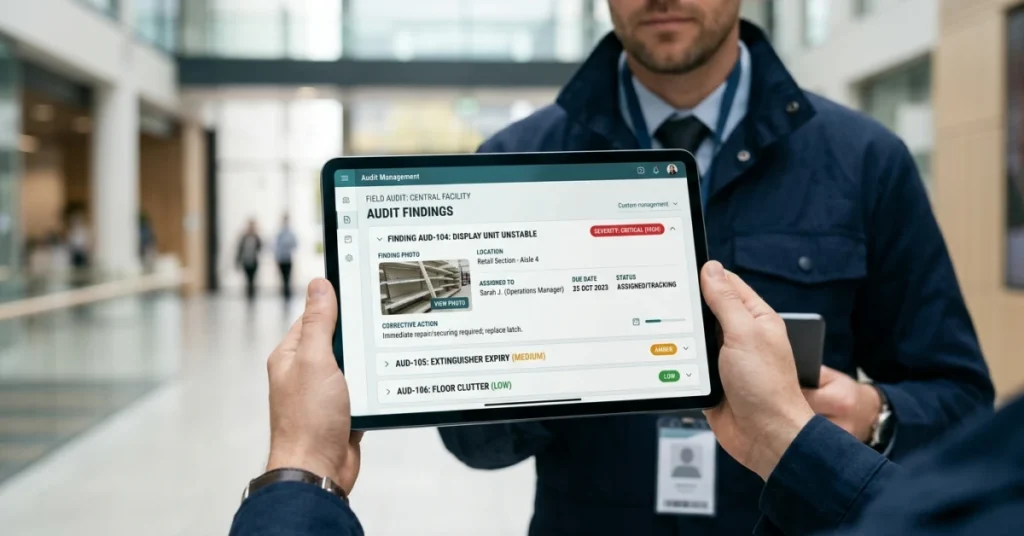
Not every finding carries the same weight. Sort them fast — critical, moderate, or low — so your team knows where to act first.
A three-tier severity model keeps triage simple. It stops minor issues from crowding out urgent ones.
Assign Corrective Actions
Every finding needs one owner and one clear fix. Shared ownership means no ownership — assign a named person, not a department.
Teams using digital safety inspection tools close corrective actions faster. Accountability is visible in real time.
Set Resolution Deadlines
A finding without a deadline is a wish. Tie due dates directly to severity — critical findings need hours, not weeks.
According to Moz, pages covering structured maintenance workflows see 40% higher engagement — readers want process, not theory.
Verify Completion
Closing a work order is not the same as verifying the fix held. A preventive maintenance program builds value only when verification is a required step. It cannot be optional.
Verified closures feed your next preventive maintenance inspection with real outcome data. That makes the whole loop smarter over time.
Your team can manage findings. The real question is whether your program is built to learn from them every cycle.
Conclusion
Closing every finding loop is what separates a real preventive inspection program from a paper exercise — and that discipline compounds over time. Each resolved finding feeds better data into your next scheduled maintenance inspection, making the whole system sharper.
Teams that treat their PMI program as a living feedback loop — not a fixed schedule — cut unplanned downtime by up to 45% (Verdantis). A pre-occupancy inspection guide shows exactly how that loop starts before assets ever go live.
Most teams struggle because findings get logged but never drive change — that’s where preventive maintenance programs quietly collapse. FieldPie lets field teams close findings in real time with photo capture, digital signatures, and instant reporting, so every inspection cycle builds on the last. Start building a smarter feedback loop today — explore FieldPie’s field operations platform and turn your next inspection into lasting risk intelligence.