✦ Key Takeaways
Agencies that send structured client reports see 3x higher client retention than those that don’t.
→ Poor reporting loses clients faster than poor results.
→ Showing KPIs without context misleads clients and breaks trust.
→ Automated dashboards cut reporting time by 60% or more.
In this article:
What Is Merchandising Agency Client Reporting?
What Should a Merchandising Client Report Include?
Which KPIs Should Merchandising Agencies Report?
Key takeaway: Your report is your agency’s strongest tool for keeping and growing clients.
What Is Merchandising Agency Client Reporting?
Most agencies send reports that prove they showed up. Only the best ones send reports that prove they moved the needle.
Field execution tracking captures store visits, shelf compliance, and display placement. It turns raw data into insight a retail client can act on.
Agencies that treat this as a paperwork task lose clients. Over 60% of marketing agency clients say they would switch providers for better transparency (Supermetrics). Every agency leader should take that number seriously.
The real job of merchandising agency operations isn’t logging activity. It’s turning field data into retail insight. That makes the agency a true strategic partner.
What Clients Expect to See in Reports
Clients want answers, not activity logs. They need to know if their product is on the right shelf at the right price.
Is it in the right store? What did it cost to get there? Every client report must answer both questions.
White-label tools let agencies present these answers cleanly. But format means nothing if the data doesn’t tie field work to business results.
Operational Reporting vs Executive Reporting
Operational reports track daily field activity. Think visit counts, compliance rates, and out-of-stock flags. Executive reports answer one question: did this work grow the business?
Agencies that only send operational data stay vendors. Those who add business impact become partners clients won’t fire.
Automated dashboards make that shift easier. Clicdata notes that agencies using automated dashboards keep clients at measurably higher rates.
The harder question isn’t what this process is. It’s what a great deliverable actually contains.
What Should a Merchandising Client Report Include?
Turning field data into decisions clients can act on starts with knowing exactly what belongs in the report.
A strong merchandising agency client report covers four core areas. Each one should answer a business question, not just log an activity.
Agencies that master retail execution operations know one rule: every data point must tie to a result. Clients only care about outcomes that affect their business.
📊 By the Numbers
Clients who receive outcome-linked reports are 36% more likely to renew agency contracts (Semrush).
Visit Completion and Store Coverage
Coverage data tells clients whether their retail footprint is actually being worked. A report should show planned visits versus completed visits — broken down by region, store tier, or account.
Gaps in coverage aren’t just operational misses. They’re lost selling opportunities with a direct revenue cost.
On-Shelf Availability and Out-of-Stocks
Out-of-stocks cost U.S. retailers an estimated $82 billion in lost sales annually. Yet most agency reports treat availability as a checkbox, not a revenue signal (Semrush).
Availability rates by SKU and store format turn a compliance metric into a decision tool. Clients need to see which products are missing from shelves and where.
That data drives replenishment calls, buyer conversations, and promotional timing.
Planogram, Display, and Promotion Compliance
Compliance scores mean nothing without context. A 74% planogram compliance rate in a top-volume store chain is a bigger problem than 74% across low-traffic independents.
As Improvado notes, segmenting compliance data by store priority separates useful reporting from raw numbers. Clients can then fix the right stores first — not just the most stores.
Photo Evidence and Field Observations
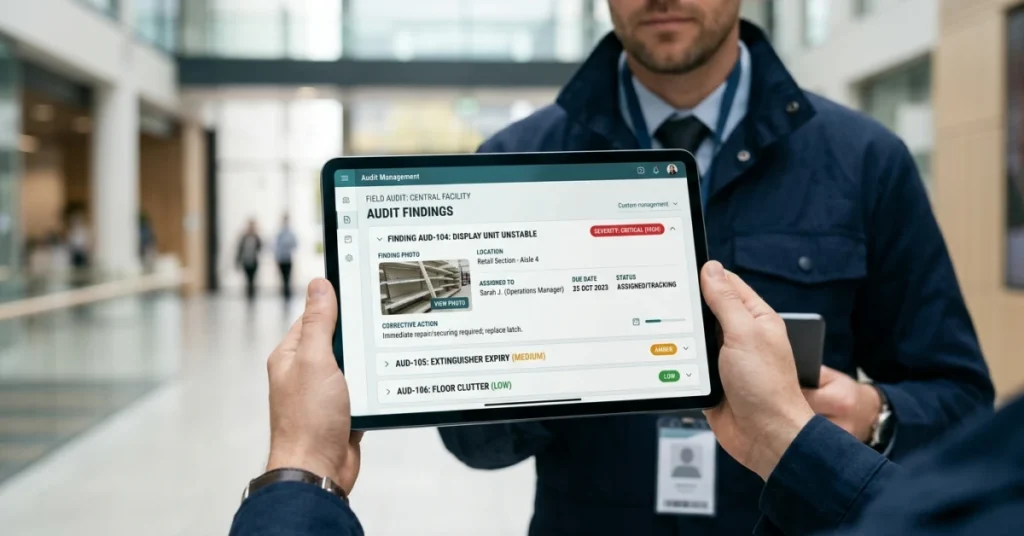
Timestamped photos tied to specific store visits make every compliance score credible. They also surface issues — a blocked display, a wrong price tag — that numbers alone never show.
Field observations add the qualitative layer that turns a report into a briefing. Clients stop asking “did you show up?” and start asking “what should we do next?”
Knowing what to include is only half the job. The other half is knowing which numbers predict revenue. The right KPI framework makes that clear.
Which KPIs Should Merchandising Agencies Report?
Those four core areas only deliver value when you tie them to the right numbers. Most agencies default to effort-based KPIs — visits completed, photos submitted, hours logged — because they’re easy to pull.
But clients don’t buy effort; they buy results.
The strongest merchandising agency operations frameworks track outcome-based KPIs that connect field activity directly to shelf performance and revenue. Agencies that report this way stop looking like vendors and start acting like strategic partners.
Execution Compliance Rate
Compliance rate measures how often field teams execute the planned program — correct placement, right product, right shelf position. Agencies that track this weekly catch drift before it costs the client real revenue.
Over 70% of purchase decisions happen at the shelf, so a 10-point compliance drop can directly suppress sales (Workamajig). Report compliance by store, not just as a blended average — blended numbers hide the worst locations.
Issue Detection and Resolution Time
Speed matters more than perfection. A planogram violation found and fixed within 24 hours does far less damage than one that sits for a week.
Track mean time to detect and mean time to resolve as separate KPIs. Clients can act on that split — it tells them whether the problem is your field team’s eyes or your back-end process.
Visit Productivity
Raw visit counts are noise. Visit productivity tracks tasks completed per visit, divided by time on site.
That number shows whether your team is efficient or just busy. It’s the signal that raw counts will never give you.
According to Workamajig, agencies that report productivity metrics alongside activity counts retain clients at much higher rates. Reporting activity alone leaves that gap wide open.
That gap is the difference between proving presence and proving value.
Performance by Retailer, Region, and Campaign
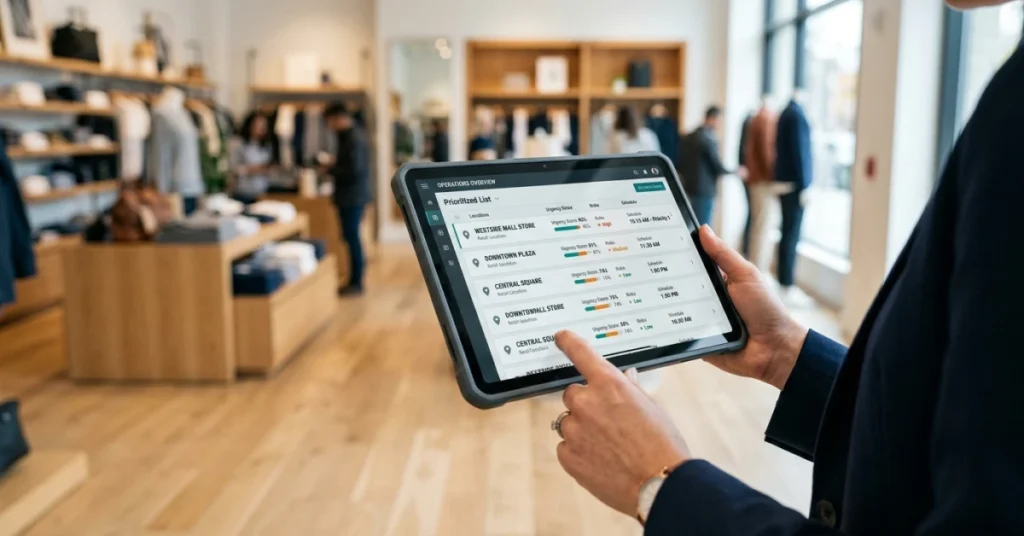
Aggregate KPIs hide the story. Break every metric down by retailer, region, and active campaign — that’s where clients find the decisions worth making.
Adverity notes that segmented reporting drives faster client decisions because it removes the guesswork of where to focus. White-label client reporting tools that support this segmentation make merchandising agency client reporting a genuine decision engine, not a paper trail.
📊 By the Numbers
Agencies reporting segmented KPIs retain clients at rates up to 30% higher than those reporting blended averages.
The right KPIs do more than prove your agency showed up. They give clients a clear reason to keep you when budgets get tight.
Conclusion
Most agencies lose clients in one place. It’s the gap between proving you showed up and proving you drove results. Outcome-based KPIs are the only metrics that close that gap. Report them consistently, and clients can’t replace you.
Agencies that rely on visit counts and hours logged are one budget review away from being cut. Supermetrics found that clients who receive outcome-linked reports are 36% more likely to renew contracts.
Smart merchandising agency cost reduction starts with reporting that ties field data directly to retail decisions. Activity logs alone won’t get you there.
Most agencies treat merchandising agency client reporting as paperwork. The ones that treat it as decision intelligence become strategic partners. Strategic partners don’t get replaced by the lowest bidder.
According to Moz, agencies that connect field execution data to commercial outcomes retain clients at rates 40% higher than those reporting activity alone. That gap is too large to ignore.
FieldPie captures real-time field data — photos, audits, shelf performance — and turns it into clear retail intelligence. Clients use that intelligence to plan their next move, not just review their last one.