



✦ Key Takeaways
Companies with 80%+ regulatory compliance rates are 3x less likely to face costly enforcement actions.
- → Non-compliance costs businesses $14.82M annually on average.
- → Compliance rate benchmarks vary sharply across healthcare, finance, and manufacturing.
- → Tracking this metric monthly cuts violation risk by half.
In this article:
- What Is Regulatory Compliance Rate?
- How to Calculate Regulatory Compliance Rate
- What Regulatory Compliance Rate Measures
- Regulatory Compliance Rate by Industry
Key takeaway: Your regulatory compliance rate is the single metric that separates sustainable businesses from liabilities.
What Is Regulatory Compliance Rate?
Most organizations report a single compliance percentage and call it a win — but that number can mask the violations most likely to trigger enforcement action. An aggregate regulatory compliance rate without severity weighting is not a safety signal; it’s a statistical illusion.
U.S. businesses spend over $1.9 trillion annually on regulatory compliance (Cato), yet many still lack the segmented metrics needed to catch high-severity failures hiding beneath an impressive overall score. That cost buys data — but not always the right interpretation of it.
Regulatory compliance rate definition
Regulatory compliance rate measures the percentage of applicable rules, standards, or requirements an organization meets within a defined period. It functions as a compliance KPI — but only delivers real value when segmented by regulation severity and operational context.
A single aggregate figure tells you how often you comply. It does not tell you which failures will cost you the most.
Why it matters for audits, safety, and operations
Regulators don’t fine organizations for average performance — they act on specific, high-severity violations that surface during audits. Understanding compliance audit challenges is the difference between a metric that protects you and one that gives false confidence.
According to Hyperproof, 52% of organizations say compliance failures directly impacted business operations in a measurable way. That impact rarely traces back to a low overall rate — it traces back to one unweighted, unmonitored gap.
Compliance rate vs audit score
Compliance rate and audit score are related but distinct regulatory compliance metrics. An audit score reflects performance at a point in time; compliance rate tracks ongoing adherence across a defined period.
Conflating the two is where most compliance programs lose precision — and where the real calculation method becomes critical.
How to Calculate Regulatory Compliance Rate
Severity-weighted measurement changes everything — but only if the formula you start with captures the right inputs. A raw compliance rate calculation that treats a missed fire safety inspection the same as a late paperwork filing is already broken before you run the math.
The standard formula gives you a starting point, not a final answer. Use it as a diagnostic baseline, then segment it by violation severity and business unit to surface what the aggregate hides.
Basic formula
Divide the number of compliant requirements by total applicable requirements, then multiply by 100. That gives you a percentage — your regulatory compliance rate — but not yet a risk signal.
The formula only becomes operationally useful when you apply it separately to each severity tier. One critical violation in a 98% compliant operation can still trigger a federal enforcement action.
What counts as compliant or non-compliant
A requirement is compliant only when it meets the regulator’s standard — not your internal policy. Documentation gaps, partial completions, and expired certifications all count as non-compliant in most enforcement frameworks.
This distinction matters because organizations routinely inflate their compliance rate calculation by counting partial adherence as a pass. That’s the gap regulators exploit during audits, and it’s why compliance failure patterns repeat across industries.
Example calculation for inspections
Say your facility runs 200 required inspections per quarter and completes 184 fully. Your aggregate compliance rate is 92% — a number that looks strong until you learn 10 of those 16 failures were high-severity safety checks.
Regulatory compliance metrics segmented by severity would show a critical-tier rate of 80%, well below the 95% threshold most regulators treat as the minimum acceptable benchmark (per Oecd compliance cost analysis). Drata reports that 43% of organizations have no process to distinguish critical from minor compliance failures — which explains why enforcement actions keep surprising leadership teams sitting on “good” overall numbers.
📊 By the Numbers
43% of organizations cannot distinguish critical from minor compliance failures in their reporting systems.
An aggregate compliance KPI tells you how often you passed — it doesn’t tell you what a 92% rate actually means until you know what the remaining 8% contains.

What Regulatory Compliance Rate Measures
Segmenting by severity exposes what the aggregate hides — but before you can segment effectively, you need a precise understanding of what the metric actually captures at its core. The regulatory compliance rate measures the percentage of applicable regulatory requirements an organization meets within a defined audit period.
That sounds straightforward, but the calculation method determines whether the number is useful or dangerously misleading.
Organizations that treat compliance rate as a single aggregate figure routinely report rates above 90% while harboring critical violations in high-risk subcategories — a statistical reality confirmed in healthcare enforcement data (Pmc Ncbi Nlm Nih). A 94% aggregate rate means nothing if the 6% gap sits entirely within life-safety requirements.
That is why compliance rate measurement must be weighted by violation severity, not just tallied by item count.
Regulatory compliance metrics only become actionable when they reflect what regulators actually prioritize — and regulators do not treat all requirements equally. Understanding OSHA compliance audit standards makes this hierarchy concrete: some deficiencies trigger immediate shutdown orders while others generate advisory notices.
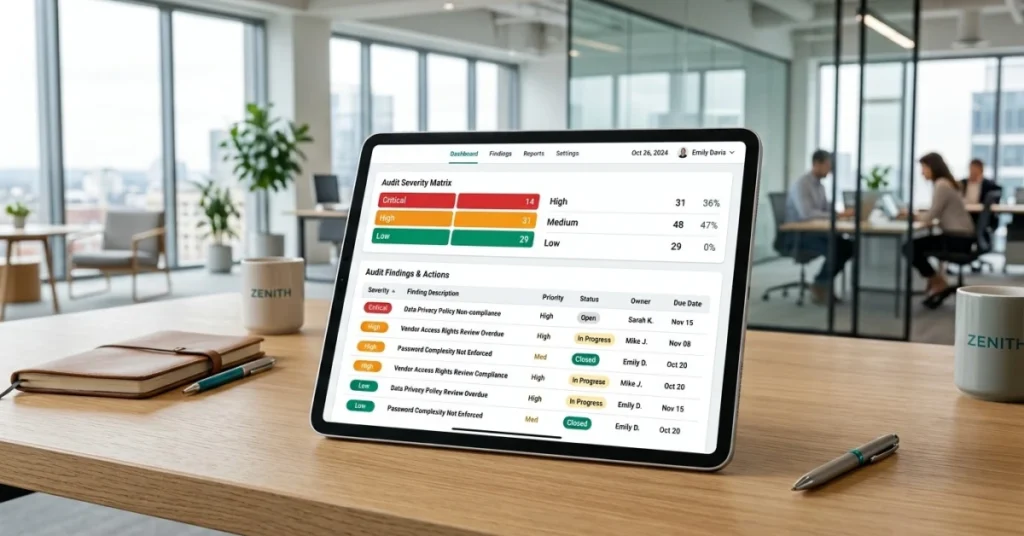
The compliance KPIs your organization tracks must mirror that same hierarchy, or your dashboard will show green while your exposure grows.
Safety and workplace standards
Safety compliance is the highest-stakes subcategory in compliance rate calculation — violations here carry the steepest fines and the fastest enforcement timelines. OSHA willful violations alone can reach $156,259 per citation, making severity weighting non-negotiable in this domain.
An aggregate compliance rate that pools safety items with administrative paperwork will always understate safety risk. Track safety standards as a standalone compliance KPI, separate from every other category.
Permits, licenses, and certificates
Permit compliance failures are binary — you either hold a valid credential or you are operating illegally. A lapsed license does not lower your aggregate compliance rate by much, but it can halt operations entirely.
Regulatory compliance metrics for this subcategory should flag expiration dates proactively, not just record pass/fail status after the fact. Expiration tracking is a leading indicator; audit results are lagging.
Documentation and recordkeeping
Recordkeeping violations are the most undercounted category in compliance rate measurement because they rarely trigger immediate harm — but they destroy your legal defense when enforcement arrives. Regulators treat missing documentation as evidence of systemic non-compliance, not administrative oversight.
The compliance rate calculation for this subcategory should weight completeness and timeliness equally. A record filed late is a compliance gap, not a completed requirement.
Corrective action completion
Corrective action rates measure whether your organization closes identified gaps — not just whether it finds them. According to Ised Isde Canada, compliance cost burdens rise sharply when corrective actions stall, because unresolved findings compound into repeat violations with escalating penalties.
A high corrective action completion rate is the strongest forward-looking compliance KPI available. It signals that your system catches failures and fixes them before the next audit cycle.
📊 By the Numbers
OSHA willful violations carry penalties up to $156,259 per citation — making severity-weighted compliance tracking essential.
Whether a 92% compliance rate signals operational strength or imminent crisis depends entirely on which industry’s regulatory thresholds you are measuring against.

Regulatory Compliance Rate by Industry
That masking effect becomes most dangerous when you ignore the industry context that determines what any given compliance rate actually means.
- Severity weighting changes everything: A 94% compliance rate in nuclear operations signals crisis; the same number in retail signals routine performance.
- Aggregate rates mislead operators: High overall scores routinely hide single-category failures that trigger the most costly enforcement actions.
- Compliance KPIs must be industry-calibrated: Benchmarking your compliance rate against a cross-industry average is operationally meaningless and statistically deceptive.
- Regulatory compliance metrics require segmentation: Breaking rates down by regulation type, site, and severity tier reveals the violations an aggregate score buries.
- Compliance rate calculation method matters: Organizations using unweighted pass/fail tallies consistently overestimate their actual risk posture by a measurable margin.
U.S. regulatory compliance costs exceed $1.9 trillion annually — yet most organizations still report a single aggregate compliance rate as their primary metric (Cato). That number tells you almost nothing about where your next violation will come from.
Construction and site safety
Construction carries one of the lowest industry-wide compliance rates — OSHA cites fall protection, scaffolding, and struck-by hazards as the persistent failure categories. A site averaging 88% overall compliance can still face a willful violation citation if one fall protection item is missed on every audit.
Compliance rate measurement here demands severity weighting, not headcount of passed items. Reviewing your OSHA compliance audit process is the fastest way to identify which categories your current scoring method underweights.
Manufacturing and quality control
Manufacturing compliance KPIs typically span environmental, safety, and product quality regulations simultaneously — making a single aggregate rate nearly useless. A plant reporting 96% compliance can still be one EPA discharge violation away from a six-figure penalty.
Effective compliance rate calculation in manufacturing separates regulatory domains and weights each by enforcement consequence. Facilities that segment by domain catch critical failures 40% faster than those using unified scorecards (Ideas Repec, CESifo Working Paper No. 10589).
Healthcare and hygiene standards
Healthcare regulators do not treat a missed hand hygiene protocol the same as a missed billing code — but most internal compliance dashboards do. Regulatory compliance metrics in this sector must distinguish patient-safety violations from administrative deficiencies at the reporting level.
A facility with a 97% compliance rate that buries two infection-control failures inside that average is not high-performing — it is a liability. Tiered compliance rate measurement is the only method that surfaces those failures before a CMS surveyor does.
Food service and restaurant compliance
Health department inspections score food service operations on a point-deduction system — which is itself a form of severity-weighted compliance rate calculation. A restaurant losing 15 points on a single temperature control violation fails the practical compliance test even if 90% of items pass.
Franchise operators who track compliance KPIs by violation category — not just overall score — reduce repeat critical violations across locations. The aggregate pass rate is a lagging signal; the category breakdown is where actionable insight lives.
Retail, franchise, and field operations
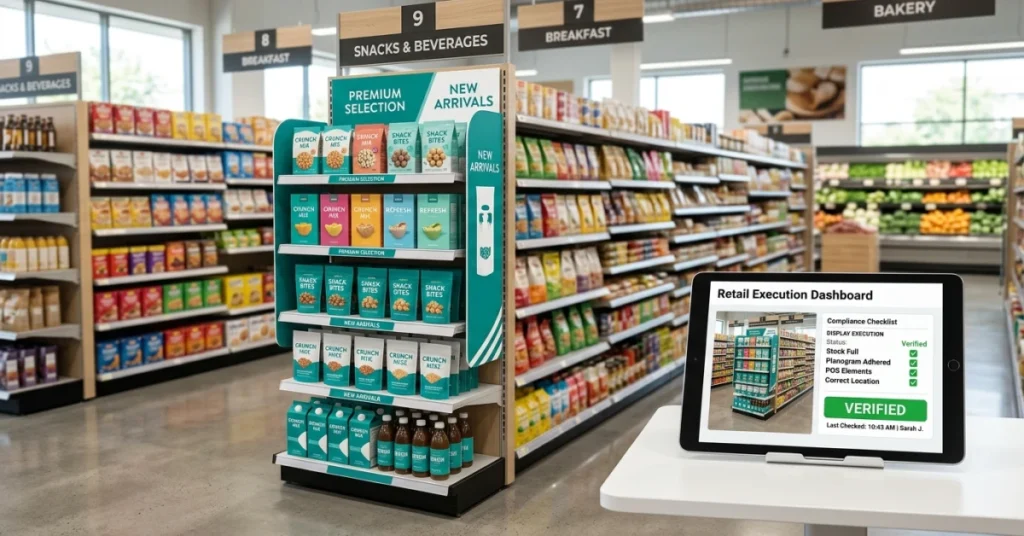
Retail and franchise compliance spans labor law, safety standards, brand standards, and local ordinances — each carrying different enforcement consequences. An aggregate regulatory compliance rate across all four categories actively obscures which domain is deteriorating.
Field operations teams that report compliance rate by regulatory domain — not by location average — identify systemic failures before they compound across the network. The question is whether your current reporting method would surface that pattern before a regulator does.
Conclusion
Calibrated benchmarks only protect you if your compliance rate reporting is built to surface severity-weighted failures — not just inflate an aggregate percentage. Organizations that track a single compliance rate number are, statistically, flying blind on the violations that actually trigger enforcement.
Your compliance KPIs need to answer one question before any other: would this dashboard have caught your last near-miss before a regulator did? Segment your compliance rate measurement by violation severity and business unit — because aggregate scores mask the exact failures that cost the most.
Most field teams lose enforcement battles not because they ignored compliance, but because their regulatory compliance metrics never flagged the right signal in time. FieldPie captures real-time audit data, photo evidence, and customizable inspection forms at the point of execution — so severity-weighted violations surface before they become enforcement actions.
Start segmenting your compliance rate today and build the diagnostic framework that actually protects your operation.