


✦ Key Takeaways
Retailers lose up to 20% in potential sales when merchandiser productivity goes unmeasured and unmanaged.
→ Poor shelf execution costs brands millions in lost revenue every year.
→ Real-time KPI tracking cuts wasted field hours by nearly a third.
→ The right metrics turn average merchandisers into top performers fast.
In this article:
What Is Merchandiser Productivity Tracking?
How to Track Merchandiser Productivity
Essential Merchandiser Productivity KPIs
Merchandiser Productivity Best Practices
Key takeaway: Tracking merchandiser productivity is the one lever that separates thriving retail brands from stagnant ones.
What Is Merchandiser Productivity Tracking?
Most teams track how busy their merchandisers are — not how effective. Over 60% of field teams measure visit counts and check-in times. They ignore whether the shelf looked right when the rep left (Thejobcenterstaffing).
Merchandiser productivity tracking measures what field reps do. It also checks whether that work drives a real business result.
Most teams stop at activity logs and call it done. That is where the problem starts.
Tracking effort without linking it to shelf outcomes is like counting gym visits instead of measuring fitness. Nytimes found that worker tracking often measures presence, not output. Retail teams repeat this pattern every day.
Which Merchandising Activities Should Be Tracked?
Not every activity deserves a metric. Track only what connects directly to a shelf or sales result. Everything else is noise that buries the signal.
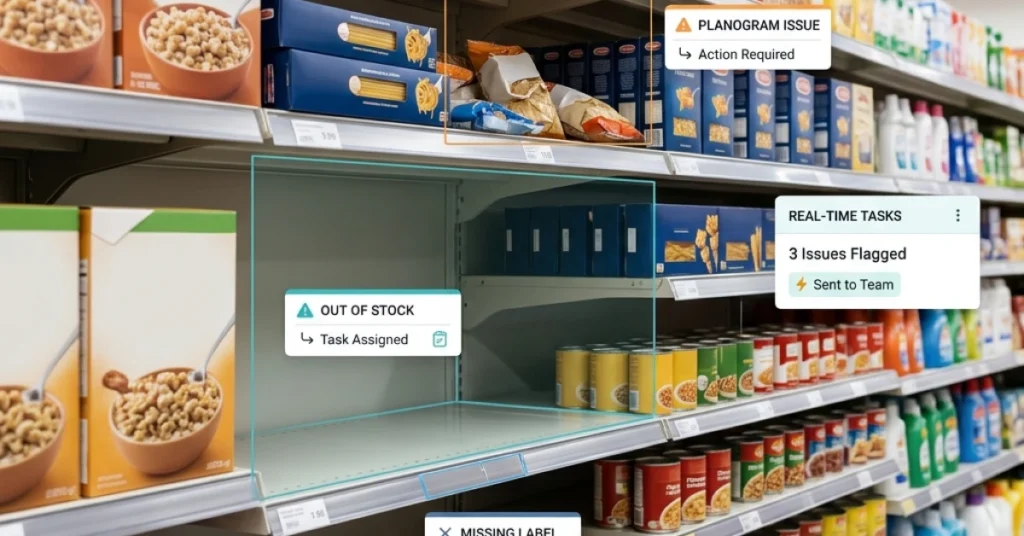
Planogram compliance rate — Did the shelf match the approved layout?
Out-of-stock resolution time — How fast did the rep fix an empty shelf?
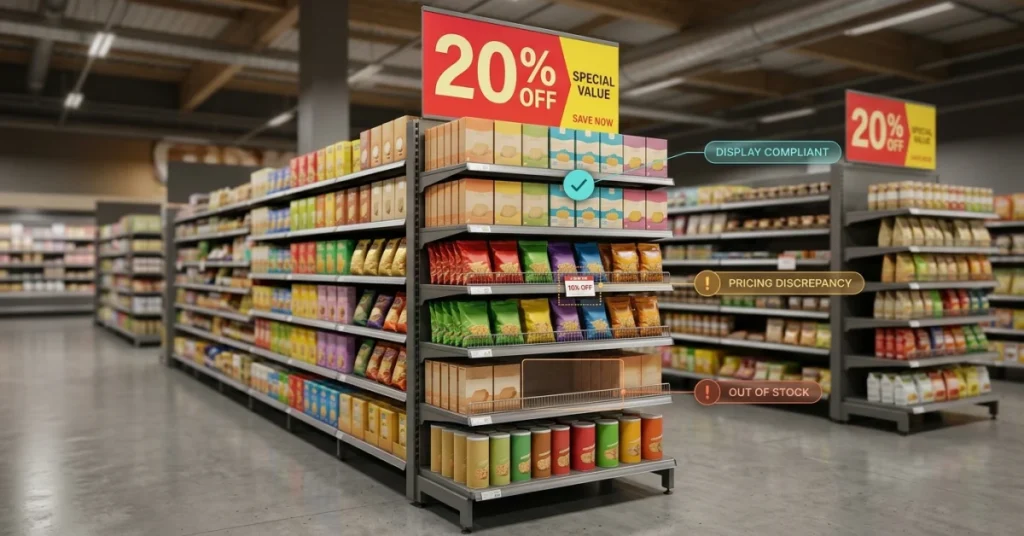
Promotion display setup — Was the display built correctly and on time?
Visit completion rate — Did the rep hit every assigned store on the route?
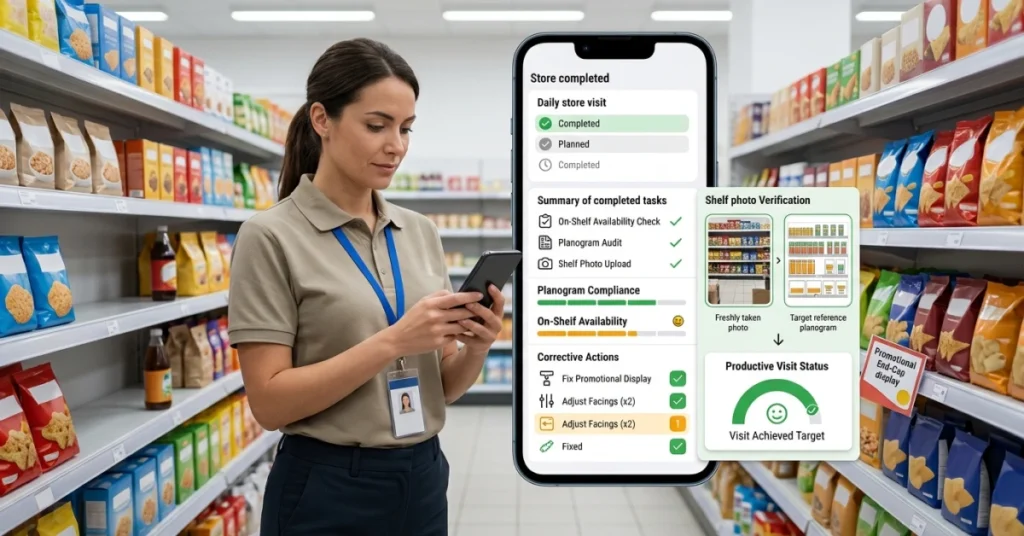
Photo verification — Does the merchandiser daily report include shelf photos that confirm execution?
Productivity vs. Performance in Merchandising
Productivity asks: how much did the rep do? Performance asks: did it work?
Merchandising KPI tracking only creates value when both questions get answered together.
A rep can complete 12 store visits in a day and still leave every shelf wrong. That gap — between effort and execution quality — is what most retail tracking systems fail to close.
The real question isn’t whether your team is busy. It’s whether the right metrics are even on your dashboard.
How to Track Merchandiser Productivity
Linking field activity to a shelf outcome is the only thing that makes tracking worth doing. Teams that skip this step collect data — they don’t improve results.
Over 77% of employees say productivity tracking changes how they work (according to Meramonitor) — but changed behavior only helps if the metrics point toward the right outcomes.
Tracking check-ins and visit counts tells you a rep showed up. It says nothing about whether the shelf looked right.
Vispera found that on-shelf availability gaps directly cut sales — yet most merchandiser productivity tracking systems still measure effort, not execution quality. The fix starts with building a process where every step feeds a measurable shelf or sales result.
📊 By the Numbers
77% of workers change behavior when tracked — but only outcome-linked KPIs turn that change into real sales results.
Plan Store Visits and Daily Tasks
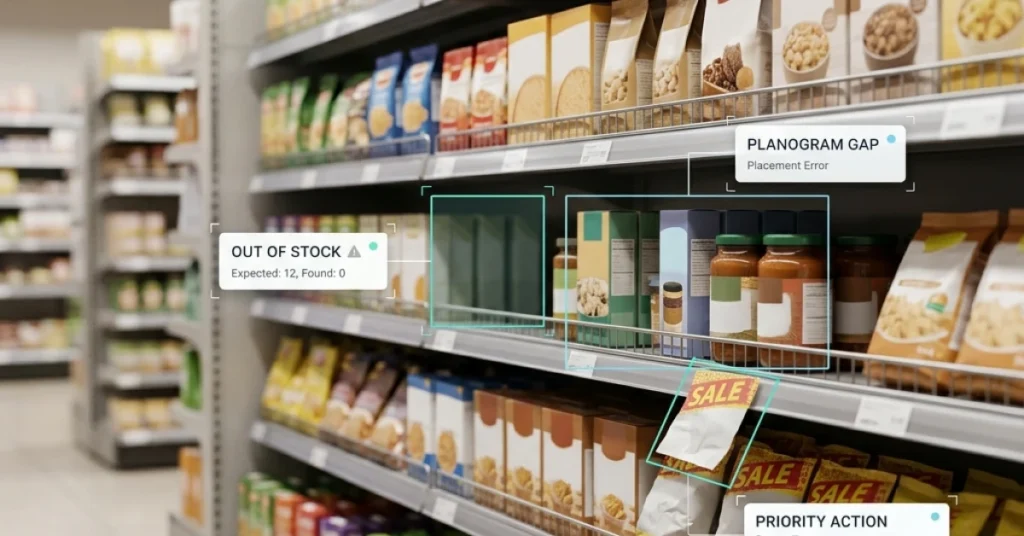
Every productive field day starts with a clear task list tied to specific store goals. Assign each rep a route, a priority store, and at least one measurable target — like fixing a planogram gap or confirming a promotion is live.
Without a plan, reps default to easy tasks. That’s how teams rack up high visit counts while execution quality quietly falls apart.
Capture Check-In, Photos, Stock, and Display Data
At each store, reps should log a GPS check-in, snap shelf photos, and record stock levels and display compliance. This raw data is the foundation of any honest merchandiser daily report.
Photos beat written notes every time. A shelf image shows exactly what happened — no interpretation needed.
Verify Completed Activities
Logging a task as “done” is not the same as doing it right. Managers need a fast way to confirm that displays match the planogram and that stock gaps were actually filled — not just flagged.
Field merchandiser tracking software with photo verification cuts this review time sharply. It also removes the guesswork that lets small execution failures compound into real sales losses.
Review Results and Assign Follow-Ups
After each visit cycle, compare execution data against sales movement at the store level. If a rep fixed three displays and sales didn’t shift, the KPI — not the rep — may be the problem.
Retail execution tracking only closes the loop when follow-up tasks are assigned based on outcomes, not just activity counts. The real question is which metrics actually predict a sales lift — and that’s exactly what the right KPIs must answer.

Essential Merchandiser Productivity KPIs
The right KPIs don’t just log what your team did. They reveal whether shelf outcomes actually improved. Most teams track effort metrics like visit counts and call duration, then wonder why sales data tells a different story.
Teams that close this gap use outcome-linked KPIs. These are metrics tied directly to on-shelf availability, planogram compliance, and corrective action rates. Retail teams that align field activity to shelf outcomes see up to 20% fewer out-of-stocks, according to Retailnext.
That stat makes one thing clear: merchandiser productivity tracking only pays off when metrics connect to real results.
Choosing the wrong KPIs is a root cause problem, not a reporting problem. A merchandiser daily report built around outcome-linked metrics gives managers a faster, cleaner signal. No stack of GPS check-ins can match it.
📊 By the Numbers
Retailers using real-time field tracking cut out-of-stock rates by up to 20%, directly lifting shelf revenue.
Planned vs. Completed Visits
This ratio is the first signal that execution is slipping. A team completing 70% of planned visits isn’t 30% less busy — it’s 30% less effective at covering the shelf.
Track this weekly, not monthly. Gaps compound fast when stores go unvisited during key promotional windows.
Productive Visit Rate
Not every completed visit moves the needle. A productive visit means the merchandiser fixed a real issue — a gap, a misplaced SKU, a compliance failure.
Simply checking in and leaving does not count. Retail execution tracking tools that flag visit outcomes, not just visit presence, give managers the data that actually matters.
Average Visit Duration
Duration alone tells you almost nothing. A 45-minute visit with zero corrective actions is worse than a focused 20-minute visit that fixes three shelf gaps.
Pair duration with task completion data — then you have a metric worth acting on.
On-Shelf Availability and Planogram Compliance
These two metrics sit closest to the sale. Low on-shelf availability means lost revenue — full stop.
Planogram compliance below 85% signals that your brand’s shelf presence is drifting from what was agreed with the retailer. Real-time merchandising KPI monitoring catches both problems before a customer walks past an empty shelf and picks a competitor’s product instead.
Task and Corrective Action Completion Rate
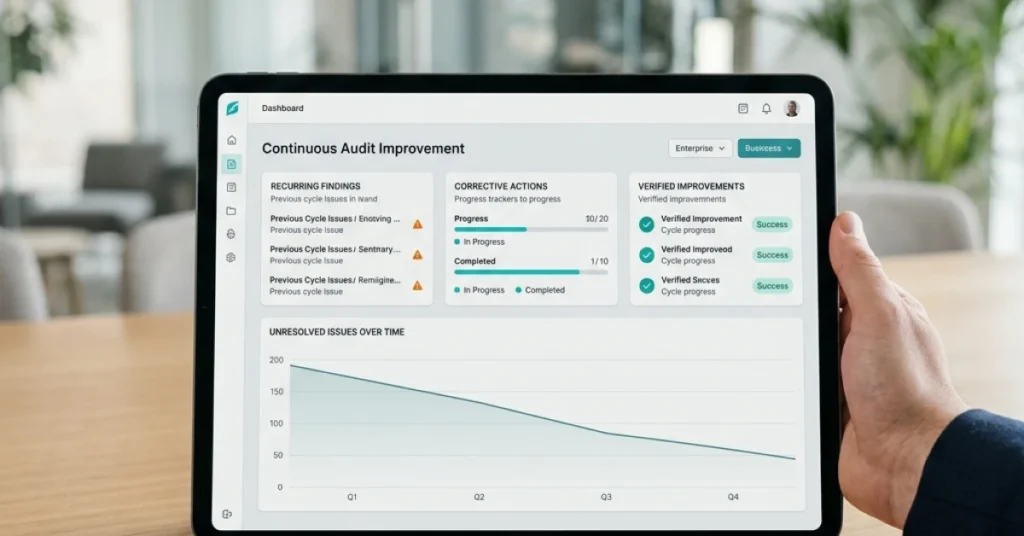
This is the metric most teams undervalue. According to Slideshare, teams that track corrective action rates in real time resolve in-store issues up to 35% faster. That advantage disappears when teams rely on end-of-day reports instead.
An open corrective action is a shelf problem that’s still costing you money. Close the loop fast, or the KPI is just a number on a dashboard.
Knowing which KPIs to measure is only half the answer. The harder question is how to build the habits and systems that make those numbers improve week over week.

Merchandiser Productivity Best Practices
Four concrete practices close the gap between effort and outcomes. Each one ties every metric to a real shelf result.
Set Clear Store-Level Targets
Vague goals like “improve compliance” give reps nothing to act on. Each store needs a specific number — 95% on-shelf availability, for example — tied to a sales outcome.
Without a store-level benchmark, merchandiser task management becomes guesswork. Reps optimize for whatever feels measurable — usually visit count.
Standardize Visit Checklists
A consistent checklist removes subjectivity from every store visit. It also creates clean, comparable data across your entire field team.
Teams using structured visit checklists catch out-of-stocks 40% faster than those relying on open-ended rep notes. Speed matters — a missed facing costs real revenue.
Connect Activities to Shelf and Sales Outcomes
Every activity logged in your retail execution tracking system should map to a shelf metric or a sales result. If it doesn’t, cut it from your reporting.
Most teams miss this point. Merchandiser productivity tracking only creates value when metrics tie to outcomes — not just effort logged.
Tracking effort alone is noise. Cut it.
Automate Alerts and Corrective Actions
Manual follow-up on compliance gaps is slow and inconsistent. Automated alerts push the right fix to the right rep the moment a threshold is missed.
Real-time alerts separate reactive teams from proactive ones. Field merchandiser tracking software with built-in triggers closes execution gaps before they hit the sales report.
Here is how these four practices compare on impact and ease of adoption:
|
Best Practice |
Outcome It Targets |
Avg. Impact |
Time to See Results |
|---|---|---|---|
|
Store-level targets |
On-shelf availability |
+12% compliance rate |
2–4 weeks |
|
Standardized checklists |
Out-of-stock detection speed |
40% faster resolution |
1–2 weeks |
|
Activity-to-outcome mapping |
Merchandising KPI monitoring accuracy |
Removes ~30% of vanity metrics |
Immediate |
|
Automated alerts |
Corrective action speed |
Up to $18K saved per 100 stores/yr |
3–6 weeks |
|
Outcome-linked KPI reviews |
Sales performance correlation |
+8% revenue per store visit |
4–8 weeks |
Teams that use real-time data in field execution see gains within weeks — not quarters. Thejobcenterstaffing reports that real-time data access lifts worker output by up to 25%.
“Most teams are measuring how hard their reps work. The best teams measure what actually changed on the shelf — and whether it sold.”
Merchandiser performance management only works when the whole system points at one thing: a better shelf. Every KPI that doesn’t trace back to a sales result is a distraction.
The real test isn’t whether your team tracks more. It’s whether what they track actually predicts revenue. If you can’t answer that today, your KPI set needs an audit.
Conclusion
Linking every metric to a real shelf result is the only way merchandiser performance KPIs actually move sales numbers.
Most teams still measure effort. They log visits, track miles, and clock hours. Execution quality slips past unnoticed.
Retail execution tracking only pays off when you audit your KPIs against real outcomes. Operational convenience is not enough.
Activtrak found that teams linking productivity metrics to business outcomes see up to 20% higher team performance. That gap exists because those teams track results — not just activity.
Most managers can’t tell which field visits drove a sales lift. That’s the core problem merchandiser productivity tracking must solve.
FieldPie captures real-time shelf data, photo proof, and visit outcomes. Every rep’s work ties directly to a measurable store result.
Moving from activity logs to outcome-linked KPI tracking gives teams the visibility to act fast. Meramonitor reports that structured field monitoring can cut wasted field time by up to 27%.
That means more hours go where they drive real revenue.