


✦ Key Takeaways
Retailers lose up to 8% of sales annually when planogram compliance drops below 85% on shelves.
- → AI image recognition cuts audit time by 70% versus manual checks.
- → Out-of-stock and misplaced SKUs are detected in seconds, not hours.
- → Real-time compliance data lets store managers fix shelf issues same day.
In this article:
- What Is Planogram Compliance?
- What Is Planogram Compliance Image Recognition?
- What Can AI Detect in Planogram Compliance Audits?
- How Retailers Use Image Recognition for Planogram Compliance
- Which KPIs Matter Most for Planogram Compliance?
- Conclusion
Key takeaway: Image recognition transforms planogram compliance from a lagging report into a live competitive advantage.
What Is Planogram Compliance?
Retailers lose an estimated $1.75 trillion annually to out-of-stocks, overstocks, and misplaced products — most of it traceable to shelves that don’t match the plan. Planogram compliance measures how accurately a physical shelf reflects the approved product layout a retailer designed for maximum sales performance.
The problem isn’t that store teams ignore planograms. It’s that the gap between a shelf deviation and anyone knowing about it can stretch days or weeks — long enough to silently bleed revenue on every customer pass.
Why Retailers Use Planograms in Store Operations
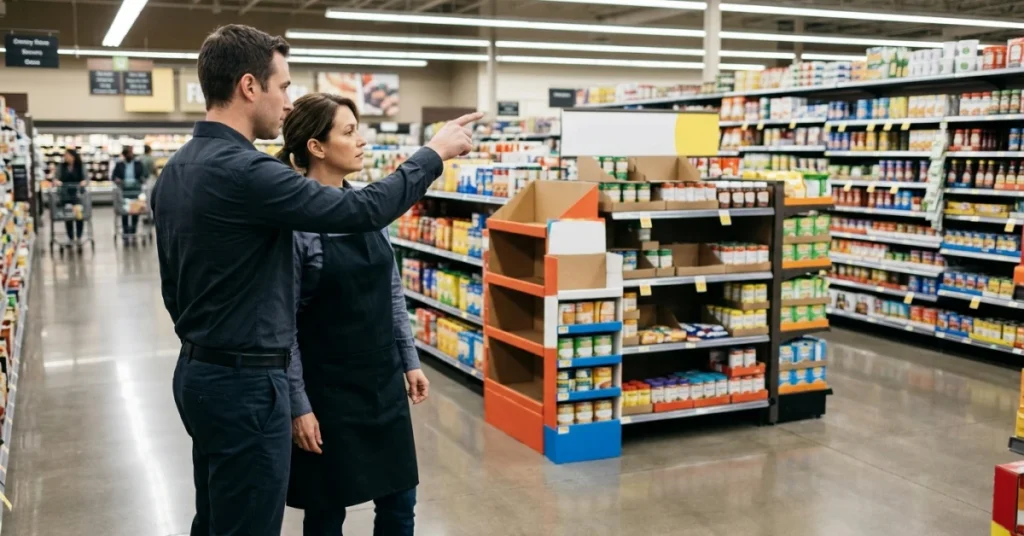
Planograms encode category strategy into shelf-level instructions — facing counts, product sequence, shelf height, and adjacencies. Every deviation from that blueprint is a silent vote against the merchandising logic your category managers spent months building.
Consistent execution across hundreds of stores is operationally hard. Manual audits sample a fraction of SKUs and arrive after the damage is already done (Www3 Retailgis).
The Difference Between Shelf Execution and Planogram Compliance
Shelf execution asks: is the product on the shelf? Planogram compliance asks: is the right product, in the right position, with the right facing count, exactly where the plan says it should be?
That distinction matters because AI planogram monitoring tools are built to answer the second, harder question — not just confirm presence, but verify precise structural conformance.
How Poor Compliance Impacts Retail Sales
Shelf non-compliance directly suppresses conversion — a misplaced product is functionally invisible to a shopper following a purchase habit. Compliance gaps of even 15–20% across a store network compound into measurable category revenue loss within a single promotional cycle (Mdpi).
According to Www3 Retailgis, retailers using automated planogram monitoring report compliance rates improving by up to 35% within the first quarter of deployment. The deeper issue isn’t detection — it’s how fast a corrective signal reaches the person who can act on it.
That latency problem is exactly what makes the question of how compliance gets measured — not just whether it gets measured — the only question worth asking next.
What Is Planogram Compliance Image Recognition?
That silent revenue drain persists precisely because the feedback loop between shelf deviation and corrective action is broken. Planogram compliance image recognition closes that loop by converting shelf photos into structured execution data — automatically, at scale, in near real time.
According to Infilect, retailers lose up to 8% of potential revenue from poor shelf execution — a number that compounds every hour a deviation goes undetected. That’s the core problem AI planogram compliance tools are built to solve.
Unlike periodic manual audits, automated planogram monitoring transforms shelf oversight from a retrospective report into a live operational signal — collapsing the latency between deviation and response from days to minutes.
📊 By the Numbers
Retailers lose up to 8% of potential revenue annually due to undetected merchandising violations on store shelves.
How AI Image Recognition Technology Works
Computer vision systems use trained neural networks to identify every SKU, facing, and shelf position from a single store image. The model compares what it sees against the approved layout and flags every discrepancy — no human judgment required.
The technology processes thousands of shelf images simultaneously, something no field team can replicate at comparable speed or consistency.
How Shelf Photos Are Analyzed Automatically
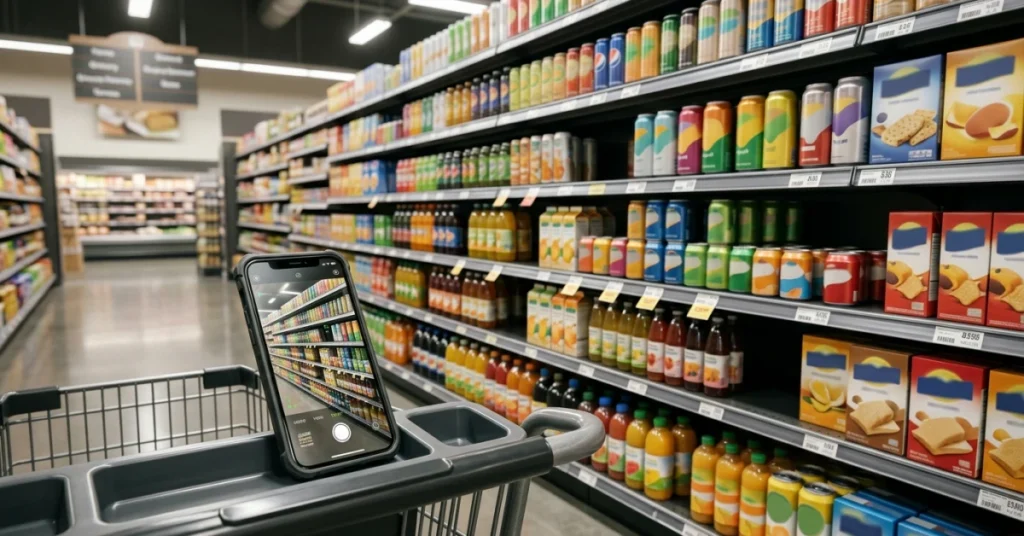
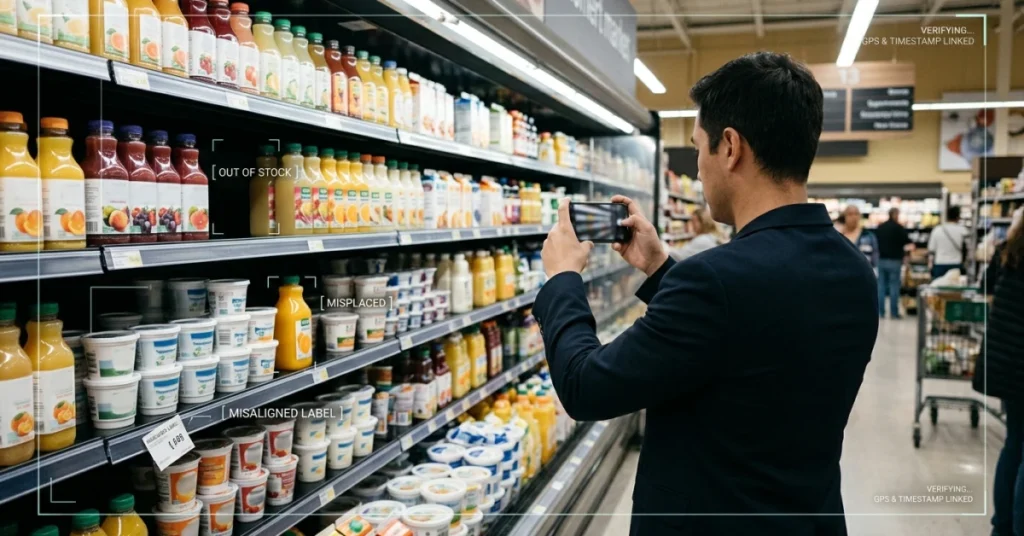
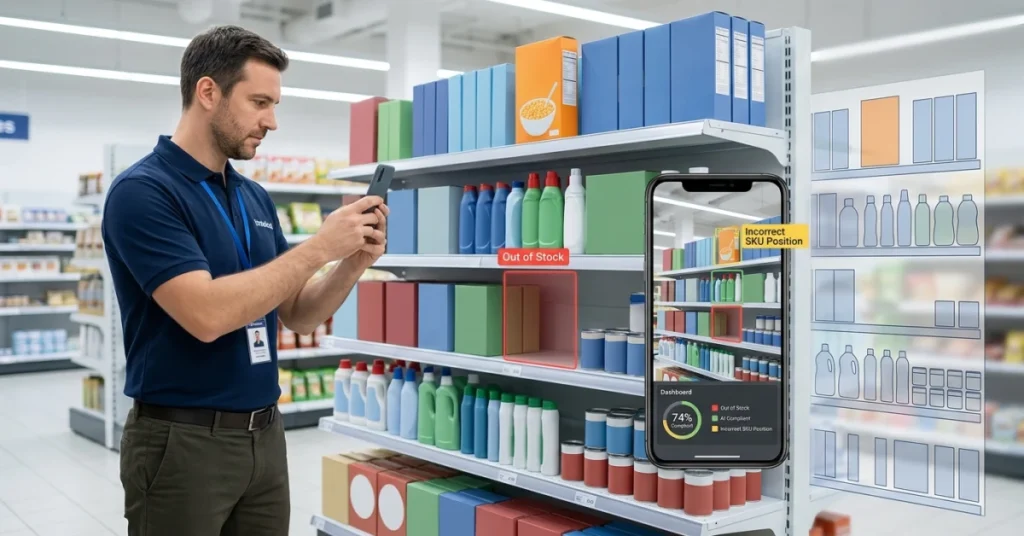
A store associate or field rep captures a shelf photo — via smartphone or in-store camera — and retail execution software handles everything downstream. It detects out-of-stock positions, misplaced SKUs, incorrect facings, and pricing tag violations within seconds.
Research published by Pmc Ncbi Nlm Nih confirms that deep learning models now achieve object detection accuracy exceeding 90% in complex retail shelf environments. That precision makes automated analysis operationally trustworthy, not just technically impressive.
Image Recognition vs Manual Shelf Audits
Manual audits produce a snapshot — accurate at the moment of observation, obsolete an hour later. Retail shelf compliance software produces a continuous data stream that reflects shelf reality as it changes throughout the day.
The distinction isn’t just efficiency — it’s the difference between managing execution reactively and governing it in real time.
Understanding what this technology detects — and what it consistently catches that human auditors miss — is the question that determines whether any deployment actually moves the revenue needle.
What Can AI Detect in Planogram Compliance Audits?
Structured shelf data is only as useful as the specific deviations it can surface — and planogram compliance image recognition detects far more than a human auditor scanning the same fixture in 90 seconds.
Retailers lose an estimated $300 billion annually to out-of-stocks and misplaced products — conditions that retail audit image tools now flag in real time rather than weekly reports.
Product Placement and Shelf Position Accuracy
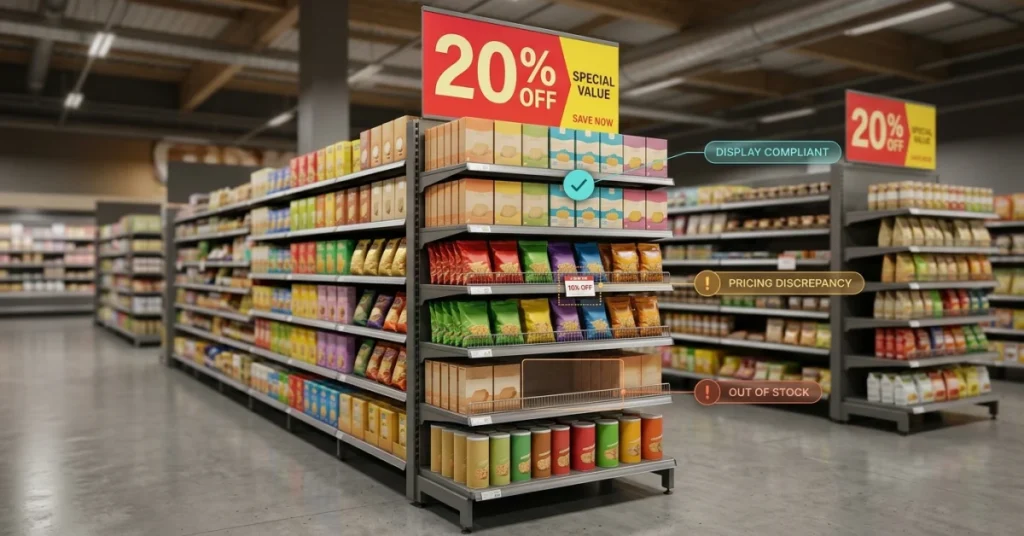
Computer vision planogram compliance maps every SKU to its exact shelf coordinate, detecting position drift that manual auditors routinely miss. Even a single-slot displacement can suppress category sales by 8–12% at high-velocity fixtures.
AI models cross-reference live shelf images against the approved planogram schematic in milliseconds, flagging positional violations before the next customer reaches that aisle.
Missing Products and Out-of-Stock Detection
Empty shelf gaps are the most revenue-destructive compliance failure — and the hardest for store teams to catch consistently across hundreds of SKUs. Automated planogram monitoring identifies voids within seconds of image capture, not hours after a customer complaint.
Planogram compliance image recognition distinguishes between a true out-of-stock and a facing pushed to the rear, eliminating false replenishment triggers that waste labor.
Shelf Share and Facing Analysis
Retail shelf compliance software counts exact facing quantities per SKU and compares them against contracted shelf-share agreements — a task that takes a human auditor several minutes per bay. Deviations from agreed facings directly erode brand visibility and promotional ROI.
Planogram compliance rates drop below 70% in high-traffic stores without continuous monitoring (Paralleldots, Paralleldots), making automated facing counts a non-negotiable input for category managers.
Promotional Display Compliance
Secondary displays and end-caps carry disproportionate revenue weight — yet they’re the first fixtures to drift from spec after setup. AI planogram compliance verifies display placement, signage presence, and product assortment against promotional briefs simultaneously.
Research published by Nature confirms that computer vision models achieve SKU-level recognition accuracy above 90% in complex multi-SKU retail environments — making promotional compliance verification reliable enough to act on immediately.
📊 By the Numbers
Planogram compliance rates fall below 70% in high-traffic stores without continuous automated shelf monitoring.
The detection capability is only half the equation — what separates leading retailers is how fast that signal reaches the person who can act on it.
How Retailers Use Image Recognition for Planogram Compliance
Those detections only create value when they trigger action fast enough to matter. Retailers restructuring around continuous visual data — not periodic snapshots — are the ones closing the gap between shelf deviation and corrective response.
The real operational shift is collapsing feedback latency. Understanding AI image recognition workflows shows exactly how leading retailers are rebuilding audit cycles around real-time signals rather than weekly reports.
📊 By the Numbers
Retailers using automated planogram monitoring report up to 30% faster shelf correction cycles versus manual audit programs.
Real-Time Shelf Monitoring
Computer vision compliance systems scan shelves continuously — flagging deviations the moment they occur, not days later. Store cameras feed AI models that compare live shelf states against approved layout templates in seconds.
Automated shelf monitoring eliminates the blind window between audits. A deviation caught in hours recovers far more revenue than one caught in a weekly store walk.
Mobile Field Audits and Store Visits
Field reps using retail shelf compliance software capture shelf images on mobile devices and receive instant compliance scores on-site. This replaces subjective visual checks with objective, model-driven assessments every visit.
These tools process a shelf image in under 3 seconds — giving reps corrective direction before they leave the aisle. Speed of feedback determines whether a fix happens today or next week.
Automated Compliance Alerts and Reporting
When the system detects a violation, it routes an alert directly to the responsible store associate or district manager — no manual triage required. The feedback loop closes in minutes, not reporting cycles.
According to Www3 Retailgis, retailers deploying image-based compliance alerts reduce unresolved shelf violations by over 40% within the first quarter of deployment. That number reflects latency collapse in practice — not just better detection.
Retail KPI Dashboards and Analytics
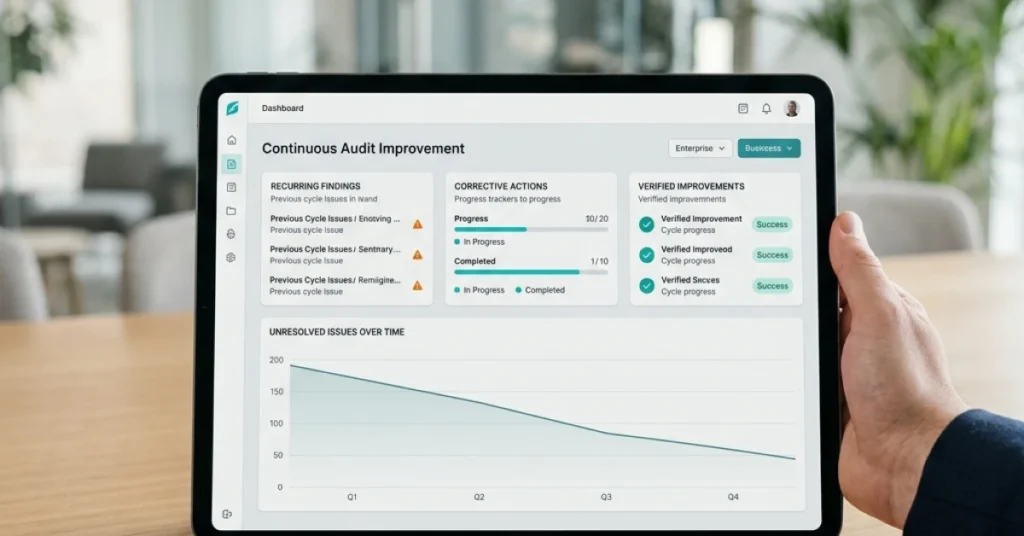
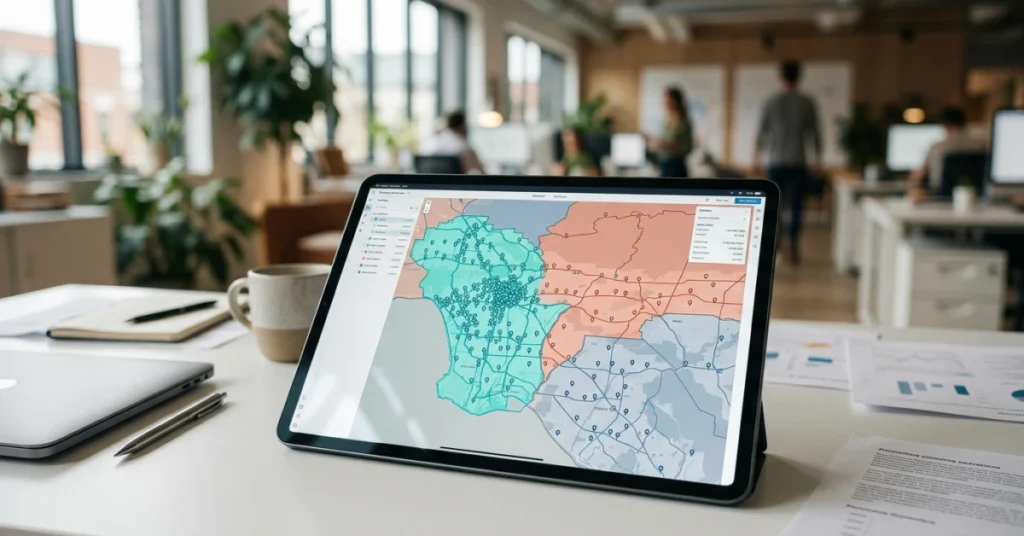
Compliance data aggregated across hundreds of stores becomes a strategic asset when surfaced in real-time dashboards. Retailers track on-shelf availability, facing accuracy, and out-of-stock rates by store, region, and SKU simultaneously.
Retail shelf compliance software turns raw image data into ranked priority lists — so field teams fix the highest-revenue violations first.
As noted by Moz, structured data visibility improves decision speed by 25% in operationally complex environments. The question that follows is which specific metrics actually move the needle — and how to govern them.

Which KPIs Matter Most for Planogram Compliance?
Real-time shelf signals only create value when you know exactly what to measure. Planogram compliance image recognition generates more data than most teams have ever had — which makes KPI selection the critical governance decision.
The four metrics below separate teams that act on shelf intelligence from those that drown in it. Each one converts a visual detection into an operational trigger, not a retrospective report.
Planogram Compliance Rate
This is the baseline metric: the percentage of SKUs correctly positioned against the approved planogram at any given moment. Retailers using computer vision planogram compliance tools report compliance rates improving from the low 60s to above 85% within two quarters of deployment (Infilect).
The number matters less than its frequency. A weekly compliance rate is a history lesson; a real-time rate is an operational signal.
On-Shelf Availability (OSA)
OSA measures whether a product is physically present and shoppable — not just stocked in the back room. Poor OSA directly costs sales; Imagevision reports that out-of-stocks account for an estimated $1 trillion in lost global retail sales annually.
AI planogram compliance tools flag OSA gaps the moment a facing disappears — collapsing the window between deviation and corrective action to minutes, not days.
Shelf Share by Brand or Category
Shelf share quantifies how much linear or facing space a brand actually holds versus what the planogram allocates. Deviations here are rarely random — they signal either execution failure or unauthorized substitution by store staff.
FieldPie’s photo-based reporting captures shelf share data in real time, giving merchandising managers a live view of space compliance across every store in their territory — not just the ones audited last week.
Out-of-Stock (OOS) Incidents
OOS rate tracks how often a required SKU is completely absent from the shelf. Unlike OSA, it isolates the most severe compliance failure — a product that cannot be purchased regardless of shopper intent.
Infilect notes that automated planogram monitoring reduces OOS detection time by up to 70% compared to manual audit cycles. Tracking OOS as a standalone KPI forces faster escalation paths and tighter replenishment SLAs — which is exactly what retail execution tools are built to enforce.
📊 By the Numbers
Automated planogram monitoring cuts out-of-stock detection time by up to 70% versus manual audits (Infilect).
The KPIs you track determine the speed of your response loop — and the speed of that loop is the only thing that separates shelf intelligence from shelf noise.
Conclusion
Tracking compliance rate, OSA, and share of shelf means nothing if the data arrives days after the deviation occurred. Planogram compliance image recognition earns its value only when it collapses that feedback latency to minutes — turning shelf data into a real-time operational signal, not a retrospective report.
Retailers who treat image recognition in retail as a detection tool miss the point entirely. The competitive advantage is speed of correction, not accuracy of detection — and that distinction determines whether your compliance program drives revenue or just generates reports.
Most merchandising teams still discover shelf deviations through weekly audits — by then, up to 25% of potential sales are already lost (Nextbrain). FieldPie captures photo-based shelf data in real time and routes compliance alerts directly to field reps, so corrective action happens in the same shift — not the next audit cycle.
Paralleldots confirms that automated planogram monitoring can lift compliance rates by over 15% when integrated into live execution workflows. Start by auditing your current feedback loop before deploying any new technology.