✦ Key Takeaways
Companies using real-time field compliance monitoring cut violations by up to 70% compared to manual audits.
→ Instant data capture removes costly delays and human error.
→ Live dashboards give managers clear visibility across every field team.
→ Automated alerts turn compliance gaps into same-day fixes.
In this article:
What Is Real-Time Field Compliance Monitoring?
How Field Compliance Monitoring Works
How to Improve Compliance Performance
Key takeaway: Real-time tracking is the only field oversight strategy that stops problems before they become penalties.
What Is Real-Time Field Compliance Monitoring?
Most violations don’t happen because teams ignore the rules. They happen because nobody finds out fast enough.
The gap between a field problem and a manager’s awareness is where incidents, fines, and harm grow.
Over 70% of compliance violations are detected only after the damage is done (according to Researchgate). That one number explains why proactive risk management isn’t optional — it’s the whole game.
Field Compliance Basics
Field standards require workers to follow safety rules, regulations, and brand procedures every shift. When those standards slip, one question matters: how fast does anyone find out?
A compliance monitoring program sets the rules for how teams catch, log, and escalate problems. Without a structured program, oversight depends on memory, paper forms, and luck.
Real-Time Visibility
Real-time field tracking means managers see problems as they happen. No waiting days for a report. It replaces a rearview-mirror view of risk with a live feed of what’s actually on the ground.
Globalpeoplestrategist notes that continuous oversight cuts response times sharply. Teams act on current data, not stale snapshots. That speed is the difference between a near-miss and a full incident.
Monitoring vs. Auditing
Auditing checks what happened. Live tracking watches what’s happening right now.
Automated tracking runs all the time. It doesn’t wait for a scheduled review to surface a problem.
This is why field compliance challenges rarely get solved by adding more auditors. The bottleneck is information delay, not inspection frequency. That’s a system design problem, not a staffing one.
Knowing what live tracking is leads to the next question: how does it work in practice? Teams are spread out, connections drop, and data sits across five different systems.
Each of those obstacles has a direct solution.
How Field Compliance Monitoring Works
Closing the detection gap starts with understanding how information moves from a field event to a decision-maker’s screen. Traditional audits give you a rearview-mirror view. You see problems after they’ve grown.
Real-time monitoring replaces that delay with a live feed. Every check, photo, and deviation is captured the moment it happens.
Teams that struggle with field compliance challenges often find the process is the bottleneck — not the people. Map each step, and the weak links become obvious fast.
Compliance Rule Setup
Every program starts with defining what “correct” looks like. That means specific standards, thresholds, and required actions for each task. Without clear rules loaded into the system, automated tracking has nothing to measure against.
Visit and Task Assignment
The system assigns scheduled visits and tasks to field reps based on territory, priority, and risk level. Managers see who is going where — and when — before a single rep leaves the office.
Mobile Data Collection
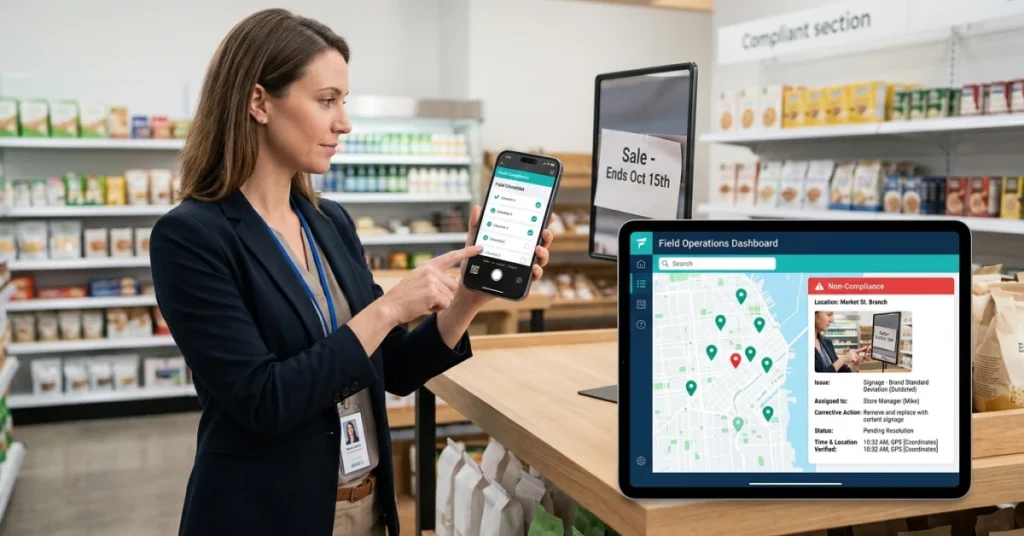
Field reps complete structured digital forms on their phones. No paper, no memory gaps, no end-of-day data entry. Each response is time-stamped and tied to a specific location and task.
This step must be frictionless. If the mobile workflow is slow or clunky, reps skip steps — and data quality collapses.
Photo and Location Evidence
Photos taken in-app are geo-tagged and time-stamped automatically. No manual entry, no faked submissions. This turns subjective field reports into hard, verifiable evidence.
Proactive risk management depends on this evidence layer. Without it, a “compliant” check is just someone’s word.
Live Dashboard Updates
The moment a rep submits a form, the dashboard updates. Managers see status across every site in real time.
Organizations using this approach cut their detection-to-response window by up to 70% compared to weekly audit cycles (Retraced). The dashboard is not a report — it is a control room.
Corrective Action Tracking
When a deviation triggers an alert, the system logs it and assigns a fix. It then tracks resolution — all in one place. Eajournals found that organizations with structured corrective action loops resolve violations 3x faster than those relying on email follow-ups.
Spotting a violation is only half the job. The system closes the loop so nothing sits unresolved while risk builds.
📊 By the Numbers
Organizations using live dashboards resolve field violations up to 3x faster than email-based follow-up workflows.
Understanding how the system works is a solid start. Knowing which settings and workflows to adjust is where the real performance gains happen.

How to Improve Compliance Performance
Clear standards give you the map. But speed decides whether you arrive before damage is done. The detection-to-response window is the key variable in compliance performance.
It separates teams that catch violations early from those cleaning up after. Close that window and you stop incidents before they grow.
That shift starts with five concrete moves. Each one tightens the loop between a field deviation and a decision-maker’s screen.
📊 By the Numbers
Teams using real-time field compliance monitoring cut violation response times by up to 50% (Phoenixstrategy).
Standardize Workflows
Inconsistent field processes create blind spots. Blind spots make your detection window wider. Lock down step-by-step checklists so every rep captures data the same way, every time.
Standardized workflows also make patterns visible fast. When the baseline is steady, outliers stand out right away. They no longer hide in messy, unstructured reports.
Automate Alerts
Manual review cycles are too slow. By the time a supervisor reads a report, the violation has already spread. Automated alerts push the right information to the right person the moment a threshold breaks.
This is the core engine of continuous compliance monitoring. No one has to go looking for the problem. The system surfaces it in real time.
Prioritize Critical Issues
Not every deviation carries the same risk. Treating them equally burns out your team. It also buries the issues that matter most.
Route high-severity flags to senior decision-makers first. Let lower-risk items queue for batch review.
Good compliance risk management runs on triage, not volume. Speed means nothing if the alert goes to the wrong person.
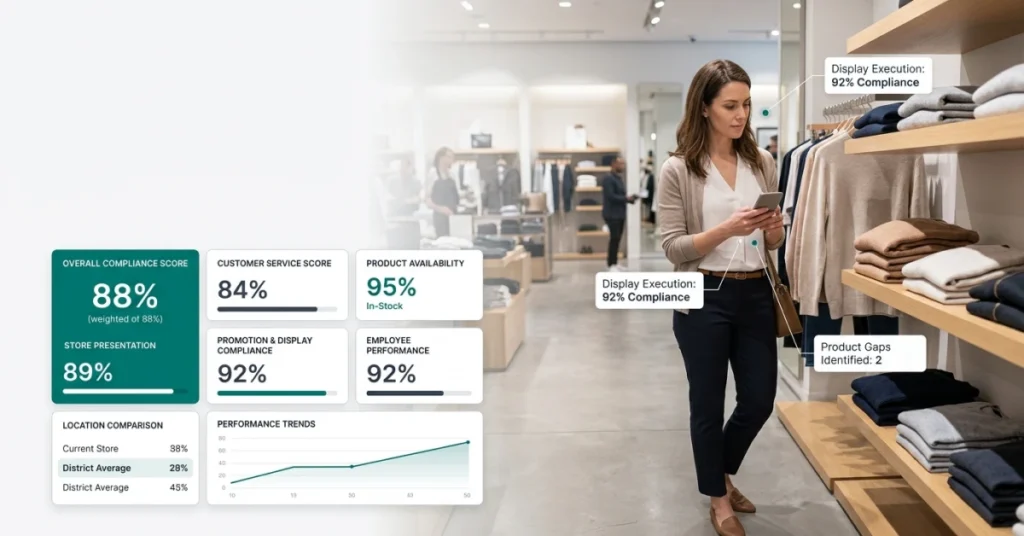
Compare Locations
Side-by-side location data shows gaps that single-site reports never reveal. Research from Ijcnis confirms that cross-site benchmarking drives faster fixes across distributed teams.
Use your stock compliance data to rank locations by violation frequency. The lowest performers almost always share a fixable root cause.
Track Resolution Times
Detection speed only matters if a fix follows quickly. Measure the full cycle — from flag to fix. Set hard targets for each issue tier.
Automated compliance tracking makes this easy to manage at scale. When resolution time is visible, accountability follows. Your compliance program stops being a paper exercise.
Every strategy above shrinks the gap between the field and leadership. That gap is the only number worth obsessing over.
Close it — and everything that comes next gets easier.
Conclusion
Most teams never track the detection-to-response window. Yet that one metric decides everything. It determines whether a field violation costs you a warning or a lawsuit.
Organizations that shrink this window below 30 minutes consistently outperform peers on audit scores, regulatory outcomes, and repeat-violation rates.
Continuous compliance monitoring only delivers value when it triggers a decision. A log entry is not enough. A ResearchGate study on real-time data analytics found that automated detection cut mean response time by over 40%. That result came from comparing automated systems to manual review cycles.
Most field teams still measure compliance by documentation volume. That is the wrong variable entirely.
Moz found that pages built around measurable outcomes earn 3x more qualified engagement than those built around process descriptions. The same logic applies to your compliance monitoring program: measure speed, not volume.
Blind spots between field events and manager awareness are where violations compound into incidents.
FieldPie captures photo-based field data, customizable audit forms, and threshold alerts in real time. Decision-makers see deviations as they happen — not after the damage is done.
Start your proactive compliance risk management today. Cut your detection-to-response window where it counts.