


✦ Key Takeaways
Continuous audit improvement examines 100% of transactions and controls, ensuring no material issues ever slip through undetected.
→ Automation transforms auditing from reactive to genuinely proactive.
→ Technology alone fails without a culture of continuous learning.
→ Measuring audit outcomes drives smarter, faster organizational decisions.
In this article:
How Do You Build a Continuous Audit Improvement Program?
What Technologies Actually Power Continuous Auditing?
How Do You Measure if Your Program Is Actually Improving?
Key takeaway: Organizations that commit to continuous audit improvement outcompete those still relying on periodic, sample-based reviews.
How Do You Build a Continuous Audit Improvement Program?
Most audit teams already have the data they need to improve. What they’re missing is a system that forces them to learn from it. Continuous audit improvement is a feedback loop you build deliberately, one control area at a time. It’s not a software purchase or a headcount decision.
Continuous auditing and monitoring detect control failures about 12 times faster than traditional periodic reviews, according to Supervizor. That speed advantage doesn’t come from better tools alone. It comes from building a process that surfaces problems before they compound.
Define KRIs Before Touching Any Tool
Key Risk Indicators, or KRIs, are the specific signals that tell you a control is starting to slip. Think of them as early warning lights on a dashboard. They only work if you decide in advance what counts as a warning.
Step 1: Map your highest-risk control areas first
Start by listing the five to ten controls where a failure would hurt most, think cash disbursements, access rights, or vendor approvals. Rank them by impact, not by how easy they are to test.
Step 2: Set measurable thresholds for each KRI
A KRI without a threshold is just a metric. Say your team flags any invoice approved outside the normal two-day window. That’s a threshold, so write it down before you build any report around it.
Step 3: Assign ownership and escalation paths
Every KRI needs one named owner, not a team or a department. That person decides when a breach gets escalated and to whom, so nothing sits in a gray zone waiting for someone to act.
Redesign Your Testing Cadence Around Risk
Annual audit cycles made sense when data lived in filing cabinets. A risk-driven schedule changes that. Your team tests more often where it matters and less often where it doesn’t.
Step 1: Shift from annual cycles to rolling reviews
Pick your top three risk areas and move them to a monthly or quarterly review instead of an annual one. You don’t need to overhaul everything at once. Just break the once-a-year habit where the stakes are highest.
Step 2: Pilot one high-risk process before scaling
Choose one process, vendor payments work well, and run your new cadence there for a full quarter. Document what you catch, what you miss, and how long each review actually takes. Good audit data quality practices make this pilot far more reliable.
Step 3: Formalize a feedback loop after each cycle
After every review cycle, hold a short debrief. Thirty minutes is enough. Ask two questions: what did the KRIs catch that you’d have missed otherwise, and what threshold needs adjusting?
That debrief is the learning mechanism that separates a real ongoing program from one that just runs more often.
The teams that pull ahead aren’t the ones with the most auditors or the fanciest dashboards. They’re the ones whose process gets sharper after every single cycle. That raises a real question: what does the technology layer need to look like for any of this to work at scale?
What Technologies Actually Power Continuous Auditing?
Building that feedback loop requires the right tools doing the right jobs, not more software stacked on top of broken habits. Internal audit automation works best when it connects data collection, analysis, and follow-up into one continuous cycle. Three separate manual steps slow everything down.
A smoke detector and a yearly fire inspection serve very different purposes. One catches the problem as it starts; the other finds the damage after the fact. That same gap exists between reactive auditing and a live continuous program.
The core technology stack for a serious continuous auditing program usually includes data analytics platforms, robotic process automation (RPA), and ERP-integrated monitoring dashboards. Tools like ACL Analytics or Microsoft Power BI let audit teams query live transaction data instead of waiting for month-end exports. Solid audit data quality practices are what make those tools actually trustworthy.
Automation and AI Tools That Move the Needle
AI-driven anomaly detection scans every transaction in a dataset, not just a sample. It flags patterns a human reviewer would miss in a standard spot-check. Say your team processes thousands of expense reports monthly. An AI layer can surface duplicate submissions or out-of-policy amounts in seconds. It feeds that signal directly back into your continuous audit improvement cycle, turning a tool into a learning system.
Continuous Auditing vs. Continuous Monitoring: Know the Difference
Continuous auditing and monitoring sound identical, but they serve different owners. Continuous auditing and monitoring have one key distinction: monitoring is management watching its own controls. Auditing is an independent function testing whether those controls actually work. These are separate roles, not interchangeable ones.
Mixing them up leads teams to buy the same tool twice or, worse, assume management’s dashboard replaces real-time audit assurance. Getting the technology right is only half the battle. The harder question is whether your program is actually getting better over time, or just running faster in the same direction.
How Do You Measure if Your Program Is Actually Improving?
Having the right stack in place is a real step forward. But tools alone won’t tell you whether your continuous auditing program is actually getting better. Most teams celebrate activity, more audits run, more dashboards built, without asking whether those activities are closing the same gaps or new ones. That distinction is everything.
The honest problem is that most organizations have no measurement layer above their audit process. They improve in the dark, mistaking motion for progress. A continuous audit improvement mindset flips that. You treat the feedback loop itself as the output you’re managing, not just the findings it produces.
4 Metrics That Signal Real Program Maturity
Say your team runs weekly store compliance audits. A mature program doesn’t just track how many audits were completed. It tracks whether the same locations keep failing the same checks. It measures how fast issues get resolved after they’re flagged. And it checks whether findings are actually changing behavior over time.
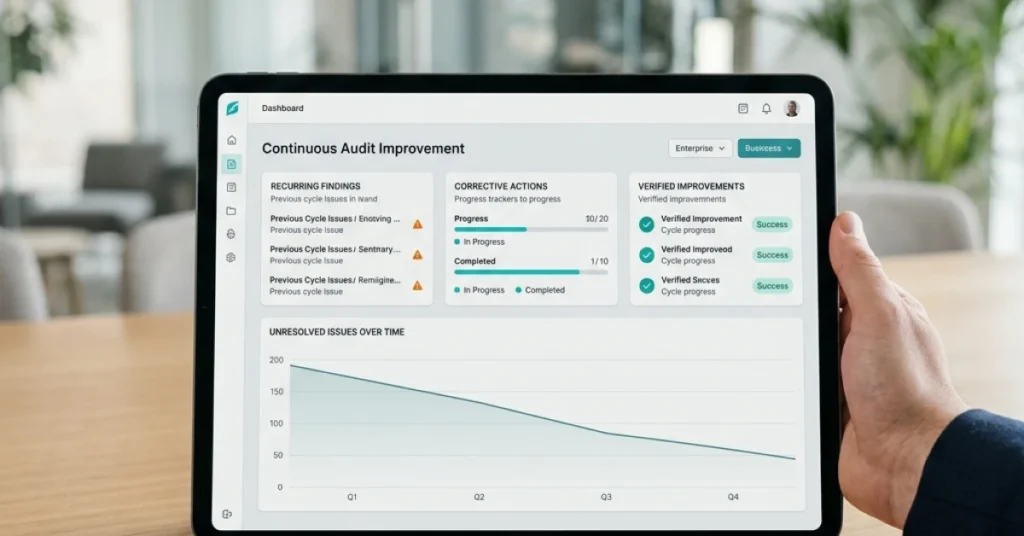
Four signals show whether your program is maturing or just running. Repeat finding rate tells you if the same issues keep coming back. Mean time to remediation shows how fast fixes happen after something gets flagged. Audit coverage drift reveals whether you’re missing the same blind spots every cycle. Predictive accuracy tells you whether your continuous auditing and monitoring flags match where real problems land.
Reviewing these four together, every quarter at minimum, gives you a learning signal instead of a compliance receipt. Pairing this review with insights from field audit productivity gains helps connect program health to real operational outcomes.
Skills Your Team Needs to Sustain Improvement
Internal audit automation handles data collection, but a human still has to read the pattern and decide what to change. Teams that sustain improvement build one specific habit: a short structured debrief after every audit cycle. That debrief focuses on what the process should do differently next time, not just on cataloging what the findings were.
This is where real-time audit assurance earns its value. Speed matters less than your ability to learn from what the speed reveals. That learning only happens when someone on the team owns the feedback loop as a standing responsibility, not something revisited once a quarter.
The hardest part isn’t building the measurement layer. It’s deciding, as an organization, that the loop itself is worth protecting.
Conclusion
That measurement gap is exactly what separates teams that grow from teams that just stay busy. Continuous audit improvement is not a technology project you hand off to IT. It’s a learning habit your whole organization builds, one feedback loop at a time.
Say your team reviews audit findings every Friday and flags any gap that appeared last month. That single weekly ritual does more for your program than adding three new auditors ever could.
The best organizations treat their continuous auditing and monitoring process as a living system, not a fixed checklist. They never let it run on a set schedule alone. Real-time audit assurance only pays off when someone actually reads the signals. Those signals must feed back into how the next audit runs. Build that loop first, then add tools to make it faster.
Most field teams lose weeks to repeated gaps because nothing forces a root-cause review before the next cycle starts. FieldPie automates audit scheduling and captures field data in real time, so your team spots patterns before they become recurring failures. FieldPie offers an AI-powered field operations platform built for businesses. It handles scheduling, routing, audits, sales, merchandising, and team tracking from one mobile-friendly tool.