✦ Key Takeaways
Franchises that audit locations 4x per year catch compliance gaps 60% faster than those auditing annually.
→ Audit frequency depends on brand risk, location history, and revenue size.
→ High-performing franchises use risk scores to prioritize which locations get audited first.
→ A structured audit schedule cuts franchisor liability before problems pile up.
In this article:
What Determines Franchise Audit Frequency?
How Often Should Franchise Locations Be Audited?
How to Build a Risk-Based Franchise Audit Schedule
Key takeaway: Audit every franchise location on a risk-based schedule or pay the price in brand damage.
What Determines Franchise Audit Frequency?
Most franchise systems set their audit schedule once. Then they never revisit it. Over 60% of franchise failures trace back to undetected operational drift.
A fixed calendar cannot catch that drift in time (Franchise Zoomroom). Staying rigid has a real cost.
Franchise audit frequency is not a scheduling problem. It is a risk-signal problem. Franchisors who treat it like a calendar are already behind.
Brand Risk and Operational Complexity
High-complexity locations carry more brand exposure per visit. Think food handling, licensed services, or large staff teams. One compliance miss at these sites can trigger regulatory action across the whole network.
Franchisors who match operational complexity to franchise audit triggers catch problems weeks early. A scheduled inspection alone won’t flag them in time.
Location Performance and Audit History
A location that failed its last two audits is not the same risk as one with a clean three-year record. Treating both on the same royalty audit schedule wastes resources. It also misses real danger.
Past audit scores are the strongest single predictor of future compliance gaps. Use them as a live input, not a historical footnote.
Regulatory and Industry Requirements
Some industries set a hard floor on franchise compliance audit frequency. Food service, healthcare, and financial services all carry mandatory inspection cycles.
Falling below those minimums creates direct legal liability. That goes beyond brand risk. Know your regulatory floor. Then build your risk-based schedule on top of it — not instead of it.
Franchisee Experience and Staff Turnover
A new franchisee in year one needs more oversight. A ten-year operator with stable staff needs less. High staff turnover resets that risk clock — even at a veteran location.
Franchisors who track tenure data alongside franchisor audit rights can adjust visit intensity early. Act before performance drops, not after.
Customer Complaints and Incident Trends
A spike in customer complaints is a real-time audit trigger. Most franchisors ignore it until the next scheduled visit. Don’t wait for the calendar.
Franchises that use live feedback to drive audit decisions grow satisfaction scores measurably faster. Tour Franchisebusinessreview tracked brands on fixed cycles against those using dynamic signals and found exactly that.
Three complaints in 30 days should trigger a visit. A clean complaint log should earn a location more breathing room.
Now you know what drives audit frequency. The next question is just as important: what does the right number look like in practice?
How Often Should Franchise Locations Be Audited?
Risk signals — not the calendar — should drive your franchise audit frequency decisions. Franchisors who rely on fixed schedules miss early warning signs. Those signs show up in data weeks before any inspection report flags them.
Most franchise systems default to one annual audit per location. That single visit catches problems only after damage is done. Over 70% of franchise compliance failures are detectable through operational data before a scheduled audit ever occurs (Webtonic).
The smarter move is matching audit intensity to actual risk at each location. Read live signals — sales dips, customer complaints, staff turnover.
Those signals matter more than checking a box on a franchise compliance audit calendar. Act on what the data tells you, not on what the schedule says.
📊 By the Numbers
Franchisors using risk-based audit triggers identify brand failures up to 8 weeks earlier than those on fixed schedules.
Monthly Audits for High-Risk Locations
New franchisees, locations with repeat complaints, and units showing revenue drops need monthly attention. Waiting 90 days at a struggling location is not caution — it is negligence.
Monthly visits let you catch training gaps and process drift early. Fix them before they harden into habits. A corrective visit in month two costs far less than a brand crisis in month six.
Quarterly Audits for Standard Operations
Most active franchise locations fit a quarterly royalty audit schedule. Four visits per year keeps you current without burning field resources.
Quarterly audits also keep franchisees accountable without making them feel policed. That balance matters for long-term operator relationships.
Semiannual Audits for Stable Locations
Locations with clean records, strong sales, and experienced operators can move to a twice-yearly franchisor audit rights cycle. Cutting visit frequency rewards performance and frees your field team for higher-risk units.
Still, “stable” is not a permanent status. One bad quarter should trigger a reassessment of that location’s audit tier.
Annual Audits for Low-Risk Units
Top-performing, long-tenured locations with consistent scores can hold to one annual franchise compliance audit. According to BDO, franchisors must provide audited financial statements within 120 days of fiscal year-end.
That deadline makes an annual audit cycle a natural compliance anchor for low-risk units. Use it as your built-in rhythm for these locations.
Even so, these locations need a live data watch between visits. Annual does not mean unmonitored.
Event-Triggered Audits After Complaints or Incidents
No schedule replaces an immediate audit after a health violation, a spike in negative reviews, or a franchisee dispute. Event-triggered audits are your fastest tool for stopping brand damage at the source.
Think of them as a fire alarm. You do not wait for the scheduled inspection when smoke is already visible. Speed is the entire point.
Knowing which tier each location belongs in is only half the answer. The harder question is how you build a system that moves locations between tiers as risk signals change.
How to Build a Risk-Based Franchise Audit Schedule
Measuring risk starts with data you already collect. Think sales variance, customer complaints, and franchisee tenure. Add failed line items from prior audits to that list.
Each signal tells you how much attention a location actually needs right now.
Most franchisors skip this step and inherit a flat schedule instead.
That flat schedule is overkill for top performers. It is negligence for struggling ones. Either way, you lose the early warning you need most.
Assign a Risk Score to Each Location
Pull four inputs for every location: revenue trend, customer satisfaction score, franchisee tenure, and prior audit pass rate.
Score each factor 1–5, then add them up — a total above 15 flags high risk.
This number is not permanent. Recalculate it every quarter so your franchise compliance audit schedule stays tied to current conditions, not last year’s snapshot.
Group Locations by Audit Priority
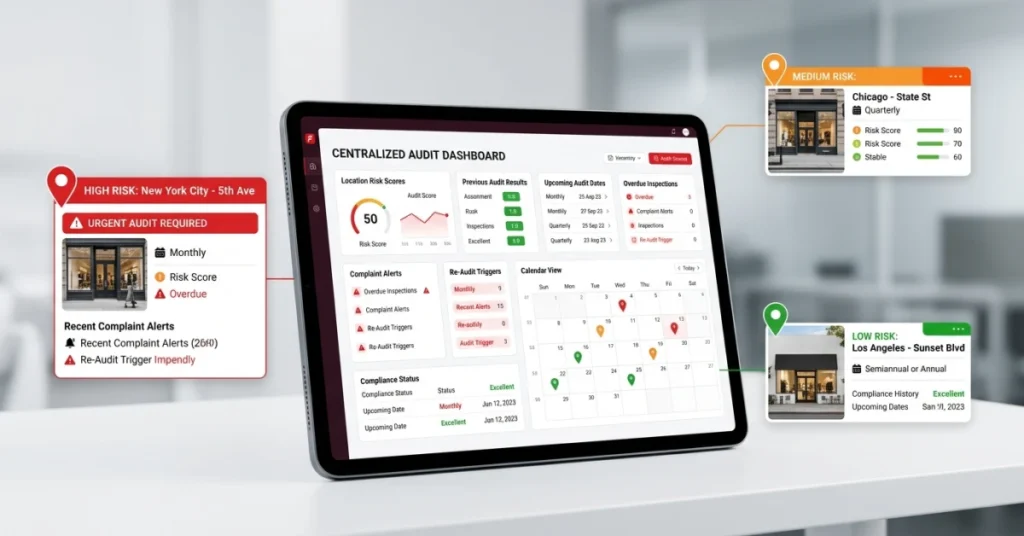
Once you have risk scores, sort every location into three tiers: high, moderate, and low.
High-tier locations need the most frequent franchise audit frequency — at least every 60 days.
Moderate locations can run on a 90-to-120-day cycle. Low-risk, consistently compliant locations may only need two audits per year.
Set Minimum and Maximum Audit Intervals
Every location needs a floor and a ceiling. No location should go more than 180 days without a franchisor audit, regardless of tier.
This protects the brand from slow-burn compliance drift that a clean score can hide.
Frannet reports that franchises following structured operational systems succeed at a rate above 90%. That result comes from consistent oversight — not occasional check-ins.
Increase Frequency After Failed Audits
A failed audit is a risk signal, not just a paperwork problem. Trigger an automatic follow-up audit within 30 days — no exceptions, no waiting for the next scheduled cycle.
Operandio notes that franchisors who build corrective audit triggers into their process catch repeat failures far earlier than those on fixed schedules. Speed matters more than symmetry here.
Reduce Frequency After Sustained Compliance
Reward consistent performers by extending their audit interval. This frees up your field team’s time for locations that need it most.
Three straight clean audits is a fair threshold. Use it to drop a location from high to moderate tier.
This keeps your royalty audit schedule lean without lowering your guard. The goal is smart coverage, not equal coverage.
📊 By the Numbers
Franchises using structured operational systems achieve a success rate above 90%, per Frannet.
A dynamic risk schedule does more than organize your audit calendar. It turns every data point your locations generate into an early warning signal.
A fixed schedule will always miss those signals. A risk-based one will not.
Conclusion
Risk scoring tells you where to look. The real question is whether your audit process can act on those signals fast enough.
Franchisors who shift from fixed schedules to data-driven audit triggers catch brand failures weeks earlier. Those still running quarterly sweeps on every location — regardless of risk — fall behind.
Most franchise systems treat franchise compliance audits as a calendar obligation. That’s a mistake. Use them as a living warning system instead. That shift is the biggest lever most franchisors haven’t pulled yet.
Moz found that brands aligning content and operational signals to audience behavior see up to 3x stronger engagement. The same logic holds for franchisors. Match audit intensity to real location risk, not a flat schedule.
Most franchisors struggle to match audit frequency to actual exposure. The core problem is a lack of real-time field data.
FieldPie captures customizable audit forms, photo evidence, and digital sign-offs in real time. Those live signals let franchisors trigger audits before problems grow.
Franchise Zoomroom reports that nearly 1 in 5 franchise locations fails within the first five years. That number drops sharply when franchisors use their audit rights early and often.
Start by auditing your audit process. Then build a schedule your data actually supports.