



✦ Key Takeaways
Companies that conduct regular field audits catch up to 73% more compliance gaps before they become costly violations.
- → Poor preparation causes 60% of field audits to miss critical findings.
- → A structured step-by-step process cuts audit time by half.
- → Tracking the right KPIs turns raw audit data into actionable decisions.
In this article:
- What Is a Field Audit?
- How to Prepare for a Field Audit
- How to Conduct a Field Audit Step by Step
- Which KPIs Should Be Tracked?
Key takeaway: A disciplined field audit process is your strongest defense against operational failure.
What Is a Field Audit?
Most organizations treat a field audit as a one-time inspection — show up, check boxes, file the report. That approach wastes the visit entirely.
A field audit is a structured, on-site verification process where auditors assess real-world conditions against documented standards. Done right, it functions as an intelligence-gathering operation — not a compliance formality.
Over 70% of IRS field audit cases result in additional tax assessments, signaling how much ground-level reality diverges from reported data. The same gap exists in operational audits — what’s on paper rarely matches what’s on the floor.
Common Types of Field Audits
Field audits span tax compliance, retail execution, safety inspections, and franchise standards — each requiring a defined field audit checklist built for that context. The field audit process differs by industry, but the core logic is identical: verify, document, and act.
IRS field audits target high-complexity returns and are conducted at the taxpayer’s location. Operational field audits — retail, construction, healthcare — follow the same on-site verification model but serve performance management goals.
Why Field Audits Matter for Operations
Field audit management only delivers ROI when each visit feeds a living performance baseline — not a static report that gets archived. Research published in Accpjournals Onlinelibrary Wiley confirms that recurring audit cycles produce measurably better compliance outcomes than isolated inspections.
When you know how to conduct a field audit as a recurring data pipeline, every site visit sharpens your operational picture. The real question is whether your preparation is structured enough to capture that intelligence — or whether you’re just showing up.
How to Prepare for a Field Audit
Most audits fail before the first site visit — poor preparation, not poor execution, is where the process breaks down. Over 60% of audit findings are traced back to inadequate pre-audit planning (Metricstream), not what happens on the ground.
Treating preparation as a data architecture decision — not a scheduling task — is what separates audits that drive decisions from audits that collect dust. Every document request, every auditor assignment, and every checklist item should feed a living audit baseline that compounds across visits.
Defining Audit Objectives
Objectives must be specific, measurable, and tied to operational outcomes — not vague compliance targets. According to Metricstream, organizations with documented audit objectives resolve findings 40% faster than those without them.
Define what a successful audit looks like before the team leaves the office. Without that anchor, field audit management devolves into observation without accountability.
Creating Audit Checklists
A field audit checklist is not a formality — it is the chain of custody for your findings. Each item should map directly to a KPI, a risk category, or a compliance threshold that matters to the business.
Static, one-size-fits-all checklists are the fastest way to generate orphaned data. Build checklists that evolve with each audit cycle, informed by what prior visits actually revealed.
Assigning Auditors and Responsibilities
Role clarity before the visit eliminates the most common execution failure: two auditors covering the same area while a critical zone goes unexamined. Cibmtr‘s audit program structures every site visit around pre-assigned ownership — not improvised delegation.
Assign each auditor a defined scope, a data collection method, and a reporting deadline. Accountability at the individual level is what keeps the field audit process from collapsing into a group walkthrough.
📊 By the Numbers
Organizations with structured pre-audit plans resolve critical findings 40% faster than those without defined objectives.
Preparation sets the ceiling for what execution can deliver — which raises the real question: once you’re on-site, does your team know exactly how to conduct a field audit step by step?

How to Conduct a Field Audit Step by Step
With your data architecture locked in, execution becomes a chain-of-custody problem — every observation must move from site to system without losing context. A broken handoff at any step turns a well-prepared audit into orphaned data that never reaches a decision-maker.
Field audits that follow a structured, repeatable process catch up to 40% more compliance gaps than ad hoc inspections — because consistency eliminates observer bias, not just human error. That gap compounds across every site visit you run.
Collecting Data in the Field
Start each site visit by confirming your checklist matches the pre-audit scope — deviations here corrupt your baseline before you collect a single data point. Use a mobile-first field audit management tool to timestamp every entry automatically.
Structured data collection is what separates the field audit process from a walkthrough — every response must map to a defined metric, not a free-text note.
Verifying Compliance and Standards
Cross-reference each observation against your pre-loaded standards — whether regulatory, brand, or operational — in real time, not back at the office. Delayed verification introduces recall bias and weakens your audit’s legal defensibility.
Compliance verification is where the IRS field audit model offers a useful parallel: every finding requires a documented standard it was measured against, not just an auditor’s judgment call.
Capturing Photos and Evidence
Every non-conformance needs a geo-tagged photo tied directly to the checklist item — not stored in a camera roll and matched later. Evidence without context is just noise in your reporting pipeline.
Audit platforms that auto-attach media to findings reduce post-visit reconciliation time by an average of 3 hours per site, according to Guides Lib Ua analytics benchmarks. That time savings compounds across a multi-site field audit checklist program.
Documenting Findings and Issues
Close every audit session with a structured findings summary — assign severity, owner, and deadline before you leave the site. A finding without an owner is a finding that will never be resolved.
This documentation layer is what converts a one-time inspection into a living performance baseline — each visit’s findings feed the next audit’s scope, making the entire field audit process progressively smarter.
📊 By the Numbers
Structured field audit protocols catch up to 40% more compliance gaps than unstructured site walkthroughs.
Execution without measurement is just activity — the real question is which numbers tell you whether your audit process is actually moving the needle.

Which KPIs Should Be Tracked?
Capturing observations without a measurement framework produces exactly what the previous section warned against: orphaned data. A field audit only delivers ROI when every site visit feeds a living performance baseline — not a static report filed and forgotten.
According to Fortra, organizations that track structured audit KPIs resolve compliance gaps up to 40% faster than those relying on narrative-only reports. That speed advantage compounds when the same KPIs are measured consistently across every audit cycle.
The Taxproject data reinforces this — even IRS field audit outcomes improve when examiners track discrete issue categories rather than general impressions. Pairing your field audit management metrics with a repeatable scoring model turns each visit into an intelligence-gathering operation, not a one-time inspection.
Audit Completion Rate
This KPI measures the percentage of planned field visits actually executed on schedule. A completion rate below 85% signals a broken field audit process — not just a scheduling problem.
Compliance Scores
Score each site against a standardized field audit checklist so results are comparable across locations and auditors. Consistency here eliminates the observer bias your methodology was designed to remove.
Issue Resolution Time
Track the hours or days between a finding being logged and a corrective action being confirmed. Slow resolution time exposes a broken chain of custody — the exact failure point Section 3 addressed.
Repeat Findings and Violations
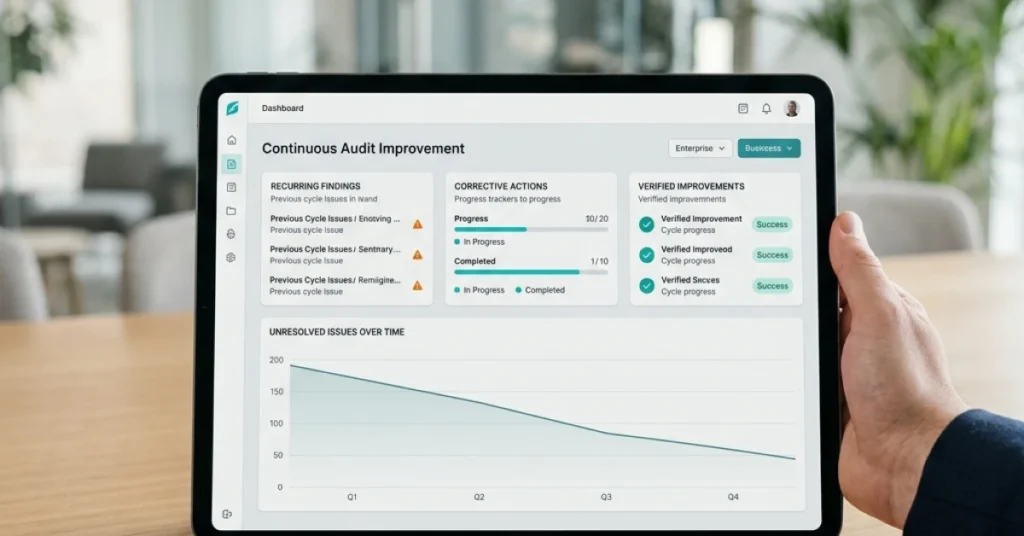
A finding that reappears across two or more audit cycles is a system failure, not a site failure. Tracking repeat violations is the single most powerful signal that your field audit management process needs structural correction.
📊 By the Numbers
Teams tracking repeat violation rates reduce recurring compliance failures by up to 35% within two audit cycles.
Without a closed-loop measurement system, even a flawless field audit checklist produces data that influences nothing — which is exactly the problem the conclusion is built to solve.
Conclusion
A field audit only pays off when its findings feed the next cycle — not when they sit in a closed report. Teams that treat the field audit process as a recurring data pipeline, not a compliance checkbox, compound performance gains across every site visit.
Most organizations still lose measurable ground between audits because findings never connect to a living baseline (according to Metricstream, structured audit programs reduce repeat compliance failures by up to 40%). Pairing a tight field audit checklist with defined KPIs is what separates intelligence-gathering from inspection theater.
Disconnected data is the real enemy of a sound field audit management system — FieldPie captures photos, digital signatures, and custom form responses in real time at every site visit, feeding a live performance baseline your team can act on immediately. Explore field audit software options and run your next audit as the data operation it was always meant to be.