


✦ Key Takeaways
Companies using advanced planning and scheduling cut operational costs by up to 20% while boosting on-time delivery rates significantly.
→ Poor scheduling wastes 30% of technician capacity daily.
→ APS matches skills, parts, and location for every job.
→ Real-time adjustments prevent costly delays before they escalate.
In this article:
What Is Advanced Planning and Scheduling?
What Does an Advanced Planning and Scheduling Process Include?
How Do You Match the Right Technician to Each Job?
Conclusion
Key takeaway: The right APS system transforms chaotic dispatching into a precise, profit-driving operation.
What Is Advanced Planning and Scheduling?
Most field operations don’t fail because people stop caring. They fail because the wrong person shows up to the wrong job at the wrong time.
Advanced Planning and Scheduling (APS) is the discipline that fixes exactly that problem.
The APS software market is valued at over $1.2 billion and grows every year. Teams at scale simply can’t survive on spreadsheets and gut instinct (Custommarketinsights).
But here’s what most definitions miss: APS isn’t really a software category. It’s a people-matching discipline. No tool delivers results until you align human capability with task demand.
How Advanced Scheduling Differs From Basic Scheduling
Basic scheduling fills time slots. Advanced Planning and Scheduling matches the right skills, certifications, and availability to each specific job — before the day starts.
A calendar tells you someone is available. APS tells you whether that person is actually qualified to do the work safely and efficiently.
Why Scheduling Becomes More Complex as Field Operations Scale
At five technicians, a manager can track everything in their head. At fifty, that mental model collapses — fast.
According to Dataintelo, demand for APS systems is rising. Growing teams create scheduling conflicts that manual methods can’t catch in time.
What Factors Should Be Considered When Building a Schedule?
A strong schedule accounts for more than open hours. It weighs skill level, travel time, equipment access, certifications, and job priority — all at once.
Miss any one of those factors and the job fails. You also get a frustrated customer and a wasted day.
When Should Field Teams Use Advanced Planning and Scheduling?
If your team regularly scrambles to cover last-minute gaps, APS isn’t a luxury — it’s overdue. The same logic applies to risk-based audit scheduling. There, sending the wrong person doesn’t just waste hours — it causes compliance failures.
Production planning and scheduling works for any operation where task complexity outpaces human memory. That’s most teams past a certain size.
You do need a structured process. The real question is what that process contains. Most teams are only using half of it.

What Does an Advanced Planning and Scheduling Process Include?
Teams that hit deadlines share one thing: a clear structure behind their people strategy. Advanced Planning and Scheduling breaks down into specific, repeatable steps. Any operation can follow them, regardless of size.
Companies using APS systems report up to 40% fewer scheduling conflicts and faster response to last-minute changes (Theaccessgroup). That number only holds when every step is followed — not just the easy ones.
Forecast Demand and Workload
Before anyone opens a calendar, the team needs to know how much work is coming. Good production planning and scheduling starts with a realistic look at demand — not a gut feeling.
Pull data from past job history, seasonal trends, and current pipelines. A wrong forecast here ripples through every step that follows.
Identify Available Technicians and Field Workers
Availability is not the same as presence. A technician on-site but finishing another job is not free for a new one.
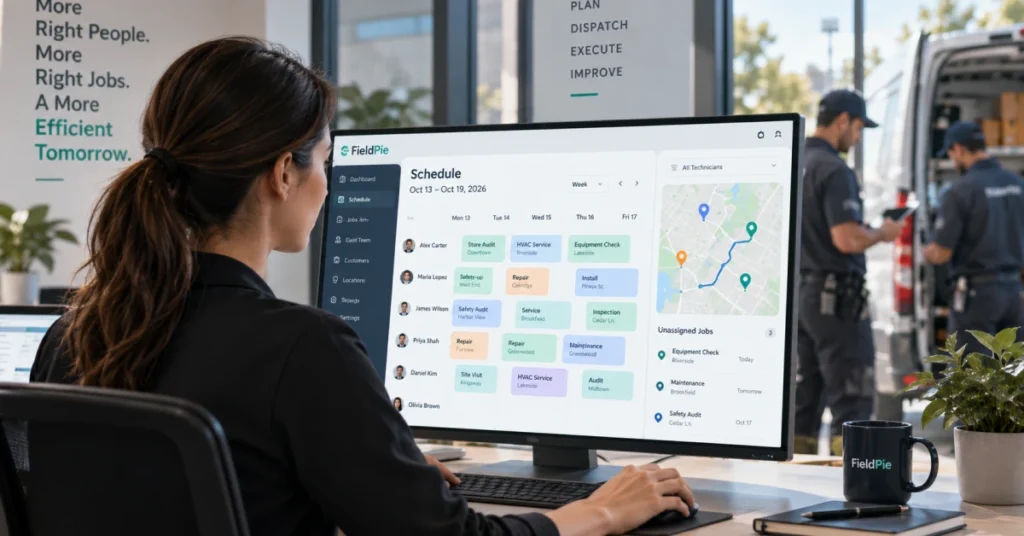
APS software tracks real-time status — who is active, who is wrapping up, and who is genuinely free. That visibility alone stops the most common double-booking mistakes.
Match Skills and Qualifications to Jobs
This is where most basic scheduling tools silently fail. Putting a person in a time slot is easy. Confirming that person holds the right certification for that specific job is harder.
Manufacturing scheduling done right treats skill matching as a hard rule, not a preference. Send the wrong tech and the job either stalls or gets redone.
Consider Location, Travel Time, and Service Areas
Distance is a hidden cost that kills schedule efficiency fast. A technician who is “available” but 90 minutes away may cost more than waiting for a closer one.
Strong audit scheduling strategies treat travel time as a real variable — not an afterthought. APS systems map proximity alongside availability to find the smartest dispatch.
Allocate Capacity Across Jobs and Locations
Capacity allocation means spreading work so no single team is buried while another sits idle. This balance keeps output steady across the whole operation.
Research published on Researchgate shows that structured capacity planning cuts idle time by a significant margin. Work gets spread by data — not by whoever speaks loudest.
Build and Publish the Schedule
Once demand, availability, skills, and capacity are confirmed, the schedule gets built and shared. Every worker needs to see their assignments clearly. No confusion, no chasing down details.
Good APS software pushes schedules directly to mobile devices. Workers know where to be, when, and why — before the day starts.
Monitor Execution and Adjust Assignments
A schedule is a plan — reality will test it. Jobs run long, workers call out, and priorities shift without warning.
The final step in any solid Advanced Planning and Scheduling process is live monitoring with fast reassignment. Teams that adjust in minutes beat teams that wait for a morning debrief.
📊 By the Numbers
Operations using APS systems report up to 40% fewer scheduling conflicts compared to manual planning methods.
These steps give you a working schedule. The real test is whether the right person — not just the nearest one — is matched to each job.
Conclusion
Most operations don’t fail because they lack software. They fail because no one has matched the right person, skill, and job to the right day.
That gap is exactly what Advanced Planning and Scheduling is built to close, one matched task at a time.
The APS market will exceed $3.5 billion by 2030 (Custommarketinsights). But tools alone won’t help until your team treats scheduling as a people-matching discipline first.
Start by auditing your current job assignments. You’ll likely find skill mismatches hiding in plain sight, costing you time and money every week.
Most field teams that struggle with scheduling are really struggling with visibility. They can’t see who’s qualified, available, and closest to the right job — all at once.
FieldPie surfaces exactly that data in real time. It connects job needs to individual team member skills so dispatchers stop guessing and start assigning with confidence.
Explore field sales capacity planning to see how smarter resource alignment drives real results. Then take that first step toward scheduling that actually works.