



✦ Key Takeaways
Retailers who share real-time data with suppliers cut out-of-stock rates by up to 30%. Most still work in silos.
→ Poor supplier visibility costs retailers billions in lost sales every year.
→ Shared forecast data cuts overstock and markdowns sharply.
→ A clear collaboration workflow turns suppliers into real growth partners.
In this article:
What Is Retail Supplier Collaboration?
What Data Should Retailers and Suppliers Share?
How to Build a Retail Supplier Collaboration Workflow
Key takeaway: Retailers that treat suppliers as data partners — not vendors — win on shelves consistently.
What Is Retail Supplier Collaboration?
Most retailers treat suppliers like vending machines. Place an order, receive the goods, repeat. That habit quietly costs the industry billions every year.
Retail supplier collaboration means both sides actively share information, plans, and feedback. It is a relationship choice — not a software feature.
What Supplier Collaboration Means in Retail
Retailers who share sales forecasts with suppliers cut stockouts by up to 30% (Phocassoftware). That gain comes from the conversation itself — not from buying new software.
Collaborative planning, forecasting, and replenishment — often called CPFR — is one formal version of this idea. Both sides agree on what they expect to sell before the product ships.
Which Teams and Partners Are Involved
A retailer-supplier partnership typically pulls in buyers, category managers, and demand planners. The supplier’s sales and logistics teams join too. Each group holds a piece of the puzzle the other side needs.
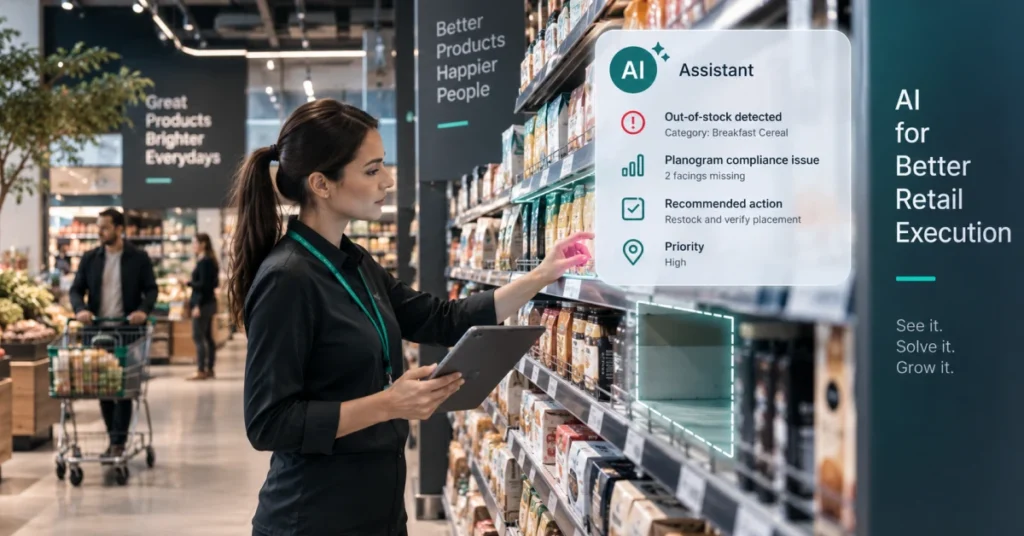
Strong retail execution tools surface shelf-level data that suppliers rarely see on their own. That visibility alone changes how both sides plan.
Supplier Collaboration vs. Basic Data Sharing
Sending a weekly sell-through report is data sharing. Supplier collaboration means both sides use that data to make a joint decision — then act on it together.
Grocery Dive reports that retailer-supplier collaboration has improved in recent years. But most partnerships still stop at the report. They never reach a shared decision.
The first step is not deciding whether to collaborate. It is knowing which data to put on the table first.
What Data Should Retailers and Suppliers Share?
That choice — to treat suppliers as partners — only pays off when both sides share the right information.
Most retailers and suppliers already hold the data each other needs. They just never hand it over.
Retail supplier collaboration fails not because the data doesn’t exist, but because no one agreed on what to exchange.
Fix that agreement, and you gain a structural edge most competitors never bother to build.
Sales and POS Data
Point-of-sale data shows suppliers exactly what sold, where, and when — in real time. Without it, suppliers guess at demand and ship the wrong quantities.
Sharing weekly POS data cuts forecast error by up to 40%. That means fewer stockouts and less wasted inventory on both sides.
Inventory and Availability Data
Retailers need to know what stock a supplier can ship before committing to a promotion or reorder. Suppliers need to see retailer warehouse levels before planning a production run.
This two-way visibility is the core of any real retailer-supplier partnership. It costs nothing to share a weekly inventory file.
Forecasts and Replenishment Plans
Collaborative planning forecasting and replenishment — often called CPFR — is a formal method where both sides build one shared demand plan. The core idea is simple: share your sales forecast with your supplier before you place the order.
Suppliers who receive advance forecasts can pre-position stock and cut lead times. That speed shows up directly on your shelves.
Promotion and Campaign Data
A supplier who learns about a big promotion the week it launches can’t help you. Share the plan 6–8 weeks out, and they can build the buffer stock you’ll need.
Promotion surprises are a top cause of out-of-stocks. Pmc Ncbi Nlm Nih ties this problem directly to poor upstream communication between retailers and their supply partners.
Store Execution and Merchandising Data
Suppliers care deeply about how their products are displayed in-store. Placement, facing count, and planogram compliance all affect sales.
Sharing shared merchandising execution data gives suppliers proof of what’s happening at shelf level. When they spot gaps, they can send field reps, adjust packaging, or flag underperforming stores.
Returns, Waste, and Out-of-Stock Data
Returns and waste data tells suppliers where their product is failing — wrong size, poor shelf life, or bad regional fit. Out-of-stock data tells them where demand outpaced supply.
Dataintelo reports that the supplier collaboration networks market is growing fast. Retailers are recognizing that shared returns and gap data is worth real money.
Retailers who close that loop gain a smarter, more responsive supply chain. No new software required.
📊 By the Numbers
Sharing POS data with suppliers can reduce forecast error by up to 40%, cutting stockouts and excess inventory simultaneously.
Knowing what to share is only half the battle. The real edge comes from building a repeatable process that makes sharing automatic, not accidental.
Conclusion
Most retailers treat supplier relationships as transactional. That single habit costs them more than any software ever could.
The fix is not a new platform. Have one honest conversation. Find out what data each side holds and when to share it.
Strong retail supplier collaboration starts with a shared agreement, not a shared dashboard. Phocassoftware shows that retailers who set up formal data-sharing routines with suppliers get faster replenishment cycles. They also see fewer out-of-stock events. Both outcomes protect margin directly.
Poor field execution can break even the best retailer-supplier partnership. FieldPie captures real-time shelf data, photo evidence, and order updates straight from the field.
Teams that act on live data close execution gaps fast. That keeps retail space planning decisions rooted in what is actually on the floor.
Start your first supplier data-sharing conversation this week. Then explore how FieldPie’s field reporting tools turn that agreement into measurable results.