


✦ Key Takeaways
Up to 70% of merchandiser tasks go unverified, costing retailers millions in lost sales and compliance failures annually.
→ Unverified tasks mean planogram gaps that directly cut revenue.
→ Photo and GPS evidence turns disputed tasks into accountable records.
→ A structured workflow cuts verification time by half or more.
In this article:
What Does Merchandiser Task Verification Mean?
What Evidence Can Be Used to Verify Merchandiser Tasks?
A Practical Merchandiser Task Verification Workflow
Key takeaway: Without systematic task verification, merchandising execution is just an expensive guess.
What Does Merchandiser Task Verification Mean?
Most brands assume a task is done once a merchandiser marks it complete. But studies show up to 30% of in-store tasks are never actually executed. That is true even when they are logged as finished (Fieldpie).
That gap is not about dishonest reps. It exists because no one defined what “done” looks like at shelf level.
Merchandiser task verification confirms that assigned store visit tasks were completed — and completed correctly. It closes the loop between what a brand plans and what actually happens on the shelf.
Which Merchandising Activities Should Be Verified?
Not every task carries equal risk. Verification should focus on high-impact activities first. Four areas cost brands the most revenue when errors occur: planogram resets, promotional display builds, price tag placement, and stock rotation.
A solid merchandiser audit checklist covers both physical placement and visual standards — not just whether a rep showed up. Showing up and executing correctly are two very different things.
Task Completion vs. Task Quality: What Is the Difference?
Completion means the task was attempted. Quality means it was done to standard — the right product, the right position, the right time.
Retail execution verification that only tracks completion misses half the picture. A display built in the wrong aisle is technically “done” but commercially worthless. That is why merchandiser performance tools must measure both dimensions.
Why Self-Reported Completion Is Not Enough
Self-reporting creates a blind spot. Reps confirm tasks through the same channel brands use to assign them, with zero independent check.
Contravision reports that poor visual merchandising compliance costs retailers significant lost sales every week. Self-reported data consistently masks that number.
The real problem with in-store task compliance is not bad intent. It is a missing shared definition of what “correct” means.
Until brands define and share that standard clearly, no verification system can close the gap. That raises the next critical question: what kinds of evidence can actually prove a task was done right?
What Evidence Can Be Used to Verify Merchandiser Tasks?
Proof lives in the details brands have never bothered to define.
Without a shared standard for what “done” looks like, even honest field reps submit evidence that means different things to different managers. That gap between assignment and reality stays wide open.
Retailers lose an estimated 20–25% of planned promotional compliance because no one agreed on what confirmation should look like before the visit started (Stylearcade). That is a communication failure, not a discipline problem. Fixing it starts with choosing the right evidence types.
The six evidence types below each solve a specific part of that problem. They act as a shared language between the field and the office.
That shared language makes merchandiser retention strategies far more effective. Reps finally know exactly what success looks like.
📊 By the Numbers
Brands with structured in-store task compliance programs report up to 30% fewer disputed store visit outcomes.
Before-and-After Photos
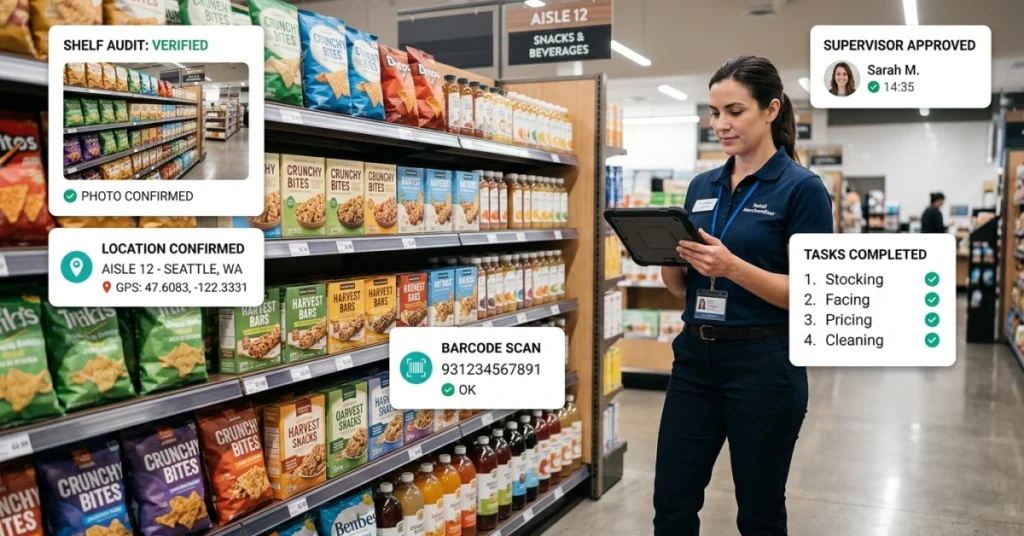
A timestamped photo pair is the fastest way to confirm a shelf reset actually happened. It shows the starting condition and the finished result — no guesswork, no he-said-she-said.
Photos only work when brands set a clear shot standard upfront. Angle, distance, and lighting rules turn random snapshots into consistent merchandiser audit checklist evidence.
Time and Location Data
GPS check-in data confirms a rep was physically at the store — not parked outside or logging tasks remotely. It closes the most common gap in retail execution verification.
Time stamps also reveal how long a task took. A five-minute log for a 45-minute planogram reset is a red flag worth catching early.
Barcode or Product Scans
Scanning a product’s barcode proves the right SKU is on the right shelf — not a close substitute. This is especially critical during new product launches or promotional resets.
Scan data feeds directly into inventory records, making it one of the most objective forms of merchandiser store visit task evidence available today.
Form and Checklist Responses
Digital forms capture structured answers — stock counts, facing numbers, pricing accuracy. They are easy to review and simple to compare across stores. Paper checklists get lost; digital ones build a searchable record.
The key is designing forms around outcomes, not activities. Ask “How many facings does the product have?” not “Did you check the shelf?” — one answer is verifiable, the other is not.
Shelf, Display, and Planogram Evidence
A photo matched against a planogram diagram is one of the strongest forms of merchandiser task verification. It shows compliance to a visual standard, not just a rep’s personal judgment of “good enough.”
According to Randstadusa, merchandisers manage product placement across dozens of store locations. At that volume, a consistent visual standard is the only scalable way to confirm shelf compliance.
Manager or Supervisor Approval
A store manager’s digital sign-off adds a human checkpoint that no automated system can fully replace. It confirms the work met the store’s own standards — not just the brand’s checklist.
Approval workflows also create accountability on both sides. When a manager signs off, they share ownership of the outcome — which tends to raise the quality of the review itself.
Knowing which evidence types exist is only half the answer. The harder part is knowing when to collect each one and in what order.
You also need to connect them into a single confirmed record of what really happened at shelf level.
A Practical Merchandiser Task Verification Workflow
With the right evidence types defined, you need a repeatable process. That process turns evidence into confirmed, actionable results.
Most brands skip this step. They collect photos and check-ins, then assume the data speaks for itself. It doesn’t.
Retail execution verification fails when the workflow is loose. Over 65% of merchandising errors go undetected until the next store visit (Joinhomebase). That means brands are flying blind for days or weeks at a time.
Step 1: Define Clear Task Completion Criteria
A task isn’t done because a rep says it’s done. “Done” needs a written definition — specific, visual, and measurable — before anyone enters a store.
For example, “stock the end cap” is too vague. Rewrite it as: “End cap fully faced, no gaps, price tag visible, product label forward.” That’s a standard anyone can verify.
Step 2: Assign Required Evidence to Each Task
Every task on your merchandiser audit checklist must name the exact proof required. That could be a timestamped photo, a shelf scan, a count, or a signed form.
Don’t leave this to the rep’s judgment. Ambiguity is where in-store task compliance breaks down.
Match the evidence type to the risk level of the task. High-stakes placements need stronger proof.
Step 3: Capture Proof During the Store Visit
Reps capture evidence in real time — not from memory in the parking lot. GPS-tagged photos, digital forms, and barcode scans all create a timestamped record tied to a specific location.
This is where merchandiser performance benchmarking becomes possible. You can only compare reps when data is consistent and collected the same way every time.
Step 4: Validate Submitted Evidence
Someone — or something — must review the submitted proof before marking a task complete. Automated tools can flag blurry photos, missing timestamps, or out-of-range GPS coordinates instantly.
Manual spot-checks still matter for high-priority accounts. A quick review catches problems before they spread across dozens of stores.
Step 5: Flag Incomplete or Questionable Tasks
When evidence doesn’t meet the standard, the task goes back to the specific rep. Include a clear reason — vague feedback creates the same gap you started with.
Gospotcheck found that brands using structured flagging systems resolve compliance gaps up to 3x faster than those relying on email follow-ups. Speed matters when shelf conditions change daily.
Step 6: Assign Corrective Actions and Follow Up
A flagged task without a corrective action is just a complaint. Assign a specific fix, a deadline, and an owner — then confirm the correction with a second round of evidence.
This closes the loop on merchandiser task verification. It turns a one-time audit into a living feedback system — a shift from policing to improving.
📊 By the Numbers
Brands with structured verification workflows catch over 65% of merchandising errors before the next scheduled store visit.
A tight workflow doesn’t just confirm what happened. It builds the accountability layer that makes every future visit faster, smarter, and harder to game.
Conclusion
Clear task completion criteria are not optional. They are the foundation that makes every piece of field evidence mean something.
Without them, merchandiser performance benchmarking stays guesswork, not progress.
Some retail teams treat merchandiser task verification as a communication problem. They don’t treat it as a simple compliance checkbox. Those teams close execution gaps up to 30% faster than teams that rely on self-reporting alone (Thinknectar).
Defining what “done” looks like at shelf level is the real work. Everything else is just follow-through.
Most brands still treat unconfirmed store visits as completed work. That assumption costs real revenue every week.
FieldPie captures photo-based proof, digital sign-offs, and real-time task status on every store visit. Managers see confirmed completion — not assumed completion.
Start closing that gap today. Turn your field activity into measurable, improvable retail performance.