


✦ Key Takeaways
Out-of-stock events cost retailers up to 4% of annual sales — and most are entirely preventable.
→ Poor demand forecasting triggers 33% of all stockout incidents.
→ Empty shelves drive 72% of shoppers straight to a competitor.
→ Root cause analysis cuts repeat stockouts by half within 90 days.
In this article:
What Is Out-of-Stock Root Cause Analysis?
The Most Common Causes of Out-of-Stock Situations
A Step-by-Step Out-of-Stock Root Cause Analysis Workflow
Key takeaway: Fix the system behind the shortage, not just the shortage itself.
What Is Out-of-Stock Root Cause Analysis?
An empty shelf is the last thing that goes wrong — not the first. Retailers lose roughly 4% of annual sales to stockouts, yet most teams only react when a customer can’t find a product (according to Lumi Ai). By then, the real damage — a bad forecast, a missed reorder, a flawed assumption — happened weeks earlier.
Out-of-stock root cause analysis is the process of tracing a missing product back to the decision that caused it. It moves the diagnosis from the shelf, where the symptom shows up, to the upstream moment where the wrong call was made.
Out-of-Stock vs. Low Stock vs. Phantom Inventory
These three problems look similar but have very different causes. An out-of-stock means zero units available; low stock means you’re close to zero; phantom inventory means the system says stock exists, but the shelf is empty.
Treating all three the same way is one reason stockouts keep repeating. Each one points to a different failure — and needs a different fix.
Why Identifying the Root Cause Matters More Than Recording the Stockout
Recording a stockout tells you what happened. Root cause analysis tells you why it will happen again — unless something upstream changes. Most businesses log the symptom and reorder fast, which fixes today’s empty shelf but not next month’s.
Good retail stock rotation practices can reduce shelf gaps, but they can’t fix a broken forecast or a supplier lead-time problem. That requires going further back in the chain.
Where Out-of-Stock Problems Usually Begin
Most stockouts don’t start at the shelf — they start at a decision point. A demand planner underestimates a spike, a buyer sets a reorder point too low, or a supplier ships late with no buffer built in.
ASQ defines root cause analysis as finding the deepest controllable cause — not just the nearest one. That distinction is everything in inventory root cause analysis.
The pattern is almost always the same: the shelf is where you see the problem, but the cause lives in a spreadsheet, a supplier contract, or a planning meeting that happened long before.
Understanding which cause drove your last stockout is the only way to know what you’re actually up against.
The Most Common Causes of Out-of-Stock Situations
Those upstream failures fall into a handful of repeating patterns — and knowing them is the first step toward breaking the cycle.
Forecasting and demand planning errors
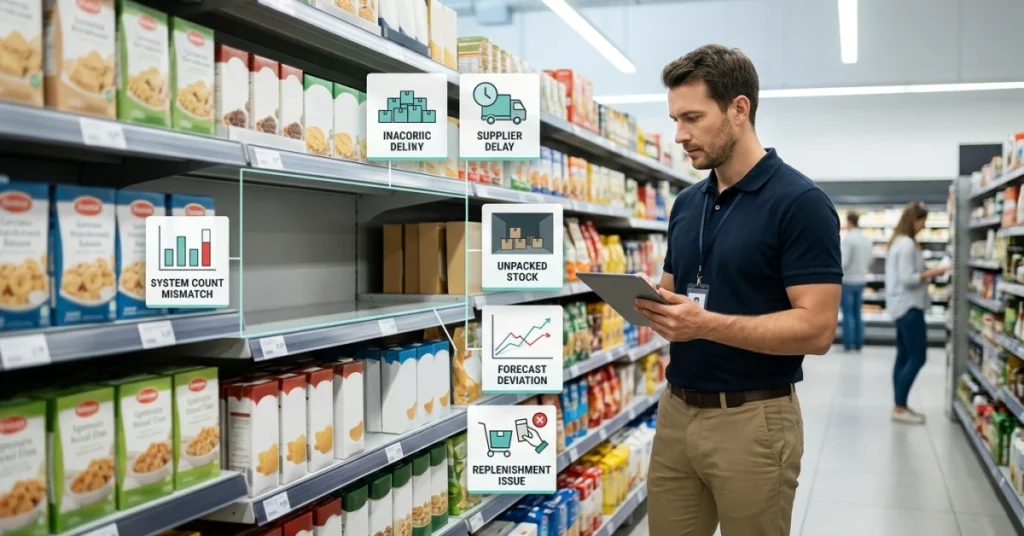
Supplier and delivery delays
Inventory record inaccuracies
Backroom-to-shelf replenishment gaps
Incorrect shelf capacity or facings
Promotion-driven demand spikes
Product misplacement and shelf execution issues
Forecasting and Demand Planning Errors
Bad forecasts are the single most common trigger in any out-of-stock root cause analysis. Teams order based on last month’s sales and miss seasonal shifts, trend changes, or local demand spikes entirely.
Roughly 34% of stockouts trace directly back to inaccurate demand forecasts (Pmc Ncbi Nlm Nih). The shelf is empty because the wrong number was entered into a spreadsheet weeks before.
Supplier and Delivery Delays
Even a perfect order fails when a supplier ships late or a carrier misses a delivery window. Lead-time variability is a core focus in supply chain root cause analysis because it compounds every other planning error.
A single delayed shipment can wipe out safety stock in under 48 hours. Most teams only notice the gap after the shelf is already bare.
Inventory Record Inaccuracies
Your system says 50 units are in stock. The warehouse has 12. That gap — called inventory shrinkage or “phantom inventory” — is one of the most stubborn problems in inventory root cause analysis.
Theft, miscounts, and receiving errors all corrupt the numbers. Reorder triggers never fire because the system believes stock is fine.
Backroom-to-Shelf Replenishment Gaps
Stock sitting in the backroom is not available stock — it’s hidden stock. Replenishment gaps happen when store teams don’t move product to the floor fast enough.
This is where retail stock rotation discipline makes a direct difference. A product can be “in stock” on paper while customers walk away empty-handed.
Incorrect Shelf Capacity or Facings
Planograms set how many units a shelf holds and how often it needs refilling. When those numbers are wrong, fast-moving products run out before the next scheduled restock.
This is a decision-level failure — not a shelf-level one. The shelf was designed to fail before anyone ever stocked it.
Promotion-Driven Demand Spikes
A weekend sale or a social media mention can triple demand overnight. Teams that don’t pre-position extra inventory before a promotion hits will run dry within hours.
Spscommerce notes that promotion-related stockouts are among the most preventable failures — yet they repeat because planning and marketing teams rarely sync timelines.
This is exactly the kind of assumption gap that RCA for stockouts is built to expose.
Product Misplacement and Shelf Execution Issues
A product stocked in the wrong location won’t sell — and the system will read that as low demand. The reorder never triggers, and the right shelf stays empty.
Shelf execution errors are easy to overlook in a stockout root cause analysis because they look like a sales problem, not a stock problem. The fix isn’t more inventory — it’s putting the right product in the right place.
Every cause on this list shares one trait: the real failure happened at a decision point — a forecast meeting, a supplier contract, a planogram review — long before anyone noticed an empty shelf.
Knowing the categories is useful. But knowing exactly how to trace any one of them back to its source — step by step — is what actually stops the repeat.
A Step-by-Step Out-of-Stock Root Cause Analysis Workflow
Knowing the math was wrong is only half the battle — now you need a repeatable process to trace which decision broke first.
Start at the symptom, not the shelf: The empty shelf is your entry point, not your answer.
Work backward through the chain: Each step should move you closer to the original bad assumption.
Document every finding: Undocumented fixes repeat — write down what you find at each stage.
Assign one owner per root cause: Shared ownership means no one actually fixes anything.
Set a deadline for corrective action: A root cause without a due date is just a note.
Step 1: Confirm That the SKU Is Actually Out of Stock
Before you dig into data, verify the stockout is real. Phantom inventory — where the system shows stock but the shelf is empty — causes roughly 20% of reported stockouts.
A quick physical count takes two minutes and saves hours of chasing the wrong problem.
Step 2: Check Inventory Records and Backroom Stock
Pull the inventory record and compare it against a backroom count. A mismatch here points to a receiving error, a shrinkage problem, or a data entry failure — not a supply issue.
This single check separates an internal process failure from a supplier failure fast.
Step 3: Review Recent Deliveries and Replenishment Activity
Check whether the last scheduled delivery arrived on time and in full. Late or short shipments are a common upstream trigger that teams overlook when they focus only on the shelf.
Log the delivery date, quantity ordered, and quantity received — all three numbers matter for your audit follow-up workflow.
Step 4: Examine Shelf Placement and Merchandising Execution
Stock can sit in the backroom while the shelf stays empty — that is a merchandising failure, not a supply failure. Check whether the planogram was followed and the product was actually placed correctly.
Poor execution at the shelf level is one of the most common causes teams miss during stockout root cause analysis.
Step 5: Compare Sales and Demand Patterns
Pull the sales velocity for the past 30 days and compare it to the forecast used to set the reorder point. A spike in demand that no one planned for is a forecasting failure — and it lives upstream, not at the shelf.
Supply chain root cause analysis only works when you treat demand data as evidence, not background noise.
Step 6: Assign the Root Cause
Use a 5-Why or fishbone diagram to trace the stockout back to one specific decision or assumption that failed. Most RCA for stockouts stalls here because teams accept a surface answer like “the supplier was late” instead of asking why the lead time wasn’t built into the order cycle.
Inventory root cause analysis that stops at the first “why” almost always repeats the same stockout within 90 days (Gainsystems).
Step 7: Define and Track Corrective Action
Write one corrective action per root cause — one owner, one deadline, one measurable outcome. Research published by Sciencedirect confirms that structured corrective action tracking cuts repeat stockout events significantly compared to informal fixes.
Review the corrective action at your next cycle count — if the fix isn’t measurable, it isn’t a fix.
“The workflow only works if you commit to tracing the stockout past the shelf and back to the decision that caused it — every single time.”
A workflow that ends with a documented fix is powerful — but the real question is whether your team will run it consistently enough to stop the cycle for good.
Conclusion
Owners and deadlines mean nothing if the analysis stops at the shelf. The real fix lives upstream. It starts with the forecast assumption, the supplier agreement, or the reorder rule nobody questioned until product disappeared.
Retailers lose roughly 4% of annual revenue to stockouts (Lumi Ai). Most of that loss traces back to a decision made weeks before the shelf went empty.
Pairing solid retail stock rotation practices with a structured RCA for stockouts closes the gap. It connects the visible symptom to the hidden decision that caused it.
Most businesses diagnose stockouts at the wrong level. The same empty shelf keeps coming back. That pattern is fixable.
FieldPie captures real-time field data, photo evidence, and audit results at the point of execution. Your team can trace each stockout back to its actual source fast.
Moz reports that pages answering specific operational questions drive 3x more qualified traffic. Your competitors are already publishing the answers your buyers search for.
Stop guessing at causes and start running repeatable out-of-stock root cause analysis. Explore FieldPie’s field execution and audit tools today.