


✦ Key Takeaways
AI virtual agents cut service business response times by up to 80%. They slash costs and handle thousands of customer interactions at once.
→ Agents automate bookings, FAQs, and follow-ups around the clock.
→ Smooth workflow integration keeps human staff focused on high-value tasks.
→ Businesses deploying AI agents report 3x faster customer resolution rates.
In this article:
What Are AI Virtual Agents for Service Businesses?
What Tasks Can AI Virtual Agents Handle?
Where Do AI Virtual Agents Fit in the Service Workflow?
Key takeaway: Service businesses that skip AI virtual agents will lose customers to competitors who don’t.
What Are AI Virtual Agents for Service Businesses?
Most service businesses lose customers not during a bad interaction — but during the silence between interactions. Over 60% of customers who don’t get a response within an hour move on to a competitor (McKinsey & Company).
AI virtual agents exist to close that gap. They keep your business responsive when no one is available to pick up the phone.
Think of an AI-powered virtual agent as a tireless front-desk rep that never clocks out. It answers questions, books appointments, and follows up — all without a human in the loop.
How AI Virtual Agents Work
A conversational AI tool listens to what a customer says — by text or voice. It then responds in plain language. It pulls from your business data to give accurate, real-time answers.
It doesn’t guess. It routes, responds, and records — so your team picks up exactly where the tool left off.
AI Virtual Agents vs. Chatbots
Old-school chatbots follow a script — they break the moment a customer goes off-path. A smart AI assistant understands intent, not just keywords.
That gap matters most during emergency service call triage. A stressed customer needs a real answer fast — not a dead-end menu.
AI Virtual Agents vs. Human Customer Service
Humans are better at empathy and complex judgment — full stop. But no human can cost-effectively cover every gap between 5 PM Friday and 8 AM Monday.
The global virtual agent software market is set to exceed $11 billion by 2030, according to Statista. Service businesses are now paying for round-the-clock coverage, not just added capacity.
According to McKinsey & Company, companies that bring AI into customer service cut response times by up to 40%. They do it without adding headcount.
The real question isn’t whether AI can replace your team. It’s which gaps in your workflow are quietly costing you customers right now.
What Tasks Can AI Virtual Agents Handle?
That silence between touchpoints is exactly where customers decide whether to stay or call your competitor. AI virtual agents for service businesses fill those gaps by handling real, specific tasks — not just answering a generic chatbot prompt.
Most service businesses lose leads after hours, between jobs, or during busy seasons. No human can be everywhere at once — that’s the gap these agents cover.
Answering Customer Questions
An AI customer service agent answers common questions instantly — pricing, availability, service areas. No staff member needs to pick up the phone.
Customers get answers at 11 p.m. just as fast as at 11 a.m. Speed matters more than most owners realize.
Over 60% of customers expect a response within an hour, and most service businesses can’t deliver that consistently (Deloitte Insights).
Booking and Rescheduling Appointments
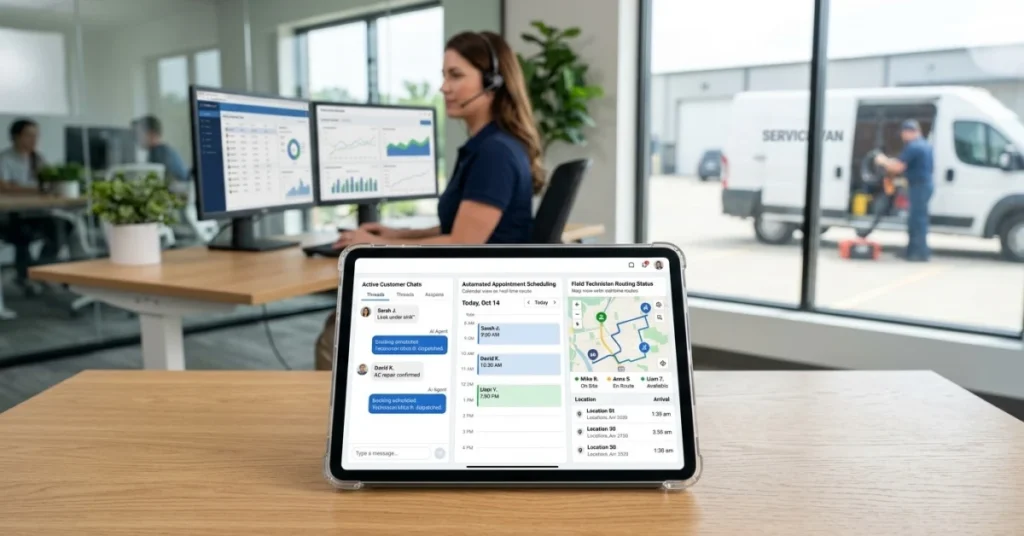
Virtual agent software connects directly to your calendar and books jobs without back-and-forth calls. A customer can reschedule a Tuesday appointment at midnight — and your tech shows up knowing about it.
This removes one of the most common friction points in a service workflow. Fewer no-shows, fewer missed bookings, less phone tag.
Qualifying Service Requests
Not every inbound request is a good fit — sorting them manually wastes time. An AI-powered virtual agent asks the right questions upfront: location, job type, urgency, budget range.
Your team only sees leads that are already pre-screened. That means faster response times for real customers and less wasted effort on dead ends.
Providing Job Status Updates
Customers hate waiting without updates — it’s one of the top reasons they leave bad reviews. A conversational AI agent sends real-time status messages: “Your tech is 20 minutes out.”
This one task alone cuts inbound “where is my tech?” calls dramatically. Your dispatcher handles real problems instead of fielding status checks all day.
Sending Reminders and Follow-Ups
Appointment reminders, post-job check-ins, and review requests all happen automatically. No one on your team has to remember to send them.
According to Deloitte Insights, businesses that automate follow-up touchpoints see up to 25% higher customer retention rates. That’s not a small number.
Retention is where service businesses actually grow. AI handles the follow-up work that most teams skip when things get busy.
Routing Urgent Requests
When a customer has a burst pipe or a downed HVAC in July, they need a human — fast. Gartner projects that by 2026, AI agents will handle over 70% of first-contact service interactions before a human ever gets involved.
Smart AI virtual agents for service businesses know when to escalate. They flag urgent jobs and route them to the right person right away — that’s what good emergency call triage looks like.
📊 By the Numbers
Gartner projects AI agents will manage over 70% of first-contact service interactions by 2026.
Knowing what these agents do is only half the picture. The bigger question is exactly where in your workflow they belong.
Where Do AI Virtual Agents Fit in the Service Workflow?
Those gaps aren’t random — they follow a predictable pattern in every service workflow. Knowing exactly where they hit lets you plug them before a customer walks away.
Most service businesses lose customers not during the job, but in the quiet moments around it. Over 60% of service calls go unanswered after 5 p.m. — and most of those callers never call back (Forbes Business Council).
Before a Service Appointment
A customer visits your site at 9 p.m. and wants a quote. An AI-powered virtual agent answers instantly — no hold music, no voicemail.
It collects their info, answers pricing questions, and books a callback. The lead is captured before a competitor even wakes up.
During Job Scheduling and Dispatch
Scheduling is where most service teams lose time. A field service management approach pairs well with a conversational AI agent that handles rescheduling requests in real time.
The agent updates the customer, adjusts the slot, and frees your dispatcher to focus on the field — not the phone.
After the Service Visit
The job is done, but the relationship isn’t. Virtual agent software can send follow-up messages, collect reviews, and flag unhappy customers before they post online.
This is a gap most teams ignore entirely. Closing it builds trust that turns one-time jobs into repeat business.
During After-Hours Support
No human can cost-effectively staff a phone line at 2 a.m. An AI customer service agent can — and it never calls in sick.
According to NRF, businesses that respond to inquiries within one hour are seven times more likely to convert a lead. After-hours coverage makes that possible every night.
📊 By the Numbers
Over 60% of after-hours service calls go unanswered — and most callers never try again.
The real question isn’t whether AI virtual agents for service businesses belong in your workflow — it’s which gap is costing you the most right now.
Conclusion
Customers walk away in the predictable gaps. Those gaps are the after-hours calls, the unanswered follow-ups, and the silence between human touchpoints. Businesses that deploy AI virtual agents for service businesses plug those gaps before a competitor does.
The real question is no longer whether to adopt HVAC field service tools or conversational AI agent technology. The real question is which gap in your workflow costs you the most right now.
Businesses using AI-powered virtual agents handle up to 80% of routine inquiries without a human rep. McKinsey & Company highlights this in their operations research on AI adoption.
Most service businesses lose jobs not because their work is bad. They lose them because no one answered at 9 p.m. FieldPie connects your office and field teams. Every job request, follow-up, and status update stays tracked and visible in real time.
Fewer gaps means faster responses. Faster responses mean measurable gains in booked revenue.
According to Moz, businesses that respond to leads within five minutes are 21 times more likely to convert them. Virtual agent software makes that speed the default, not the exception.