


✦ Key Takeaways
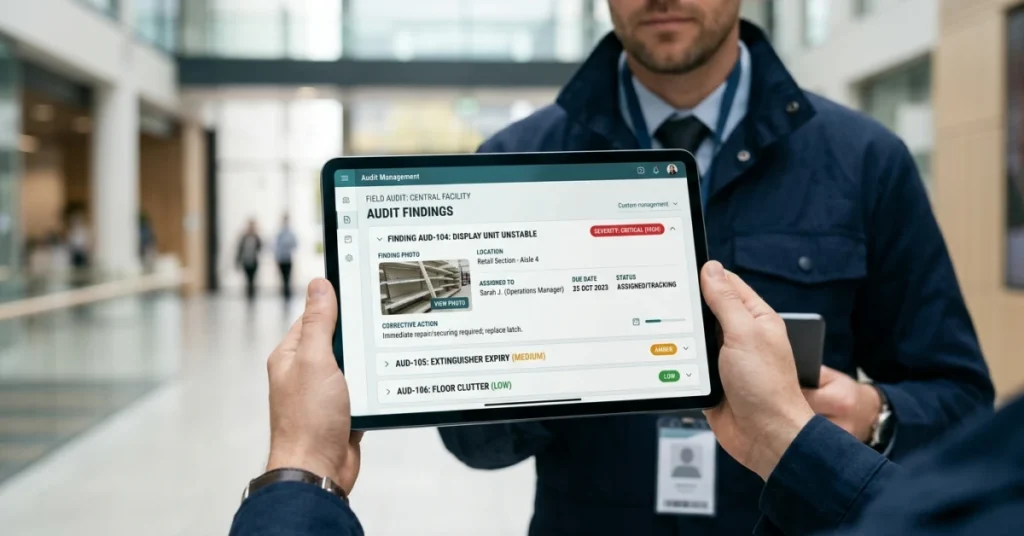
Up to 80% of inspection failures trace back to errors in data entry, not actual defects found on-site.
→ Bad data turns valid inspections into costly compliance failures.
→ Validation catches discrepancies before they trigger false regulatory penalties.
→ Three fields — date, location, and inspector ID — cause most errors.
In this article:
What Is Inspection Data Validation?
What Should Be Validated During an Inspection?
Key takeaway: Validate inspection data at the point of capture or pay for it downstream.
What Is Inspection Data Validation?
Most people trust inspection reports the moment they’re printed. That trust is a problem.
Bad inspection data costs organizations up to 30% more in rework and failed audits. Catching errors at the source costs far less.
Inspection data validation checks whether the data an inspection produces is accurate, complete, and consistent. Think of it less like a technical checkbox and more like a second set of eyes asking: “Does this actually make sense?”
Validation vs. Verification in Inspection Workflows
Verification asks whether an inspector followed the right steps. Validation asks whether the data those steps produced is trustworthy and usable downstream.
These two things sound similar but fail in completely different ways. A verified inspection can still carry wrong unit entries or blank fields. Mismatched asset IDs slip through too — and no one notices until a decision goes wrong.
Why Inspection Data Quality Matters
Every decision made after an inspection — repair orders, compliance filings, safety ratings — rests on whether that data was checked. Poor data integrity verification doesn’t just slow teams down; it quietly corrupts the decisions built on top of it.
Broken data pipelines affect over 80% of enterprise data projects before results ever reach a decision-maker (Monte Carlo). Smarter inspection data prefill methods cut entry errors before they start.
What Makes Inspection Data Valid and Reliable
Valid inspection data meets four basic tests: it’s complete, it’s in the right format, it’s consistent with past records, and it makes logical sense. Data quality testing flags anything that fails even one of those four checks.
Errors caught at the point of entry cost far less to fix. IBM identifies entry-point validation as the single highest-leverage fix in data pipelines.
Waiting weeks — until a report lands on the wrong desk — is where the real damage happens. The inspection validation process only works when someone, or something, actively checks whether each data point earns its place.
The real question isn’t whether your team runs inspections. It’s whether anything specific inside those inspections is actually being validated — and that gap is exactly where most failures hide.

What Should Be Validated During an Inspection?
Those silent errors don’t stay small. They attach to specific fields, timestamps, and identifiers inside every inspection record.
Knowing exactly where data breaks down is the first step. It’s what lets you trust what your inspections actually produce.
Roughly 60% of data quality issues trace back to missing or incorrectly formatted entries at the point of collection. That finding comes from Rudderstack. Most bad data isn’t a system failure — it’s a human one, and it’s preventable.
📊 By the Numbers
60% of data quality issues stem from missing or misformatted entries at the point of collection.
Required Fields and Missing Responses
A blank field isn’t neutral — it’s a gap. It forces whoever reads the report to guess. Every required field left empty is a decision made without evidence.
Inspection data validation starts by confirming every mandatory field has a response. “N/A” counts; blank never does.
Measurement Ranges and Numeric Values
A temperature reading of 4,500°F on a food storage unit isn’t data — it’s a typo. Numeric values need upper and lower bounds checked automatically, not by eye.
Data quality testing flags entries outside expected ranges before they reach a report. One out-of-range number can void an entire compliance record.
Dates, Times, and Inspection Timestamps
A timestamp proves when work happened — or it proves nothing. Dates in the wrong format break the chain of evidence. So do times that predate the inspector’s arrival.
The inspection validation process must confirm timestamps are logical, sequential, and match the assigned schedule. A report dated before the site visit is worthless in any audit.
Location and GPS Data
GPS coordinates that place an inspector 40 miles from the job site look wrong. They also signal the inspection may not have happened at all.
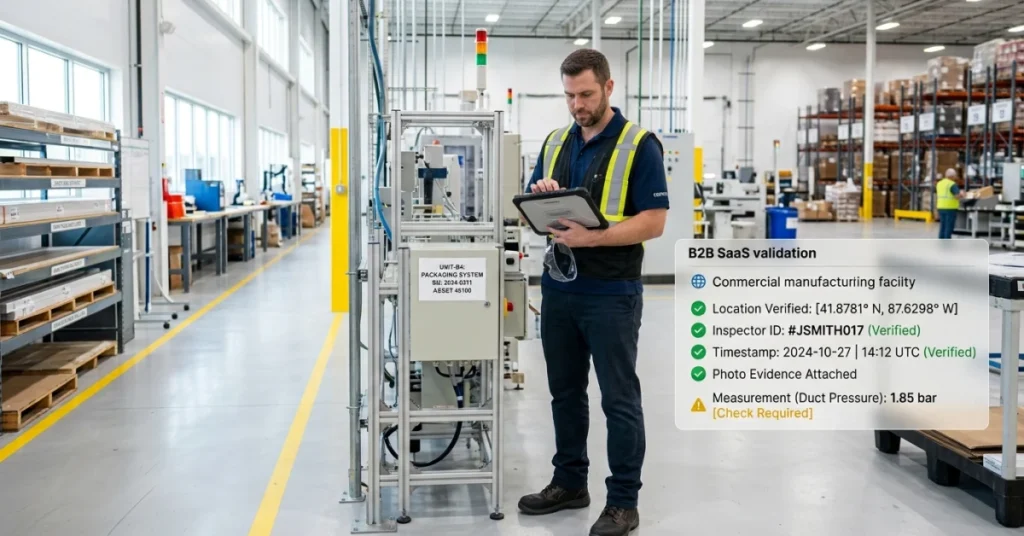
Location data is one of the strongest trust signals in any field report. Checking GPS entries against the expected site address catches both honest errors and deliberate shortcuts.
Without this check, location becomes decoration, not proof.
Photos, Signatures, and Supporting Evidence
A photo attached to the wrong asset adds noise, not proof. A signature with no timestamp does the same. Supporting evidence only helps the record when it’s verified as relevant and complete.
Data integrity checks should confirm photos are present where required. Signatures must match the assigned inspector. Using inspection data prefill tools cuts the chance that evidence gets mislinked at entry.
Asset, Equipment, or Location Identifiers
Misidentified assets are among the most common — and most costly — errors in field inspections. A maintenance record filed under the wrong unit ID means the right unit never gets the attention it needs.
Quanticate notes that identifier errors compound across records in clinical data management. The same holds for any inspection program that tracks assets over time.
Validate IDs against a master list every single time.
Inspector and Assignment Information
If you can’t confirm who ran the inspection, you can’t stand behind the results. Inspector name, ID, and assigned territory must all match the original work order.
Data validation testing on assignment fields closes the loop. It connects who was scheduled to who submitted the report. Without that match, accountability disappears — and so does trust in the entire program.
Every field on this list is a place where trust holds or breaks. Checking them all is what separates a reliable inspection program from a liability.
Conclusion
Knowing where data breaks down is only half the job. Acting on that knowledge is what separates trustworthy inspections from expensive guesswork.
Inspection data validation isn’t a technical add-on. It decides whether every downstream decision stands on solid ground — or shaky assumptions.
Bad field data costs real money. Over 88% of spreadsheets contain at least one critical error, according to Wispaper.
Most of those errors trace back to the same gaps: missing fields, wrong units, and misidentified assets. Statistical checks at the point of collection catch these errors before they grow into bad decisions.
Field teams that treat data quality testing as a built-in step — not an afterthought — earn trust. Every report they send carries that trust with it.
Statswork confirms that structured validation protocols cut downstream reporting errors by a measurable margin. That means fewer re-inspections and faster decisions.
That’s the real payoff of a solid inspection validation process. Your data earns trust the moment it’s collected — not after someone audits it later.
Most field teams still lose hours chasing errors that slipped through during collection. A structured field data capture process would have caught those errors right away.
FieldPie enforces validation rules at the point of collection. It uses customizable forms, required fields, and photo-based verification — so bad data never enters your reports.
Start running inspections your whole team can trust — explore FieldPie’s field operations platform today.