



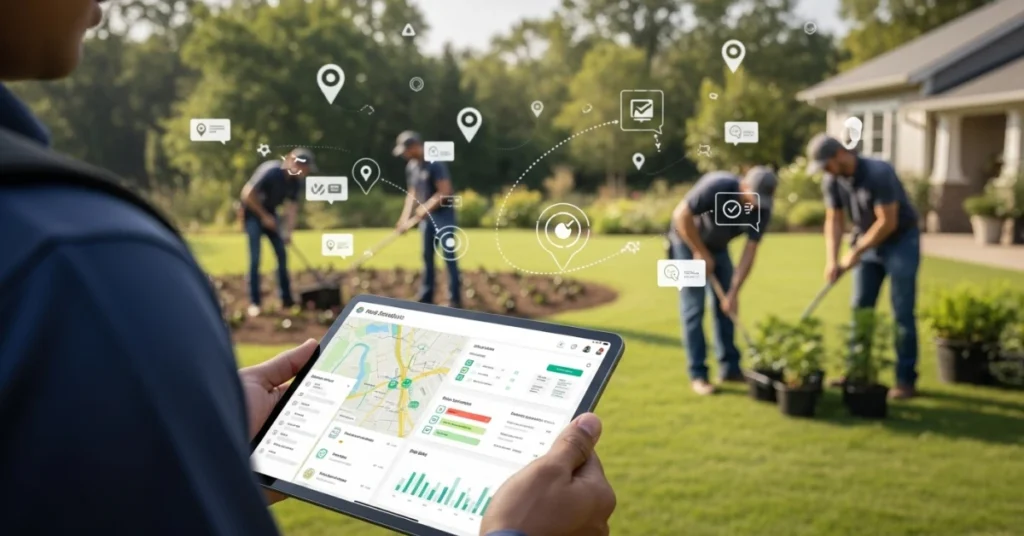
The landscaping industry is growing fast, with the global market valued at USD 129.7 billion in 2025 and projected to reach USD 201.9 billion by 2034 (5.04% CAGR).
Yet many businesses still rely on spreadsheets and manual tools, leading to scheduling conflicts, billing delays, and limited operational visibility.
Landscaping management software brings operations together in one place, helping businesses grow in a structured and scalable way.
This article reviews the best landscaping software based on real field needs, usability, and long-term scalability.
Why Your Landscaping Business Needs Software
Landscaping businesses increasingly rely on software to stay efficient, competitive, and scalable.
Here’s why investing in landscaping software makes sense:
- Manual tools like spreadsheets create scheduling issues and billing delays.
- Centralized software brings visibility, control, and scalability.
- Real-time tools reduce missed jobs, errors, and rework.
- Businesses using software operate more efficiently and grow faster.
What These Landscaping Software Solutions Have in Common
Landscaping software differs in features and focus, yet the tools in this list are built to support efficient field operations as businesses scale — from schedule jobs to invoices & payments.
These platforms were selected because they:
- Replace manual tools (e.g. spreadsheets, paper schedules, text-based coordination)
- Centralize scheduling and job execution
- Connect office teams and field crews
- Support estimating, invoicing, and payments
- Improve operational visibility
Together, these capabilities replace fragmented tools with a single operational system.
This shared foundation helps landscaping businesses handle more jobs, manage larger teams, and scale operations without added complexity.
Top Landscape Management Software Solutions
This list highlights leading landscape management software solutions built for modern field operations.
The platforms below support landscaping contractors and small businesses by combining scheduling, field execution, job costing, reporting, and Customer Relationship Management to help teams manage crews and scale efficiently.
Each solution supports different business sizes, from small crews to complex, multi-team operations.
Feature Coverage Across Landscape Management Software
*Features may vary by plan, region, and integrations. ‘Via integration’ indicates functionality provided through third-party tools.
1. FieldPie
The Best Landscape Management Software for Field Operations at Any Scale

FieldPie is a modern landscape management platform built for real field work. It supports both small crews and large, multi-team operations—without forcing businesses to choose between ease of use and advanced capability.
Instead of stitching together multiple tools, FieldPie brings scheduling, field execution, dynamic forms, reporting, customer data, service history, GPS tracking, and location-based services into a single, unified system. Teams can get up and running quickly, while managers gain clear, real-time control as operations become more complex.
FieldPie can operate as a standalone system or integrate with existing business tools when needed, making it easy to fit into both simple and mature operational setups.
FieldPie’s core capabilities include:
- End-to-end field execution — schedule jobs, manage visits, tasks, and complete work order management in one continuous flow
- Smart job scheduling and routing — mobile-first workflows that guide crews efficiently in the field
- Offline-ready field operations — collect data, photos, signatures, and forms without connectivity, with automatic sync when online
- Custom forms and inspections — fully configurable data collection tailored to landscaping workflows
- Real-time operational visibility — live insights into job progress, locations, and field performance
- Flexible roles and permissions — control access for crews, supervisors, and managers
- Scalable reporting — operational and performance reporting without enterprise-level complexity
Where FieldPie stands out:
FieldPie is designed as a long-term platform, not a short-term tool. It combines advanced field capabilities with a clean, intuitive experience and transparent pricing. Whether you run a two-person crew or manage large, distributed teams, FieldPie scales naturally with your business—without slowing you down or forcing constant tool changes.
Things to consider:
FieldPie focuses on deep operational execution and field excellence rather than niche add-ons, often reducing the need for multiple separate systems.
2. Jobber
Jobber is a popular field service platform tailored to small and mid-sized service businesses, including landscaping companies.
It covers the essentials — scheduling, quoting, invoicing, and customer communication — in a clean and user-friendly interface, making it easy for smaller teams to get started quickly.
Core capabilities include:
- Job scheduling with calendar and map views
- Client-facing quotes, invoices, and online payments
- Automated customer notifications
- Mobile app for field teams
Where Jobber stands out:
Jobber excels in customer communication and ease of use, especially for service-based SMBs.
Things to consider:
As teams grow, customization, reporting depth, and internal operations management can feel limited.
3. HouseCall Pro
HouseCall Pro focuses heavily on the customer experience, combining scheduling, billing, and communication tools into one platform.
It is widely used by service businesses that prioritize online booking, automated reminders, and fast payments.
Core capabilities include:
- Online booking and automated customer notifications
- Scheduling and dispatch
- Invoicing and payment processing
- Mobile app for field staff
Where HouseCall Pro stands out:
Strong customer-facing tools and accessible support make it appealing for service-driven businesses.
Things to consider:
Employee management, operation details, and growth for bigger teams are weaker than in focused platforms.
4. Service Autopilot
Service Autopilot is a landscaping and lawn care platform. It focuses on automation and growth. It works well for recurring service models.
It combines operations, CRM, and marketing tools to help growing businesses reduce manual work and standardize processes.
Core capabilities include:
- Advanced scheduling and route optimization
- Workflow automation for invoicing, reminders, and follow-ups
- Built-in CRM and marketing tools
- Mobile app for field operations and billing
Where Service Autopilot stands out:
Strong automation and recurring service management make it attractive for lawn care companies focused on scale.
Things to consider:
The platform has a steep learning curve, and many advanced features are locked behind higher-tier plans.
5. Aspire Crew Control
Aspire Crew Control is part of Aspire’s broader enterprise landscape management ecosystem, designed for mid-sized to large landscaping companies.
It provides advanced planning, routing, job costing, and operational oversight for complex organizations.
Core capabilities include:
- Advanced crew scheduling and route optimization
- Job costing and estimating
- Inventory and equipment tracking
- Custom dashboards and reporting
Where Aspire stands out:
It has strong tools for large operations. It helps control finances.
Things to consider:
Implementation complexity, learning curve, and pricing make it less accessible for smaller or fast-moving teams.
6. LMN by Granum
LMN is a business management platform made for landscaping companies. It focuses on estimating, budgeting, and making profits.
It helps companies understand true job costs and improve margins through data-driven planning.
Core capabilities include:
- Estimating and budgeting tools
- Job costing and profitability tracking
- Scheduling and invoicing
- Mobile access for crews
Where LMN stands out:
Deep financial insight and cost analysis for landscape-focused businesses.
Things to consider:
As features and customization increase, the system can become complex and slower to adopt.
7. Yardbook
Yardbook is a budget-friendly solution designed for small landscaping and lawn care businesses.
It offers essential tools to manage customers, schedules, and billing without high upfront costs.
Core capabilities include:
- Customer management
- Scheduling and routing
- Estimates, invoices, and payments
- Web and mobile access
Where Yardbook stands out:
Accessible pricing and ease of use make it a solid entry-level option.
Things to consider:
Limited integrations, customization, and mobile features can slow growth over time.
Not sure yet?
See how FieldPie works in real field scenarios.
Schedule a demo to explore workflows, reporting, and field execution.
Your Strategic Roadmap: How to Choose the Right Landscaping Software
Choosing the right landscaping software starts with understanding your operations, growth goals, and daily field needs. As teams scale, visibility into customer data, service history, job scheduling routing, and GPS tracking becomes just as important as core operations.
Must-Have Features for Landscaping Software
Industry data shows that the most commonly used tools focus on accounting (77%), invoicing (72%), and estimates (61%), highlighting the importance of these core capabilities.
Some features are very important for running landscaping work well. They help make the business profitable.
- Dashboard: Detailed client profiles, property details, service history, and communication logs.
- Scheduling & dispatch: Route optimization, crew assignment, and real-time job tracking.
- Estimating & quoting: Accurate labor and material cost calculations.
- Invoicing & payments: Support for one-time and recurring services to protect cash flow.
- Mobile access: Field teams can view jobs, update statuses, and collect payments on-site.
- Reporting & analytics: Insights into job costing, profitability, and operational efficiency.
How to Choose the Right Landscaping Software
Choosing landscaping software requires a strategic approach focused on long-term fit, not just features.
- Define core needs
Base your choice on your workflows, team size, service types, and growth plans. - Ease of use
A simple, intuitive interface ensures fast team adoption without heavy training. - Scalability
The software should support more clients, crews, inventory, and jobs as you grow. - Support & training
Strong onboarding, documentation, and responsive support make a real difference. - Trials & demos
Always test the software in real scenarios before committing.
Conclusion: Choosing Software for Landscaping Business
The right landscaping software should support how your teams work today and still scale with you tomorrow.
While all tools on this list cover core needs, FieldPie stands out by combining powerful field execution with a clean, easy-to-use experience—working just as well for small crews as for large operations.
See it in action.
Schedule a FieldPie demo and explore real-world workflows, reporting, and field execution.