


Ensuring the quality of food products is essential for consumer safety, regulatory compliance, and brand reputation. Quality Assurance (QA) proactively prevents production issues, while Quality Control (QC) identifies and corrects defects through systematic inspection and testing. Together, they form a comprehensive framework that protects public health and strengthens trust in brands.
Understanding Quality Assurance (QA) and Quality Control (QC) in Food Industry
Quality Assurance (QA) and Quality Control (QC) are fundamental to effective food quality management. Although closely related, they serve different purposes: QA focuses on preventing issues through process control, while QC verifies product compliance through inspection and testing.
Understanding this distinction is essential for ensuring food safety, consistency, and regulatory compliance.
Key Differences Between QA and QC in Food Quality Management
| Aspect | QA | QC |
|---|---|---|
| Definition | Proactive, process-oriented | Reactive, product-oriented |
| Focus | Prevent defects, standardize processes, train staff | Detect defects, ensure product compliance |
| Timing | Continuous throughout production | At checkpoints and finished products |
| Activities | SOP development, audits, risk management, preventive controls | Sampling, sensory evaluation, microbiological & chemical testing, statistical monitoring |
| Compliance Role | Demonstrates adherence to regulations and industry standards | Verifies that end products meet safety and quality requirements |
Key takeaway: QA lays the preventive framework, QC monitors outcomes, and both together ensure food safety, consistent quality, and regulatory compliance.
Food Quality Assurance (QA): Definition, Scope, and Objectives
Food Quality Assurance (QA) is a proactive, system-wide approach that focuses on preventing defects before they occur. It covers the entire food production lifecycle—from raw material sourcing to distribution—ensuring consistency, safety, and regulatory compliance through standardized processes.
Key Components of a Food Quality Assurance (QA) System
A strong QA system is built on interconnected components that work together to minimize risk, maintain consistency, and ensure traceability across the supply chain.
Raw Material Sourcing and Supplier Quality:
- Supplier audits and certifications (ISO 22000, SQF, BRCGS)
- Material acceptance criteria: moisture content, microbial load, pesticide limits
- Traceability from farm to processing facility
Process Design, HACCP, and Preventive Controls:
- HACCP-based workflow mapping
- Critical Control Points (CCPs) identification and monitoring
- Preventive maintenance and process simulation
Packaging, Labeling, and Traceability Controls:
- Correct material selection for safety and shelf-life
- Label verification: allergens, nutrition, lot coding
Storage, Distribution, and Cold Chain Management:
- Cold chain management (temperature & humidity monitoring)
- FIFO (First-In-First-Out) and FEFO (First-Expired-First-Out) implementation
- Transportation audit protocols
Regulatory Compliance and Audit Readiness:
- Adherence to FDA, USDA, FSMA, ISO 22000, and local legislation
- Internal and external audits
- Documentation of HACCP plans, SOPs, and employee training
Continuous Improvement and Preventive Action:
- Hazard analysis, preventive controls, and feedback loops
Food Quality Control (QC): Role, Scope, and Responsibilities
Food Quality Control (QC) is a reactive, product-focused function designed to detect defects and ensure that only safe, compliant products reach consumers. QC verifies that QA systems are working as intended by testing, inspecting, and monitoring finished and in-process products.
Core Food Quality Control (QC) Testing Methods
- Microbiological Testing: Salmonella, E. coli, Listeria; culture, PCR, ELISA methods
- Chemical Testing: Pesticide/heavy metal residues, allergens, preservatives, nutritional content
- Physical Inspection: Foreign object detection, packaging integrity, weight and portion checks
- Process Monitoring: Real-time temperature/pH tracking, automated logging systems
Food Safety vs Quality Assurance (QA): Key Differences Explained
| Aspect | Food Safety | QA |
|---|---|---|
| Definition | Prevent contamination and foodborne illness | Ensure consistent standards across batches |
| Focus | Biological, chemical, and physical hazards | Taste, texture, appearance, nutritional content |
| Objective | Protect public health | Maintain product consistency |
| Approach | HACCP, hygiene, inspections | SOPs, GMP, process-driven QA |
| Compliance | FDA, USDA enforcement | Industry QA standards and certifications |
Key takeaway: Food safety prevents hazards, QA ensures consistency, and QC inspects compliance for both.
Food Quality Inspections: Methods, Best Practices, and Compliance

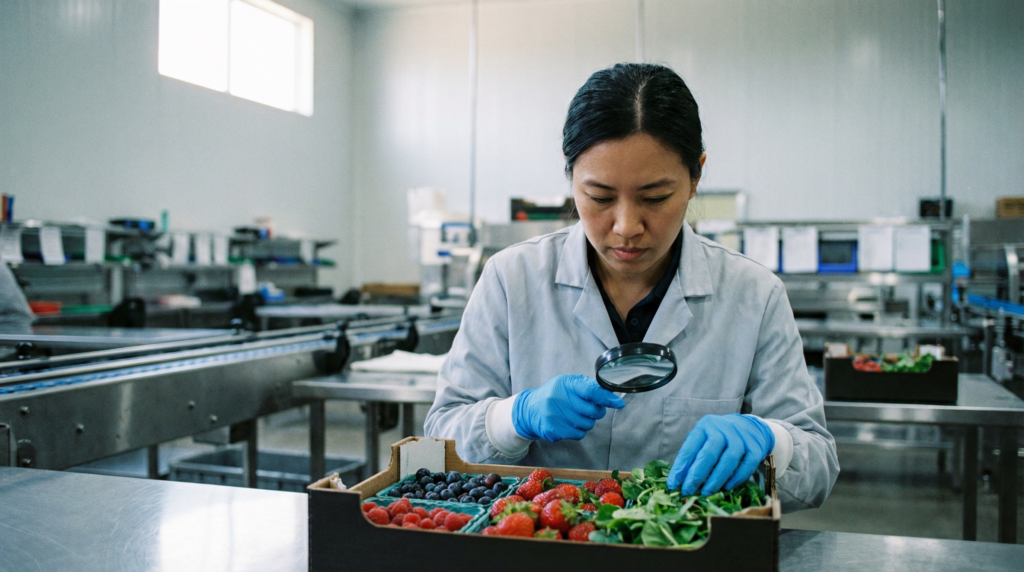
Food quality inspections translate QA and QC policies into day-to-day operational checks. Effective inspections ensure compliance, identify deviations early, and support timely corrective actions.
Best Practices for Food Quality Inspections:
- Align inspections with HACCP and GMP principles
- Regular training and calibration for inspectors and equipment
- Detailed documentation of inspections and corrective actions
- Use advanced tools like near-infrared spectroscopy and electronic noses
- Continuously update procedures based on audit findings
Common Food Quality Inspection Methods:
- Process control (SOP adherence, HACCP verification)
- Physical examination (packaging, appearance, texture)
- Sensory evaluation panels
- Microbiological and chemical testing
- Nutritional labeling verification
- Shelf-life and packaging integrity checks
- Weight, portion, and consistency checks
- Equipment calibration and preventive maintenance
📊 Manual inspections, delayed corrective actions?
Digitize QA/QC inspections and act in real time with FieldPie—book a demo.
How QA and QC Maintain Consistent Food Product Quality
Consistency is essential for meeting consumer expectations and protecting brand trust. QA and QC systems work together to reduce variability across batches and production cycles.
QA/QC ensures consistency through:
- Standardized production and measurement processes
- Statistical monitoring of moisture, pH, seasoning, and texture
- Real-time adjustments using AI or automated monitoring systems
Improving Food Production Efficiency Through QA and QC
When QA and QC are integrated into daily operations, they improve efficiency by reducing waste, minimizing downtime, and enabling faster corrective actions.
QA and QC integration enhances efficiency by:
- Identifying inefficiencies and reducing waste
- Real-time monitoring for immediate corrective actions
- Statistical analysis for process and equipment optimization
- Predictive analytics for potential failures
Overcoming QA/QC Challenges
A robust QA/QC framework plays a critical role in safeguarding public health while reinforcing brand credibility. Preventing quality failures reduces recalls, regulatory penalties, and reputational damage.
A strong QA/QC framework:
- Prevents unsafe products from reaching consumers
- Builds trust and customer loyalty
- Enhances brand reputation and competitive positioning
- Supports compliance during audits and industry crises
Common QA/QC Implementation Errors
- Treating QA and QC as separate silos
- Inadequate employee training and refreshers
- Neglecting equipment calibration and documentation
- Failing to integrate preventive QA with reactive QC
Overcoming QA/QC Challenges
Many QA/QC challenges stem from operational pressure, skill gaps, and fragmented systems. Addressing these issues requires both cultural and technological solutions.
Practical solutions:
- Continuous staff education and certifications
- Digital traceability and recordkeeping systems
- Standardized testing protocols with equipment calibration
- Promote a culture of continuous improvement
- Strategic investment in training and technology
- Collect consumer feedback to refine QA/QC systems
- Regular HACCP updates for emerging hazards
QA/QC Best Practices by Food Industry Segment
QA and QC practices vary by industry due to differences in raw materials, processing methods, and risk profiles. Applying sector-specific controls improves both safety and compliance.
- Dairy: Pasteurization, microbial testing of milk and cheese
- Meat Processing: Slaughter audits, contamination risk control
- Bakeries: Baking time and temperature monitoring
- Beverages: Filtration and sterilization to prevent microbial growth
- Seafood: Proper handling and storage to prevent histamine formation
Food QA/QC Regulatory and International Standards
Food QA/QC systems must align with multiple regulatory frameworks to ensure safety, traceability, and compliance across markets.
QA/QC systems comply with:
- International: Codex Alimentarius, ISO 22000, FSSC 22000, IFS
- Industry: GMP, SQF, BRCGS
- National: FDA, USDA, FSA, EFSA
Advanced Food QA/QC Techniques and Technologies
Modern QA/QC increasingly relies on advanced technologies to improve speed, accuracy, and predictive capability.
- Statistical Process Control (SPC) and trend analysis
- Real-time monitoring of critical parameters (temperature, moisture, pH)
- Predictive analytics for equipment and process failures
- Rapid quality assessment via near-infrared spectroscopy and electronic noses
- Continuous improvement loops driven by audit feedback
Strategic Role of QA and QC in Food Quality Management
QA and QC are not only operational functions but also strategic drivers of efficiency, risk management, and brand value.
QA/QC affects both operations and strategy by:
- Reducing variability, recalls, and compliance risks
- Enhancing customer satisfaction, loyalty, and brand reputation
- Supporting long-term performance through trained teams and a culture of continuous improvement
QA vs QC Implementation Perspective
- QA: Preventive controls, SOP definition, process optimization, batch consistency
- QC: Defect identification, compliance verification, feedback for process improvement
Together: Ensure food safety, high quality, regulatory compliance, and consistent products while reinforcing operational efficiency and consumer trust.
Conclusion
QA and QC shift food production from reactive to proactive, ensuring:
- Product safety and consistency
- Operational efficiency
- Consumer trust and brand value
- Long-term sustainability
Integrating practical examples, digital solutions, regulatory compliance, advanced techniques, and strategic management transforms food production and strengthens public health protection.