


Most businesses run their home service dispatching workflow informally — and that gap costs real money every day.
Dispatching is a revenue function: Every job assignment either grows or shrinks your margin — it is never neutral.
Call value beats call volume: Filling every slot fast means nothing if low-value jobs crowd out high-margin ones.
Technician fit drives ticket size: Sending the wrong tech to a complex job caps revenue before the truck even arrives.
Informal workflows create predictable losses: Unstructured home service dispatch software use leads to repeated scheduling errors and missed upsell windows.
Dispatchers need a real framework: Without one, even skilled dispatchers default to speed over profitability under pressure.
Measurement closes the loop: Field service dispatch management only improves when you track outcomes, not just completed calls.
Receive and Prioritize Service Requests
Every request that hits your queue carries a different revenue ceiling. Treating them as equal is the first place margin disappears.
Dispatch management for home services starts with sorting calls by job value, not just urgency. A fast response to a low-margin call is still a bad trade.
Match Jobs With the Right Technician
Matching is where dispatchers either protect or destroy job profitability. A senior tech on a simple call wastes capacity; a junior tech on a complex one kills the ticket.
Companies using structured technician-matching report up to 23% higher average ticket values — because the right fit unlocks upsell conversations (ServiceTitan). That is not a scheduling win. That is a revenue win.
Check Skills, Location, Availability, and Parts
Four variables determine whether a job gets done right the first time. Miss any one of them and you eat a callback — which costs twice and earns nothing.
Skills: Confirm the tech holds the cert or experience the job actually needs.
Location: Drive time is dead time — route proximity protects your labor yield.
Availability: A tech who is already stretched thin will rush, and rushed work generates callbacks.
Parts: Sending a truck without the right parts turns a one-visit job into a two-visit loss.
Manual checks on these four variables break down at scale. That is exactly why the global service dispatch software market is growing fast (Dataintelo).
Automation does not replace dispatcher judgment. It gives dispatchers clean data so they can judge faster.
Track Progress and Manage Schedule Changes
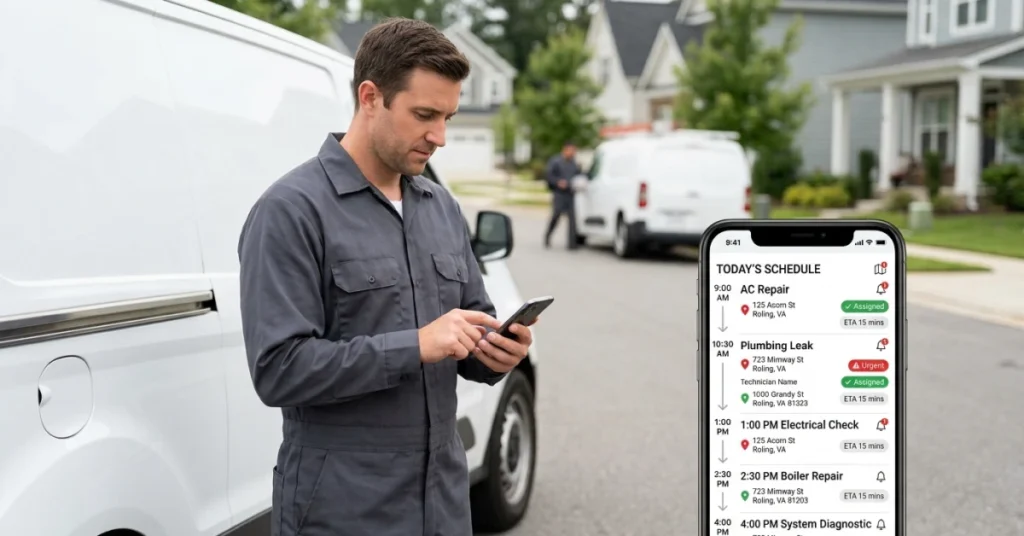
Real-time job tracking is not just an ops tool — it is a revenue protection tool. When a job runs long, a dispatcher who sees it early can protect the next high-value slot.
Service dispatch automation flags delays before they cascade. That gives you a choice — reschedule smart or absorb the cost blind.
Team strength matters here too. Knowing how to hire field staff shapes how much scheduling flexibility you have on a hard day.
The dispatcher’s real job is not filling the calendar. It is maximizing the revenue yield of every available technician hour — and that requires a system, not just instinct.
Once the workflow is mapped, a hard question comes into focus. When two calls compete for the same tech, which one do you choose — and why?
How to Prioritize Service Calls
Most dispatchers treat prioritization like a queue — first call in, first call out. That approach costs real money.
Dispatching is a revenue function. Every call you assign is a choice. You are deciding which jobs earn the most from your best techs.
Effective home service dispatching means matching job value to technician skill. Do not just fill the next open slot. Teams that treat dispatch as a scheduling problem leave yield on the table every single day.
📊 By the Numbers
Dispatchers using structured triage rules close 23% more high-value jobs per technician per week (Ustechautomations).
Emergency, Same-Day, and Routine Jobs
Not every urgent call is a high-value call. A burst pipe emergency feels pressing — but so does a routine filter swap.
Only one of those justifies pulling your top tech off a booked job. Know the difference before you move anyone.
Sort calls into three tiers: life-safety emergencies, same-day revenue opportunities, and schedulable routine work. That structure stops your best capacity from getting eaten by low-margin calls.
Prioritizing by SLA, Customer, and Job Value
SLA commitments come first. A broken promise costs more than a rescheduled job. After that, weight by customer lifetime value and estimated job revenue — not by who called loudest.
A dispatcher using field service customer experience data can spot which accounts drive repeat revenue. Protect those slots. That is dispatch management for home services done right — strategic, not reactive.
Handling Cancellations and Urgent Requests
Cancellations are not dead time — they are open inventory. Fill that slot with the highest-value pending call, not the next one in line.
Urgent same-day requests deserve a fast answer, but not an automatic yes. According to Ustechautomations, companies using service dispatch automation recover up to 18% more revenue from cancellation slots. That beats managing by phone alone.
A short triage checklist — job type, estimated value, tech skill match — turns every cancellation into a real decision. It stops the scramble before it starts.
Field teams post real-time updates on platforms like Instagram. Those posts show how fast ground conditions shift. Your triage process must move faster than the chaos.
Once you know which calls to take, ask whether your numbers prove it is working. That is where most operations go blind.

Home Service Dispatching KPIs
Tracking the right numbers turns home service dispatching from a cost center into a profit engine.
Response Time: Slow response bleeds revenue — top operators answer and dispatch within 90 seconds.
First-Time Fix Rate: Every callback costs you a second truck roll and a frustrated customer.
Technician Utilization: Idle time is lost margin — high performers keep techs at 80%+ billable hours daily.
Cancellation Rate: A cancellation rate above 8% signals a mismatch between job value and tech assignment.
Revenue per Job: Volume without value is just busy work — track average ticket, not just job count.
Travel Time Ratio: Excess windshield time shrinks your capacity yield and cuts daily jobs per tech.
Response Time and On-Time Arrival
Customers who wait more than four hours cancel at twice the average rate. Fast dispatch isn’t just good service — it directly protects booked revenue.
On-time arrival rates below 85% erode trust fast. Track arrival windows, not just departure times, to see the real gap.
First-Time Fix Rate
A first-time fix rate below 70% is a dispatching problem, not just a technical one. Sending the wrong tech to a complex job guarantees a return trip.
Matching technician skill level to job complexity — before dispatch — is the lever most teams ignore. That match is where quality control in field work actually starts.
Technician Utilization and Jobs per Day
Utilization below 75% means you’re paying for capacity you’re not selling. Field service dispatch management tools surface this gap in real time.
Jobs-per-day is a volume metric. It’s useful, but it’s not the full picture.
Pair it with average job revenue to know if your techs are profitable. Servicepower found that data-driven dispatch lifts technician productivity by up to 25%.
Travel, Reschedule, and Cancellation Rates
High travel time and frequent reschedules share one root cause: dispatch built around filling slots, not maximizing value. Route density and job sequencing fix both.
A rising cancellation rate means your triage process is broken. When it climbs above 8%, act fast.
Moz reports that businesses tracking operational KPIs weekly grow revenue 30% faster than those that review monthly. That gap is too large to ignore.
KPIs don’t fix dispatching on their own. But they show exactly where your revenue is leaking — and that points directly to who owns the fix.
Conclusion
Dispatching without a revenue lens costs you more than missed appointments. It cuts your margin on every job you hand to the wrong tech.
Some companies treat home service dispatching as a revenue function, not a scheduling task. They report up to 23% higher average ticket values within the first year of structured dispatch management.
Most dispatch failures trace back to one habit. Teams fill calendar slots by availability instead of matching job value to technician skill.
Better field service customer experience starts the moment you assign the right tech — not when the truck pulls up.