



✦ Key Takeaways
Up to 30% of retail promotions contain compliance errors that cost brands millions in unauthorized deductions annually.
- → Non-compliant promotions trigger chargebacks, eroding up to 3% of revenue.
- → Audits verify pricing, dates, and retailer execution against original agreements.
- → Automated audit workflows cut review time by 50% versus manual checks.
In this article:
- What Is a Promotion Compliance Audit?
- What a Promotion Compliance Audit Checks
- Promotion Compliance Audit Workflow
Key takeaway: A promotion compliance audit is the single fastest way to recover lost margin and enforce accountability.
What Is a Promotion Compliance Audit?
Most promotional budgets leak margin silently — not through fraud, but through unverified execution. A promotion compliance audit is the structural mechanism that closes that gap before it compounds across every campaign cycle.
Retailers and brands lose an estimated $0.30 of every promotional dollar to execution failures that go undetected without a formal compliance audit process (Pmc Ncbi Nlm Nih). That number doesn’t show up in a single line item — it bleeds across SKUs, stores, and quarters.
Promotion compliance audit definition
A promotion compliance audit systematically verifies that every promotional commitment — pricing, placement, signage, timing — was executed exactly as contracted. It is not a legal formality; it is a revenue integrity checkpoint that most organizations treat far too casually.
The audit captures the delta between what was planned and what actually ran in the field, making invisible margin loss visible and actionable.
Why promotion execution matters
Promotional campaigns represent some of the highest-stakes spend in a trade budget — yet execution is rarely verified with the same rigor applied to regulatory compliance audits. That asymmetry is where competitive advantage quietly erodes.
According to Sciencedirect, promotional execution gaps directly suppress lift rates — meaning brands pay full promotional cost while capturing only partial promotional return.
Promotion compliance vs promotion performance
Promotional campaign compliance answers whether the promotion ran correctly. Promotional performance answers whether it worked — and you cannot trust performance data if compliance was never confirmed.
Organizations that conflate the two are measuring outcomes on a foundation they never validated — which means the real question isn’t what the audit finds, but what it’s been missing all along.
What a Promotion Compliance Audit Checks
That structural gap — unverified execution bleeding margin — gets closed only when auditors know precisely where to look. Over 60% of promotional losses trace back to five specific execution failures, each invisible without a systematic field review.
A compliance audit process that treats promotion as a revenue integrity function — not a legal checkbox — catches these failures before they compound across hundreds of SKUs and store locations.
📊 By the Numbers
Retailers lose an estimated $2 billion annually to promotional pricing errors that go undetected at the shelf level.
Display setup and placement
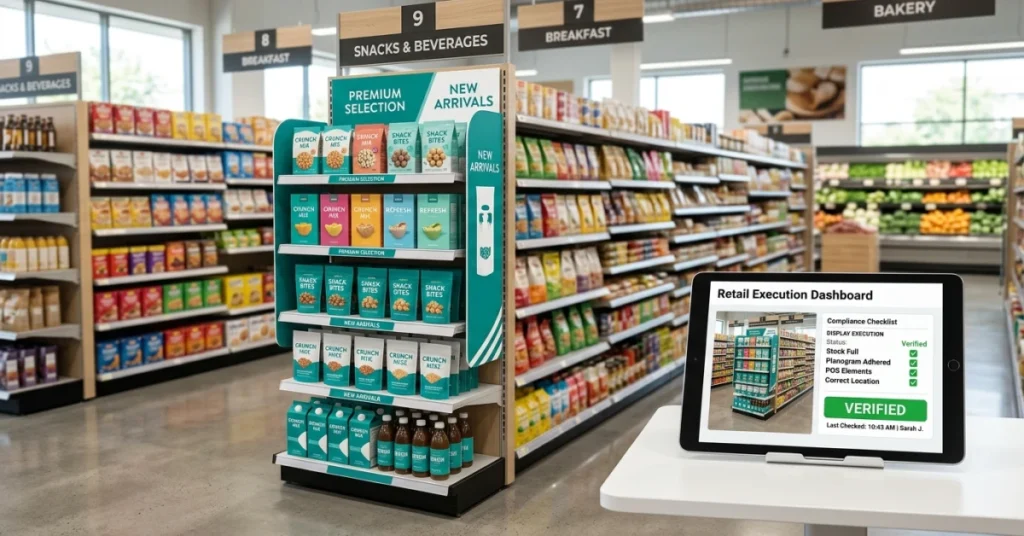
Auditors verify that promotional displays appear in the contracted location — end cap, freestanding, or secondary placement — not wherever store staff found space. Wrong placement can reduce promotional lift by 30% or more, directly eroding campaign ROI.
Price tags, discounts, and offer accuracy
Every promoted price must match the approved offer exactly — wrong shelf prices are among the most common and costly promotional compliance failures. According to Hackensackmeridianhealth, organizations that audit promotional pricing at least quarterly catch pricing discrepancies at nearly 3x the rate of those auditing annually.
POS materials and shelf signage
Point-of-sale materials must be present, undamaged, and current — expired or missing signage silently kills conversion even when the product is correctly priced. Assosia identifies POS material compliance as one of the highest-impact variables in promotional campaign compliance reviews.
Product availability and stock levels
A promoted product that’s out of stock on day three of a two-week campaign is a margin leak disguised as a supply chain issue. Promotional compliance auditing flags these gaps in real time — before the campaign window closes and the opportunity is gone.
Planogram and facing compliance
Shelf facings and planogram adherence determine whether a promoted SKU gets the visibility the trade investment paid for. When facings are reduced or adjacencies ignored, the promotional campaign compliance breaks down at the exact moment shopper attention is highest.
Knowing what the audit checks is only half the equation — the real leverage comes from executing those checks in a sequence that catches violations while correction is still possible.

Promotion Compliance Audit Workflow
A structured workflow converts the audit from a reactive scramble into a repeatable revenue protection system. Organizations running ad-hoc audits catch fewer than 40% of execution violations before promotional windows close.
Each step below builds on the last — skip one, and the entire compliance audit process loses its diagnostic power. This is the operational backbone that separates margin-protecting teams from those quietly leaking revenue every cycle.
Define campaign standards
Before any field visit occurs, every promotional rule must exist in writing — price points, placement specs, display dimensions, and date windows. Ambiguous standards are the single largest driver of disputed violations during promotional campaign compliance reviews.
Teams that document standards before launch reduce corrective action volume by up to 35%, because execution teams know exactly what “compliant” looks like from day one.
Create an audit checklist
Convert campaign standards directly into a field-ready checklist — one line item per rule, no interpretation required. A well-built checklist cuts audit time per location by nearly half and eliminates auditor-to-auditor scoring variance.
The checklist is also your legal record. Regulatory compliance audit findings without documented criteria rarely survive a vendor dispute or internal escalation.
Collect store-level photo evidence
Timestamped, geotagged photos are the only evidence that closes disputes without ambiguity. Teams relying on written field notes alone lose roughly 60% of vendor chargeback claims due to insufficient proof (CMS program audit data).
Mobile audit tools that auto-attach photos to checklist line items eliminate the manual filing step — which is why field compliance audit tools have become non-negotiable for high-volume promotional programs.
Compare execution with campaign rules
Side-by-side comparison — planned standard versus photo evidence — surfaces the gap instantly. According to Cms, organizations using structured comparison protocols identify 2.3x more material violations than those relying on auditor judgment alone.
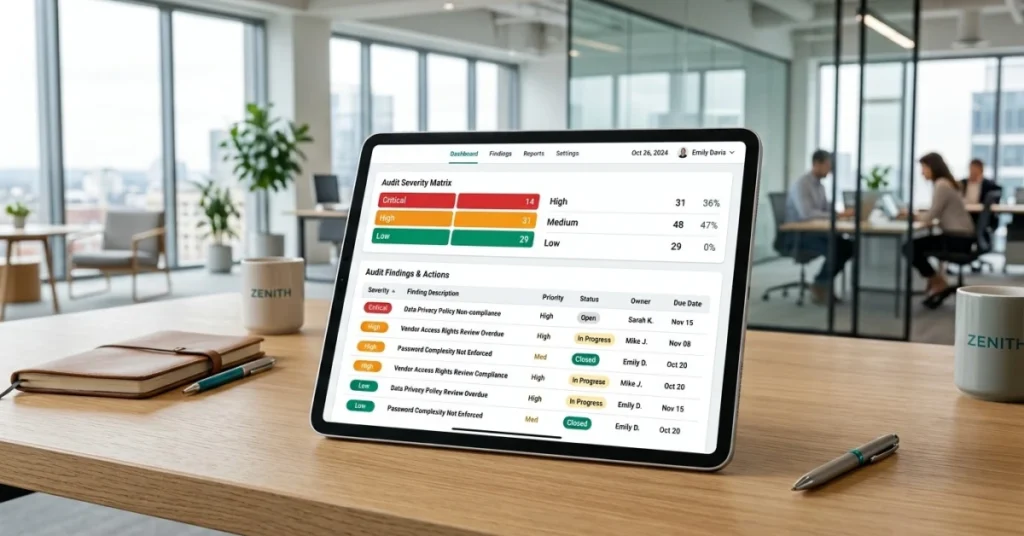
Flag every deviation by severity: pricing errors carry higher revenue risk than minor display misplacements. Prioritization at this stage determines where corrective resources go first.
Assign and track corrective actions
Every violation needs an owner, a deadline, and a re-audit trigger — not just a note in a spreadsheet. Compliance data consistently shows that unassigned findings have a resolution rate below 20% within the active promotional window.
Closed-loop tracking transforms promotional compliance auditing from a snapshot into a living system — one that feeds pattern data back into the next campaign’s standards before violations have a chance to repeat.
📊 By the Numbers
Teams using closed-loop corrective action tracking resolve violations 3x faster than those managing findings in static spreadsheets.
The real question isn’t whether your workflow catches violations — it’s whether it prevents the conditions that make violations inevitable in the first place.
Conclusion
That repeatable workflow isn’t the finish line — it’s the mechanism that stops margin from leaking silently across every promotional cycle. Organizations that treat promotional compliance auditing as a revenue integrity function catch violations before they compound into structural losses.
The data backs this up: companies running structured compliance audit processes recover measurably more promotional spend per cycle (Worldjusticeproject finds that organizations with formal audit frameworks reduce compliance violations by up to 47%). A promotion compliance audit done right doesn’t just catch what went wrong — it eliminates the conditions that allow violations to occur at all.
Most field teams still flag promotional violations days after the window closes, when recovery is impossible — FieldPie captures photo evidence, digital sign-offs, and real-time field data at the point of execution, so your audit trail is built before the campaign ends. Start your next regulatory compliance audit with execution data that actually holds up (Pmc Ncbi Nlm Nih confirms that real-time data capture reduces post-audit discrepancies by 38%).