



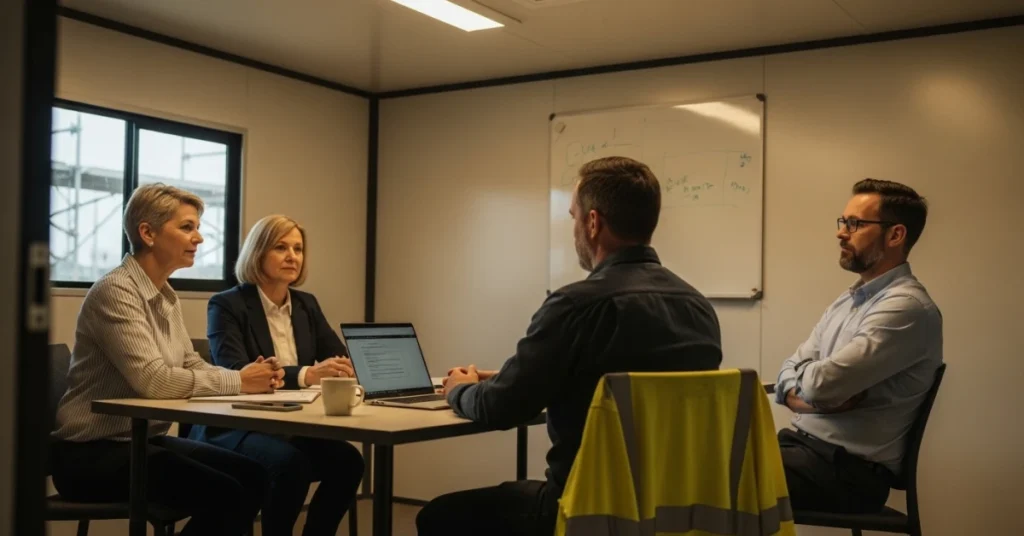
An OAC meeting in construction is a structured, recurring project meeting between the Owner, Architect, and Contractor — the three core decision-makers on any build. These sessions align stakeholders on schedule, budget, design, and open issues, preventing costly miscommunication before it escalates into change orders or delays.
What Is an OAC Meeting in Construction?
An OAC meeting — short for Owner-Architect-Contractor meeting — is the primary governance forum for active construction projects. Held weekly or biweekly on most commercial jobs, it gives every key party a fixed cadence to surface risks, review progress, and make binding decisions. As Procore’s construction library notes, these meetings are the single most effective mechanism for improving collaboration and project efficiency across the entire project team.
The three core roles at every OAC table:
- Owner (or Owner’s Representative): Holds financial authority, approves changes, and sets project priorities.
- Architect (or Design Professional): Interprets drawings, responds to RFIs, and ensures design intent is preserved.
- Contractor (General Contractor or Construction Manager): Reports on schedule, cost, subcontractor performance, and field conditions.
Depending on project size, the owner may bring a project manager, lender representative, or facilities director. The contractor typically brings the superintendent and project engineer. The more people who are genuinely accountable attend, the more productive every session becomes.
Why Do OAC Meetings Matter on Every Project?
Construction projects fail for predictable reasons: unresolved RFIs, scope creep, unapproved substitutions, and schedule slippage that goes unreported until it’s irreversible. OAC meetings in construction exist precisely to intercept those failure modes at the earliest possible stage.
According to research highlighted by RIB Software, poor communication is a root cause in the majority of construction disputes and cost overruns. A disciplined OAC cadence creates a documented, time-stamped record of every decision — which protects all parties and keeps the project moving.
Key reasons these meetings drive impact:
- They force a weekly schedule look-ahead, so delays surface 2–3 weeks before they hit the critical path.
- They create a live risk register that every stakeholder reviews and owns.
- They reduce email chains by resolving issues in real time, in the room.
- They establish accountability: action items are assigned with names and due dates.
- They generate meeting minutes that serve as a contemporaneous record in any dispute.

Who Should Attend an OAC Meeting?

The right attendees depend on project phase and agenda, but the core group is consistent. Bloating the room with too many people kills decision velocity; excluding key people creates information gaps.
| Role | Typical Attendee | Frequency |
|---|---|---|
| Owner | Owner or Owner’s Rep | Every meeting |
| Design | Architect of Record | Every meeting |
| Construction | General Contractor / CM | Every meeting |
| Field | Superintendent | Every meeting |
| MEP Coordination | Lead MEP Subcontractor | When scope is active |
| Structural | Structural Engineer | As needed |
| Finance | Owner’s Lender/PM | Monthly or at milestones |
| Specialty | AV, IT, or specialty trade manager | When scope is active |
The project manager on the contractor’s side typically runs the meeting, distributes the agenda in advance, and issues minutes within 24 hours. That turnaround is not optional — delayed minutes mean delayed action items, and delayed action items mean delayed projects.
How Often Should OAC Meetings Be Held?
Most commercial and institutional projects hold OAC meetings weekly during active construction. Pre-construction and closeout phases may drop to biweekly. The cadence should match project velocity, not personal preference.
- Pre-construction: Biweekly; focus on design coordination, permitting, and procurement.
- Active construction: Weekly; focus on schedule, RFIs, submittals, and open issues.
- Substantial completion / closeout: Biweekly or monthly; focus on punch list, commissioning, and owner training.
Skipping or shortening meetings to “save time” is one of the most expensive decisions a project manager can make. Every unresolved issue has a compounding cost.
What Should Be on Every OAC Meeting Agenda?
A consistent agenda structure is the difference between a productive 60-minute session and a meandering 2-hour conversation that resolves nothing. The most effective OAC meetings in construction follow a standing agenda that every attendee can prepare for in advance.
Standard OAC Meeting Agenda Items
- Safety update — incident log, near-misses, OSHA compliance status
- Schedule review — 3-week look-ahead, critical path status, float analysis
- RFI log — open items, days outstanding, response urgency
- Submittal log — pending approvals, resubmittals, expedite flags
- Change order status — pending PCOs, approved COs, budget impact
- Budget / cost report — cost-to-complete, contingency remaining, forecast
- Owner decisions required — items needing owner approval before work can proceed
- Quality and inspections — failed inspections, corrective actions, open NCRs
- Old business — action items from prior meetings, status updates
- New business — emerging issues, upcoming milestones, coordination needs
When the agenda is distributed 24–48 hours before the meeting, people come prepared. That single habit cuts average meeting duration by 30–40% and dramatically improves the quality of decisions made.
How Do You Run a High-Impact OAC Meeting? Step-by-Step
Running a high-impact session isn’t about personality — it’s about process. As Kyle Nitchen details in his OAC meeting framework, the project manager who follows a disciplined structure consistently earns a reputation as the most effective leader in the room.
Before the Meeting
- Distribute the agenda at least 24 hours in advance.
- Update all logs — RFI, submittal, change order — so data is current.
- Identify decisions needed from the owner and flag them explicitly on the agenda.
- Pre-brief the superintendent on schedule status so field reality matches the report.
- Book a fixed recurring slot — consistency builds attendance habits.
During the Meeting
- Start on time, every time. Waiting for late arrivals trains people to be late.
- Assign a dedicated note-taker who is not also running the meeting.
- Park scope creep — off-agenda topics go to a “parking lot” list for follow-up.
- Assign every action item with a name, a date, and a clear deliverable.
- End with a read-back of all action items before closing.
After the Meeting
- Issue minutes within 24 hours — this is non-negotiable.
- Track every open action item in a rolling log, not just in the minutes PDF.
- Follow up on overdue items before the next meeting, not during it.
- Archive minutes in the project management platform where all parties can access them.
For project teams managing complex field operations, a purpose-built field management platform can automate log updates, action item tracking, and minutes distribution — eliminating the manual overhead that causes most post-meeting breakdowns.
What Are the Most Common OAC Meeting Mistakes?
Even experienced teams fall into patterns that erode meeting value. Recognizing these traps is the first step to fixing them.
No agenda distributed in advance. People arrive unprepared, decisions get deferred, and the meeting runs long. Every time.
Wrong people in the room. If the owner sends a junior coordinator who can’t approve anything, every decision requiring owner authority gets tabled. This is one of the most common sources of schedule impact on mid-size commercial projects.
No action item tracking. Meeting minutes are written, filed, and forgotten. The same issues reappear week after week. A rolling action item log — reviewed at the top of every meeting — eliminates this entirely.
Meeting becomes a status report, not a decision forum. If the project manager can read the schedule update in an email, don’t spend 45 minutes on it in the room. Use meeting time for issues that require dialogue, judgment, and authority.
Minutes issued days later. By the time people read minutes issued 72 hours after the meeting, they’ve already forgotten the context. The 24-hour rule exists for a reason.
What Questions Should Every Owner Ask at an OAC Meeting?
The owner holds financial authority and ultimate project accountability. Asking the right questions is how an owner exercises that authority without micromanaging. As INGENIOUS.BUILD outlines, the most effective owner questions are forward-looking, not retrospective.
The five questions every owner or owner’s representative should ask at every OAC session:
- “Are we on track to hit the next milestone, and if not, what’s the recovery plan?” — Forces the contractor to own schedule accountability, not just report it.
- “What decisions do you need from me in the next 14 days to keep work moving?” — Proactively surfaces owner-caused delays before they happen.
- “What is the current forecast cost at completion versus the approved budget?” — Distinguishes between approved contract value and actual exposure.
- “Are there any emerging risks I should know about that aren’t yet in a formal change order?” — Uncovers informal scope creep and field conditions early.
- “What quality or safety issues were identified this week, and how are they being resolved?” — Signals that the owner takes quality and safety seriously, which changes contractor behavior.
Owners who ask these questions consistently make better decisions and experience fewer surprises. The project manager who helps the owner ask them is a more effective project manager.
OAC Meeting Checklist: Complete Pre/During/Post Guide
Use this checklist on every project, every meeting cycle, without exception.
✅ Before the Meeting (48–24 Hours Out)
- Update RFI log with current status and days outstanding
- Update submittal log with pending approvals and expedite flags
- Update change order log with pending PCOs and approved COs
- Pull current schedule and identify any slippage vs. baseline
- Identify items requiring owner decision; flag on agenda
- Distribute agenda to all attendees with supporting logs attached
- Confirm attendance of owner, architect, and superintendent
- Reserve meeting room or send video conference link
✅ During the Meeting
- Start on time
- Confirm note-taker is assigned and recording
- Walk agenda in order; do not skip items
- Assign every action item: name + due date + deliverable
- Capture parking lot items for follow-up outside the meeting
- Read back all action items at close of meeting
- Confirm date and time of next meeting
✅ After the Meeting (Within 24 Hours)
- Issue meeting minutes to all attendees and project file
- Update rolling action item log
- Log any new RFIs or change events identified during discussion
- Send owner any decision requests in writing with a response deadline
- Archive minutes in project management system
Teams that consistently execute this checklist reduce open action items by an average of 40% within the first month of implementation. For projects using integrated construction project management tools, this checklist can be templated and automated across every project in the portfolio.
How Should OAC Meeting Minutes Be Written?
Meeting minutes are a legal document. They establish what was decided, who decided it, and when. Sloppy minutes are a liability; precise minutes are an asset.
Effective OAC meeting minutes include:
- Project name, number, date, time, and location
- Attendee list with names, companies, and roles
- Agenda items covered, in order, with a concise summary of discussion
- Decisions made, stated clearly and unambiguously
- Action items: responsible party, deliverable, due date
- Open issues carried forward to next meeting
- Distribution list and date/time issued
Minutes should be written in past tense, third person, and active voice. Every action item entry should follow this format: “[Name] to provide [specific deliverable] by [date].” No ambiguity, no passive constructions.
When a dispute arises — and on complex projects, disputes arise — well-written minutes are often the single most important document in the file. Project managers who understand this write better minutes. Teams using digital construction documentation platforms can generate structured minutes templates that enforce this standard automatically.
OAC Meetings vs. Other Construction Meetings: What’s the Difference?
Construction projects run multiple meeting types simultaneously. Understanding which forum handles which issues prevents the wrong conversations from happening in the wrong room.
| Meeting Type | Attendees | Frequency | Primary Purpose |
|---|---|---|---|
| OAC Meeting | Owner, Architect, Contractor | Weekly | Decisions, alignment, escalation |
| Subcontractor Coordination | GC + Subs | Weekly | Field coordination, sequence |
| Design Review | Owner, Architect, Engineer | As needed | Design decisions, RFI resolution |
| Safety Meeting | All field personnel | Weekly | OSHA compliance, hazard review |
| Schedule Pull Planning | GC + Subs | Weekly | 3-week look-ahead, commitments |
| Owner Progress Meeting | Owner + PM | Monthly | Budget, milestone, executive update |
The OAC meeting sits at the top of this hierarchy. Issues that cannot be resolved at the subcontractor coordination level or the design review level escalate to the OAC. The project manager’s job is to make sure the right issues reach the right forum — and that the OAC is not burdened with problems that should have been resolved in the field.

How to Manage Difficult Dynamics in OAC Meetings
Every project has interpersonal friction. The owner is frustrated with architect response times. The architect believes the contractor is substituting materials without approval. The contractor’s project manager thinks the owner’s representative is overstepping authority. These dynamics are normal. Managing them is the project manager’s responsibility.
Practical tactics for managing difficult OAC dynamics:
- Separate the issue from the person. Address the RFI response time problem, not the architect’s character.
- Use data, not opinions. “The RFI log shows 14 open items with an average response time of 18 days against a 10-day contractual standard” is not a personal attack — it’s a fact.
- Establish ground rules early. In the first OAC meeting, agree on how decisions will be documented, how disagreements will be escalated, and what constitutes an approved change.
- Never ambush people in the meeting. If a difficult topic is coming up, brief the relevant parties before brief the relevant parties before the meeting so they can prepare, align expectations, and avoid defensive reactions during the discussion.
Conclusion
OAC meetings are the central decision-making forum of any construction project. When structured properly, they align stakeholders, surface risks early, and ensure that every issue is addressed before it impacts schedule or budget.
The difference between a smooth project and a delayed one often comes down to how these meetings are run. Clear agendas, defined responsibilities, timely minutes, and disciplined follow-up turn OAC sessions from routine check-ins into high-impact execution tools.
As projects become more complex, combining strong meeting practices with real-time data and the right tools ensures faster decisions, better coordination, and more predictable outcomes.