


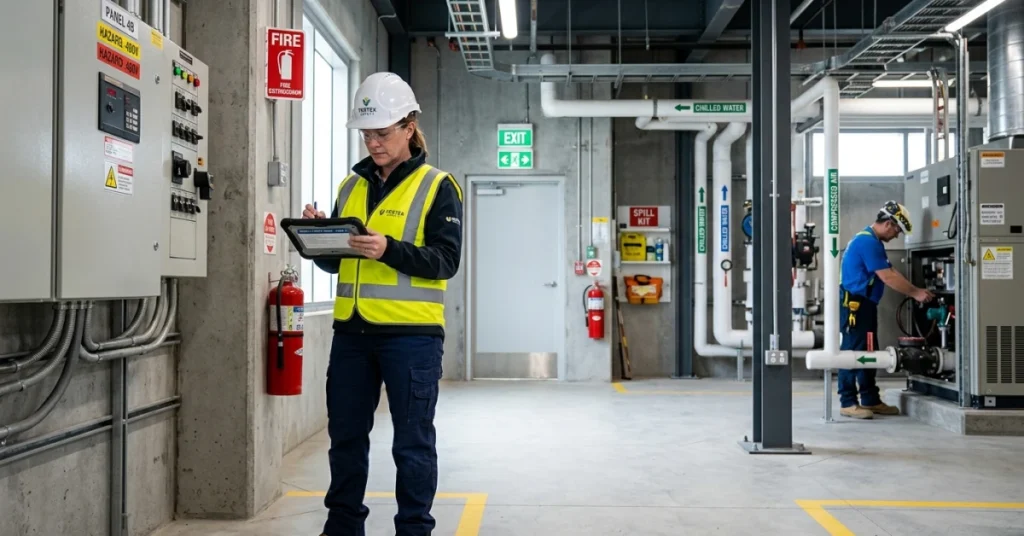
A construction safety inspection is a systematic, on-site evaluation of a jobsite’s conditions, equipment, and work practices to identify hazards, verify regulatory compliance, and protect workers from injury or death. Conducted by qualified personnel, these inspections are mandated under OSHA 29 CFR 1926.20 and form the backbone of any credible safety health program.
Why Does Construction Safety Inspection Matter?
Construction kills. According to the Texas Department of Insurance, Division of Workers’ Compensation, construction accidents account for roughly 20% of all work-related deaths in America each year, producing thousands of career-ending injuries annually. No other major industry sector carries that burden.
The stakes go beyond human cost. OSHA citations for missed inspections routinely reach five figures per violation. Project delays triggered by a single recordable incident can consume weeks of schedule and hundreds of thousands in rework costs.
Regular inspections on construction sites serve three non-negotiable functions:
- Hazard identification before an incident occurs
- Regulatory compliance with federal and state OSH standards
- Documentation that protects employers in litigation and insurance audits
What Are the Main Types of Construction Site Inspections?
Not every inspection looks the same. The type you conduct depends on project phase, regulatory trigger, and risk level.
| Inspection Type | Trigger | Typical Frequency |
|---|---|---|
| Pre-construction survey | Before groundbreaking | Once per project |
| Daily walk-through | Ongoing site conditions | Daily |
| Scheduled safety audit | Management compliance review | Weekly or monthly |
| Post-incident investigation | After an accident or near miss | Immediately |
| Regulatory (OSHA) inspection | Complaint, referral, or programmed | As required |
| Equipment inspection | Before each use or shift | Per equipment cycle |
As the International Labour Organization’s training guide on OSH in construction notes, effective inspections in construction sites must account for the dynamic nature of the work environment—hazards on a site change daily as structures rise, trades overlap, and equipment moves.

Who Should Conduct a Construction Safety Inspection?
Responsibility for inspections is layered. Each level carries distinct authority and accountability.
- Competent Person (OSHA definition): Someone capable of identifying existing and predictable hazards, with authority to take prompt corrective action. Required by 29 CFR 1926.20 for most inspection categories.
- Site Superintendent or Foreman: Conducts daily walk-throughs and pre-task checks.
- Safety Manager or OSH Officer: Leads formal weekly or monthly audits, reviews findings, and manages corrective action tracking.
- Third-Party Inspector: Used for pre-occupancy, insurance, or regulatory compliance inspections.
- OSHA Compliance Officer: Conducts unannounced or complaint-driven inspections with citation authority.
For multi-trade projects, the general contractor’s safety manager typically owns the master inspection schedule, while subcontractor supervisors run task-level checks. Effective management of this layered structure is what separates proactive sites from reactive ones.
How Do You Conduct a Construction Safety Inspection Step by Step?
A structured process eliminates guesswork and ensures nothing gets missed. Follow these eight steps on every formal inspection.
Step 1 — Pre-Inspection Preparation
Pull the previous inspection report and open corrective actions. Review the day’s work plan and identify which trades and equipment will be active. Confirm your checklist version aligns with the current project phase.
Step 2 — Documentation Setup
Record the date, time, site address, inspector name, and superintendent on file. If you’re using digital field inspection software, open the form before entering the site perimeter.
Step 3 — Site Perimeter and Access Review
Check that warning signs, barriers, and secured access controls are in place. Verify open ditches are protected, ladders are secured after hours, and hazard lights are operational. Traffic routes must be clearly identified per OSHA requirements.
Step 4 — Housekeeping and Sanitation
Inspect the general neatness of work areas. Confirm waste containers are provided and used, passageways and walkways are clear, and sanitary facilities are adequate and clean. Adequate potable water and first aid kits must be accessible to all workers.
Step 5 — Equipment and Machinery Check
Inspect all active equipment for pre-use certification tags, operator credentials, and visible damage. Verify that guards are in place, load ratings are posted, and lockout/tagout procedures are followed. Equipment used without current inspection documentation is a direct OSHA violation.
Step 6 — Hazard Communication Review
Confirm Safety Data Sheets (SDS, formerly MSDS) are on file and accessible. Check that all chemical containers are properly labeled, a site chemical log exists, and workers have received hazard communication training.
Step 7 — Fall Protection and Personal Protective Equipment
Falls remain the leading cause of construction fatalities. Verify that guardrails, safety nets, or personal fall arrest systems are installed at all leading edges above 6 feet. Inspect PPE for damage and confirm workers are wearing required gear for their task. This area is consistently among the top OSHA citation categories for construction sites.
Step 8 — Corrective Action and Closeout
Log every deficiency with a description, photo, responsible party, and target correction date. Assign findings in your management system immediately—do not wait until you’re back at the office. Verify prior open items are closed before ending the inspection.
What Are the Most Commonly Cited OSHA Violations on Construction Sites?
OSHA publishes its top 10 citation list annually. For construction, these five categories dominate year after year:
- Fall Protection (1926.501) — No. 1 cited standard for construction sites
- Scaffolding (1926.451) — Improper erection, no fall protection, overloading
- Ladders (1926.1053) — Missing side rails, improper angle, used as work platforms
- Hazard Communication (1910.1200) — Missing SDS, unlabeled containers
- Lockout/Tagout (1910.147) — Equipment not de-energized during maintenance
Each of these is directly addressed by a rigorous construction safety inspection program. Sites that conduct weekly formal audits with documented corrective actions consistently show lower citation rates and lower experience modification rates (EMR) on workers’ compensation insurance.
What Role Does OSH Regulation Play in Construction Inspections?
In the United States, OSHA sets the federal floor. Title 29 CFR Part 1926 governs construction-specific safety health requirements, with 1926.20 establishing the general safety and health provisions that form the basis of any compliant inspection program. State-plan states—including North Carolina, California, and Michigan—operate their own OSH programs that must be at least as effective as federal OSHA.
Internationally, the ILO’s Safety and Health in Construction Convention No. 167 (1988) and Recommendation No. 175 provide the framework that national regulators use to develop their own standards. The ILO’s published guide on inspecting OSH in the construction industry remains one of the most comprehensive references available for understanding what inspectors look for and why.
The UK’s Health and Safety Executive (HSE) takes a similar approach. The HSE’s essential health and safety toolkit for smaller contractors outlines minimum compliance requirements that mirror many OSHA provisions, reinforcing that the fundamentals of site safety are universal regardless of jurisdiction.
Compliance is not a one-time achievement. It requires a continuous cycle of inspection, corrective action, re-inspection, and management review. Organizations that treat inspections as a project management discipline—rather than a reactive exercise—consistently outperform peers on both safety and productivity metrics.
How Should Construction Inspection Findings Be Managed?
Identifying a hazard is only half the job. The other half is closing it out. A finding that sits open for weeks is arguably worse than no inspection at all—it creates documented evidence of a known hazard that went unaddressed.
Effective finding management follows four steps:
- Categorize by severity: Immediate danger to life (correct now), serious violation (correct within 24 hours), moderate risk (correct within the week), low risk (schedule for next planned maintenance).
- Assign ownership: Every finding needs a named responsible party, not a department.
- Set a realistic deadline: Deadlines must account for material lead times and crew availability.
- Verify closure: The same inspector who identified the finding—or a peer—must physically verify the corrective action before marking it closed.
Project management teams that integrate inspection findings into their weekly project review meetings see faster closure rates and fewer repeat violations. Using a unified platform for managing site safety data and project workflows ensures findings don’t get lost between the field and the office.
What Are Special Considerations for High-Risk Construction Activities?
Certain operations on construction sites carry elevated risk profiles and require inspection protocols beyond the standard checklist.
Excavation and Trenching: Trenches deeper than 5 feet require a competent person inspection before workers enter—every shift, after rain, and after any ground disturbance. Cave-ins kill within seconds. No inspection interval is too frequent for active excavations.
Crane and Rigging Operations: Cranes must be inspected by a qualified person prior to each use. Annual inspections by an accredited third party are required for most crane types under ASME B30 standards. The load chart must be posted in the cab and used by equipment operators on every lift.
Confined Space Entry: Any confined space on a construction site requires a permit system, atmospheric testing, and a trained attendant. The competent person must inspect the space and verify atmospheric conditions before entry is authorized.
Scaffold Erection and Dismantling: Scaffolding must be erected, moved, and dismantled under the supervision of a competent person. Workers must not use scaffolding that has not been inspected and tagged within the current shift.
For safety managers overseeing multiple high-risk operations simultaneously, building a digital permit-to-work system into your inspection workflow eliminates the paper-based gaps that cause incidents.

How to Build a Sustainable Construction Safety Inspection Program
A single inspection changes nothing. A program changes culture. Here’s how to build one that lasts.
Define inspection frequency by risk level. High-hazard activities (excavation, crane work, confined space) require daily or per-shift checks. General site conditions warrant weekly formal audits. Full compliance audits should occur monthly.
Train your inspectors. A checklist is only as good as the person using it. Competent person training, OSHA 30-hour construction certification, and task-specific training are minimum thresholds for anyone conducting formal inspections.
Use leading indicators, not just lagging ones. Inspection completion rates, near-miss reporting rates, and corrective action closure times are leading indicators that predict incident frequency. Relying only on recordable incident rates tells you what already went wrong.
Integrate with project management. Safety inspections should feed directly into the project schedule. A failed scaffold inspection that halts work for a day is a schedule event, not just a safety event. When safety health data flows into the project management system, both teams make better decisions.
Conclusion
A strong construction safety inspection program depends on consistent execution, timely corrective actions, and a proactive safety culture. From fall protection and equipment checks to hazard communication and housekeeping, inspections help prevent injuries, reduce compliance risks, and keep projects on schedule.
The most effective contractors treat construction safety inspections as an ongoing operational process — not just a compliance requirement. By combining structured checklists, trained inspectors, and real-time reporting tools, companies can identify hazards earlier, improve site visibility, and maintain safer, more efficient jobsites.