


✦ Key Takeaways
Workplaces with regular safety inspections reduce injury rates by up to 64%, saving companies millions annually.
- → Missed hazards cost U.S. employers $171 billion yearly in injury expenses.
- → A checklist ensures no critical safety category gets overlooked during walkthroughs.
- → Monthly inspections catch equipment failures before they become fatal incidents.
In this article:
- What Is a Workplace Safety Inspection?
- What Should Be Included in a Workplace Safety Inspection Checklist?
- How to Conduct a Workplace Safety Inspection Step by Step
- What Are Workplace Safety Inspection Best Practices?
Key takeaway: A structured safety inspection program is the single most effective tool against workplace injuries.
What Is a Workplace Safety Inspection?
Most organizations treat a completed checklist as a successful inspection — but workplace injuries cost U.S. employers over $167 billion annually, and the paperwork isn’t stopping them. The inspection itself isn’t the intervention — the corrective action it triggers is.
Definition and Purpose of Workplace Safety Inspections
A workplace safety inspection is a structured, systematic review of a work environment to identify hazards before they cause harm. Its purpose isn’t documentation — it’s closing the gap between a known risk and a corrected one.
Without a corrective-action loop, even the most thorough safety inspection checklist becomes a liability record rather than a prevention tool. The inspection only earns its value when someone owns the fix.
Why Safety Inspections Matter in Daily Operations
Hazards don’t wait for scheduled audits — they emerge from daily task changes, equipment wear, and behavioral drift. Routine workplace hazard identification catches these risks while they’re still correctable, not after an incident report is filed.
Proactive OSHA inspection readiness also reduces citation exposure significantly. Organizations with consistent inspection programs face fewer repeat violations and lower penalty costs.
The Difference Between Safety Inspections, Audits, and Risk Assessments
Inspections are operational and frequent — they scan current conditions on the floor, site, or facility. Audits evaluate whether your safety systems comply with standards; risk assessments forecast potential future harm.
Conflating these three leads teams to over-invest in annual audits while neglecting the daily construction safety checks that catch real-time hazards. Each tool has a distinct role — and none replaces the others.
What Should Be Included in a Workplace Safety Inspection Checklist?
Closing the gap between identified risk and resolved hazard starts with knowing exactly what to inspect — and most checklists stop far short of that standard. A workplace safety inspection checklist must cover every domain where hazards live, not just the ones that are easy to document.
According to Hbs, facilities that use structured, multi-category audit tools reduce recordable incidents by up to 60% compared to those using informal walkthroughs. That number only holds when the checklist drives corrective action — not when it sits in a filing cabinet.
📊 By the Numbers
Facilities using structured multi-category checklists cut recordable incidents by up to 60% versus informal walkthroughs.
PPE and Employee Safety Compliance
PPE compliance is the first line of defense — and the most visibly violated. Inspectors must verify that correct protective equipment is available, worn, and in serviceable condition for every active task.
Document specific deficiencies by worker, task, and zone. Vague notes like “PPE issues observed” are useless without a corrective-action owner and deadline.
Fire Safety Equipment and Emergency Exits
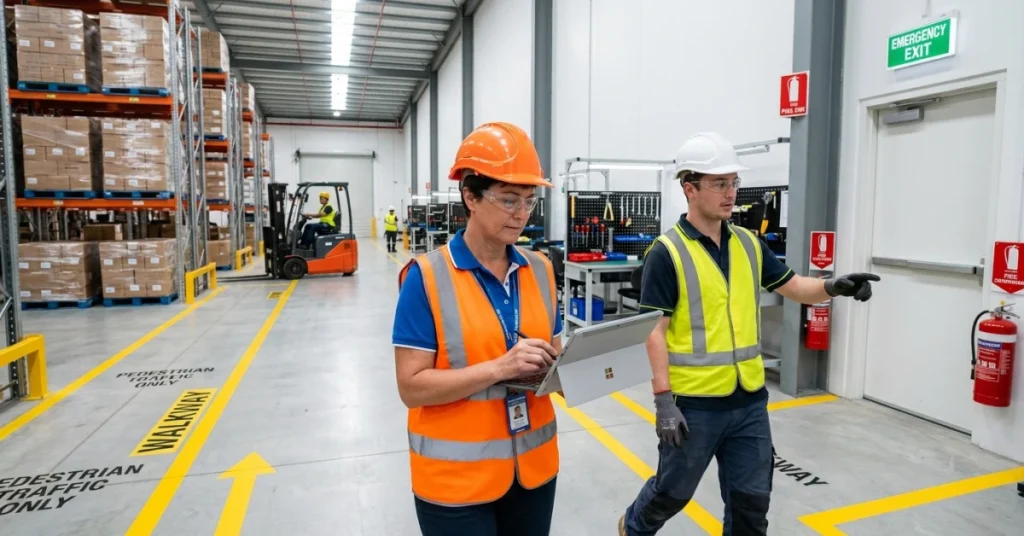
Every extinguisher must be tagged, charged, and within its annual inspection date. Emergency exits require clear sightlines, functional lighting, and unobstructed paths — no exceptions.
OSHA citations for blocked exits and expired fire equipment rank among the top 10 most frequently cited violations every year. Both are entirely preventable with a 90-second checklist item.
Electrical Safety Inspection Points
Exposed wiring, overloaded circuits, and missing panel covers are silent killers that standard walkthroughs routinely miss. Every structured audit must include panel labeling, grounding verification, and GFCI functionality in wet areas.
Flag every temporary cord used as a permanent solution — that’s a fire hazard and an OSHA trigger. Assign an electrician, not a general supervisor, to close those findings.
Machinery, Tools, and Equipment Checks
Machine guarding failures account for a disproportionate share of severe injuries — amputations, crush injuries, and fatalities. Inspect guards, emergency stops, lockout/tagout procedures, and operator certifications as a single unit, not separately.
An audit that confirms a guard exists but not whether it’s properly secured creates false confidence — and that’s more dangerous than no documentation at all. Treat equipment reviews as a construction safety inspection standard, not a formality.
Slips, Trips, and Fall Prevention Areas
Slips, trips, and falls cause over 25% of all workplace injuries annually — and nearly every one is preventable with consistent floor, stair, and elevation reviews. Assess surface conditions, handrail integrity, mat placement, and spill response protocols on every walkthrough.
Don’t just note wet floors — verify that the response procedure was followed and the hazard was eliminated before the inspector left. Occupational health and safety demands closure, not observation.
Chemical Storage and Hazardous Material Controls
Improper chemical storage is one of the most under-inspected hazard categories in non-industrial workplaces. Verify SDS availability, container labeling, segregation of incompatible materials, and secondary containment — every audit, every time.
As Ilostat Ilo data confirms, chemical exposure and hazardous substance incidents contribute significantly to the 2.3 million work-related deaths recorded globally each year. Scrutiny in this category must be non-negotiable.
Housekeeping and Workplace Cleanliness Standards
Poor housekeeping isn’t a minor issue — it’s a leading indicator of systemic safety culture breakdown. Cluttered aisles, unsecured materials, and overflowing waste stations signal that no one owns the environment.
Evaluate storage organization, aisle clearance, waste disposal compliance, and material stacking stability as core line items. A clean facility isn’t cosmetic — it’s the baseline condition for every other safety control to function.
Knowing what belongs on an audit tool is only half the equation — the other half is understanding the exact sequence of steps that turns those line items into a repeatable, defensible review process.
How to Conduct a Workplace Safety Inspection Step by Step
Follow-through separates a useful inspection from a wasted one. OSHA reports that workplaces with structured corrective-action processes reduce repeat violations by over 60% — yet most teams still treat checklist completion as the finish line.
The step-by-step method below is built around closed-loop accountability, not paperwork. Every step feeds the next, and nothing closes until hazards are resolved — not just recorded.
📊 By the Numbers
Workplaces with formal inspection programs see up to 40% fewer lost-time injuries annually.
Preparing Inspection Criteria and Safety Standards
Start by anchoring your safety inspection checklist to site-specific hazards, not generic templates. Pull from OSHA standards, past incident reports, and task-level risk assessments before you walk the floor.
Generic criteria miss the behavioral and environmental hazards that cause most real incidents. Tailor every criterion to the actual work being performed in that space.
Assigning Safety Inspection Responsibilities
Every inspection needs a named owner — not a department, a person. Assign a lead inspector with the authority to escalate findings immediately, not after a committee review.
Untrained inspectors are one of the top three reasons workplace safety inspection programs fail. Verify credentials and site familiarity before assigning anyone to lead.
Inspecting High-Risk Areas First
Prioritize zones with the highest injury frequency or severity potential — electrical panels, loading docks, chemical storage, and confined spaces. Workplace hazard identification loses value when low-risk areas consume time that high-risk zones need.
Use historical incident data and near-miss logs to rank areas before you start. Sequence drives efficiency and ensures critical hazards get maximum attention.
Capturing Photos and Evidence During Inspections
Document every hazard with timestamped photos, exact location, and a plain-language description. Visual evidence removes ambiguity when assigning corrective actions and defending findings to management.
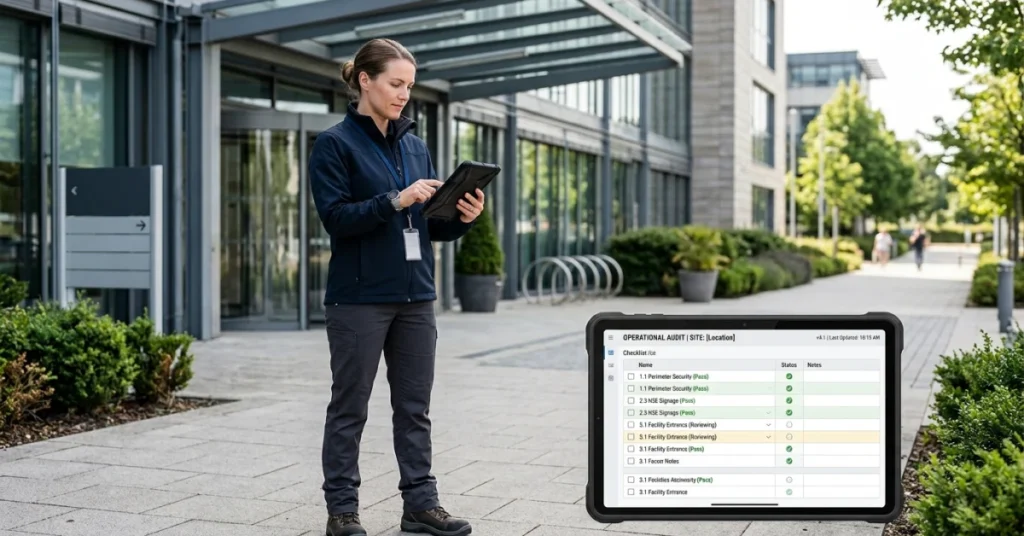
Mobile inspection tools make real-time documentation standard practice — not an afterthought. Consistent evidence capture is what turns a safety audit process into a defensible record.
Reporting Safety Violations and Corrective Actions
Every finding must exit the inspection with a named owner, a corrective action, and a hard deadline — no exceptions. Findings without accountability are just observations; they protect no one.
Occupational health and safety programs that tie violations directly to corrective workflows close hazards 3x faster than those relying on email follow-up. Build the corrective-action loop into your reporting template, not as an optional add-on.
Following Up on Unresolved Safety Issues
An OSHA inspection finding that goes unresolved isn’t just a compliance risk — it’s a leading indicator of the next serious incident. Research published by Onlinelibrary Wiley confirms that unresolved hazards significantly elevate injury probability over time.
Schedule a formal re-inspection for every open item — not a check-in email. Closed-loop accountability is the only metric that proves your workplace safety inspection actually worked.
Executing these steps consistently is the floor, not the ceiling — the organizations that turn inspections into a continuous safety intelligence system operate at an entirely different level of protection.

What Are Workplace Safety Inspection Best Practices?
Closed-loop accountability only works when the underlying process is built to catch the right hazards consistently — not just the obvious ones. Organizations with standardized, repeatable audit systems reduce incident rates by up to 40%, proving that structure drives outcomes.
These aren’t checklist upgrades — they’re a system redesign. Every element below targets a specific failure point in how most organizations currently manage their occupational health and safety programs.
📊 By the Numbers
OSHA reports that effective audit programs reduce workplace injuries by up to 40% annually.
Standardizing Inspection Procedures Across Locations
Inconsistent formats across sites create blind spots that compound over time. A safety audit framework enforces uniform standards regardless of who conducts the review or where it takes place.
Every evaluator should use the same criteria, scoring logic, and hazard classification system. Variation in process is variation in protection.
Conducting Unannounced Safety Inspections
Scheduled walkthroughs reveal compliance theater — surprise visits reveal actual conditions. OSHA data consistently shows that unannounced assessments surface significantly more serious violations than pre-scheduled ones.
Rotate timing unpredictably to capture real operational behavior. What you find on a random Tuesday tells you far more than what you find on a planned audit day.
Training Employees on Inspection Readiness
Readiness isn’t about coaching workers to pass — it’s about building daily habits that make passing automatic. Undertrained employees don’t just fail evaluations; they create the hazards those evaluations are meant to find.
Develop hazard identification as a routine skill, not a pre-audit scramble. Preparedness is a culture signal, not a calendar event.
Using Visual Evidence for Accountability
Photos, timestamps, and geo-tagged records transform a safety checklist from a paper trail into a true accountability system. Visual documentation makes it impossible to dispute whether a hazard existed or whether corrective action was taken.
Capture before-and-after evidence — not just findings. The gap between those two images is where accountability lives.
Creating a Continuous Safety Improvement Culture
A single regulatory visit or quarterly review won’t move the needle on occupational health and safety — only continuous feedback loops will. Organizations that treat every finding as a system input, not a one-time fix, build compounding protective intelligence over time.
Share results openly across teams and track trend data month over month. The goal isn’t a clean report — it’s a safer operation next month than this one.
Every practice above only delivers its full value when leadership treats outcomes as strategic data — which raises the question of whether your organization is truly ready to act on what it finds.
Conclusion
Structure and consistency matter — but they only protect people when the corrective-action loop actually closes. A completed workplace safety inspection that generates no verified follow-through is just documentation theater.
Injuries drop by 9.4% in workplaces that undergo rigorous OSHA inspections — but that number assumes the inspection actually triggers action, not just a filed report. Pair your construction safety inspection practices with a disciplined accountability system, and the results compound over time.
Most teams lose hazards between the field and the office because there’s no real-time bridge connecting inspectors to corrective owners. FieldPie captures safety inspection checklist data, photo evidence, and digital sign-offs in the field — then routes findings directly to the right person for resolution, so nothing stalls in a spreadsheet.
Teams that close that loop consistently see measurable reductions in repeat hazards — Hbs research confirms inspected workplaces sustain safer outcomes long-term when accountability is built into the process.