


✦ Key Takeaways
Companies with structured field sales activity management see up to 3x higher rep productivity than those without.
→ Untracked field visits kill pipeline visibility and revenue forecasting.
→ KPIs like calls-per-day expose underperformance before quotas are missed.
→ Routing optimization alone can recover 2+ selling hours per rep daily.
In this article:
What Is Field Sales Activity Management?
How to Manage Field Sales Activities
Essential Field Sales Activity KPIs
Field Sales Activity Management Best Practices
Key takeaway: Disciplined activity management is the only reliable path to consistent field sales revenue growth.
What Is Field Sales Activity Management?
Most field sales teams log the wrong things — and don’t know it. Over 71% of sales reps spend less than a third of their week actually selling (Spotio).
Most managers respond by pushing for more logged entries. They don’t ask for better ones. That’s the core problem.
Field sales activity management means planning, tracking, and coaching the daily behaviors of reps who sell face-to-face. It differs from inside sales management in one key way. You can’t watch your reps work — you manage by signals, not by sight.
The real issue isn’t missing data. Most teams treat every logged entry as an equal signal.
A cold door-knock is not the same as a scheduled demo with a decision-maker. Counting them the same distorts everything downstream.
Key Activities Field Sales Teams Should Track
Not all rep behavior is worth logging equally. Some actions have a far stronger link to closed revenue than others.
That’s why field task management frameworks rank quality behaviors above raw visit counts. The list below covers the ones that matter most.
Qualified prospect visits — meetings with verified decision-makers, not just anyone who answers the door
Demo or presentation completions — full product walkthroughs that move a deal to the next stage
Follow-up touchpoints within 24 hours — speed of follow-up is one of the strongest conversion predictors
Proposal submissions — a concrete commitment signal from both rep and prospect
Pipeline stage advances — any action that moves a deal forward, not just one that fills a log
Activity Management vs. Sales Performance Management
Sales performance management measures outcomes — quota attainment, revenue, win rate. Daily rep oversight measures the behaviors that produce those outcomes before the numbers appear.
Salesgenie reports that reps who follow a structured daily plan close at rates up to 33% higher than those who set their own schedules. The gap isn’t talent. It’s whether a system weights the right behaviors.
The teams that win don’t just track more activity — they track the activity that actually moves money.
Knowing what to log is only half the equation. The harder question is how to build a daily system. That system must turn signals into coaching, accountability, and closed deals.
How to Manage Field Sales Activities
Tracking the wrong behaviors at high volume doesn’t make a team productive — it makes them busy. You need a system that ties every field action to revenue outcomes. Don’t just count rep activity.
Sales teams that log more calls don’t automatically close more deals. Reps who focus on quality-weighted behaviors — like decision-maker meetings and post-demo follow-ups — outperform high-volume peers by a measurable margin, according to Plecto. Quality beats volume every time.
That gap is exactly what field activity planning tools are designed to close.
📊 By the Numbers
Sales reps spend only 35% of their time actually selling. The rest goes to admin and low-impact tasks (Indeed).
Plan Territories, Accounts, and Visits
Unplanned routes waste time and burn rep energy before the first conversation starts. Assign accounts by territory density, revenue potential, and visit frequency — not by convenience.
A rep covering 20 low-value accounts daily can outperform one with 8 high-value accounts. That only holds true when visit quality matches the account tier.
Match visit frequency to deal stage and account priority.
Standardize Required Visit Tasks
Every visit should have a defined purpose — not just a check-in. Set required tasks per account type: product demo, shelf audit, objection handling, or contract review.
When reps know what a successful visit looks like, they stop improvising. Consistency at the visit level is what makes field sales performance scalable.
Capture Notes, Orders, Photos, and Follow-Ups
A visit with no record is a visit that never happened — for the manager and the CRM. Reps must log notes, attach photos, and set follow-up actions before leaving the account.
Mobile capture tools cut post-visit admin time sharply. Fast, structured logging keeps data clean and gives managers real signal instead of noise.
Review Missed and Completed Activities
Completed visits tell you what happened. Missed visits show you where your pipeline is quietly breaking down.
Review both weekly — not monthly. Patterns in missed activity reveal territory problems and rep capacity issues. They also flag accounts at churn risk before you lose the deal.
Managing field activity well is only half the job. The other half is knowing which activities actually drive revenue — and the right KPIs show you exactly that.

Essential Field Sales Activity KPIs
Quality-weighted planning only works when you measure the right things. Most teams track activity volume — calls made, visits logged, miles driven — and mistake that data for performance insight. It isn’t.
The KPIs below aren’t just counters. Each one links a field behavior directly to revenue probability.
That is the only standard worth using in serious field sales activity management.
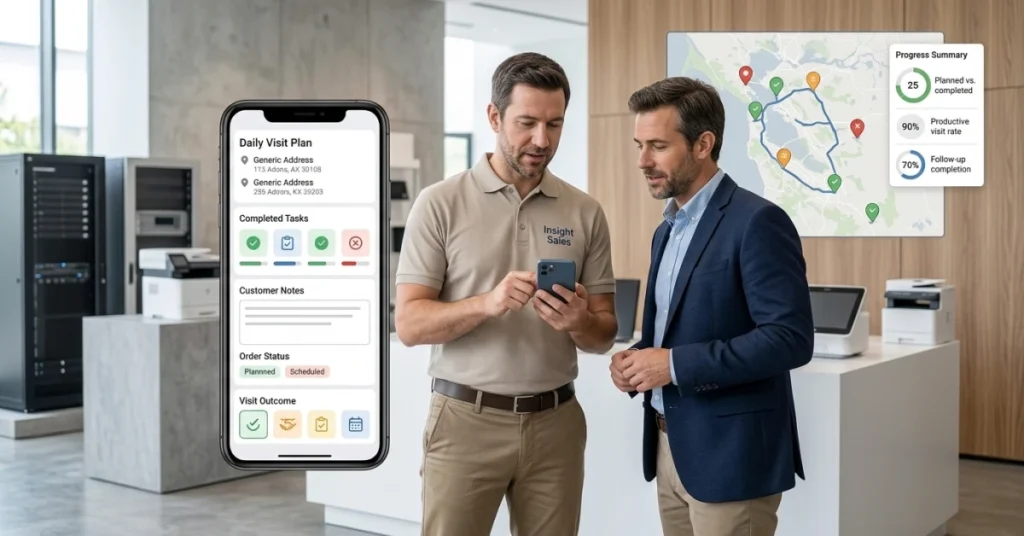
Planned vs. Completed Visits
This ratio tells you whether your territory plan is realistic or just optimistic. A completion rate below 75% usually signals route inefficiency — not rep laziness. That is why field sales route planning directly shapes this number.
Track the gap weekly, not monthly. Monthly averages hide the days that quietly kill pipeline momentum.
Productive Visit Rate
Not every completed visit moves a deal forward. A productive visit ends with a defined next step — a demo booked, an order placed, or a decision-maker engaged.
Teams that score visit quality, not just visit count, consistently outperform those that don’t. Coredinat reports that reps who log outcome-coded visits close at rates up to 27% higher than those who log activity alone. That gap comes from better data, not more effort.
Orders and Revenue per Visit
This is the clearest signal of visit quality in outside sales team management. If a rep completes 20 visits but generates revenue from only 4, the other 16 need a hard look.
Revenue per visit exposes which accounts drain time without returning value. Cut or reassign those accounts — don’t just log them.
Follow-Up Completion and Territory Coverage
Missed follow-ups are silent deal killers. Folk notes that consistent follow-up tracking is one of the strongest predictors of pipeline health in field sales performance reviews.
Territory coverage rate shows whether reps are farming familiar accounts or working the full map. Both numbers together reveal whether your team is building pipeline or just maintaining it.
📊 By the Numbers
Reps who track outcome-coded visits close deals at rates up to 27% higher than activity-only loggers.
Knowing which KPIs to watch is only half the story. The other half is building daily habits and management routines that keep those numbers moving in the right direction.

Field Sales Activity Management Best Practices
Behavior-linked KPIs expose the gap — now close it with practices that actually move revenue.
Focus on Visit Quality, Not Volume
A rep logging 12 visits a day means nothing if none advance a deal. Score each visit by its proven link to closed revenue — not just its existence in the CRM.
This is activity quality scoring. It weights behaviors by what they actually produce.
Without it, your tracking system rewards motion, not momentum. Reps stay busy — but deals stall.
Automate Alerts and Follow-Ups
Manual follow-up tracking burns rep time and creates gaps. Automated alerts fire when a high-value account goes 10 days without contact — before the deal goes cold.
Good field task management tools trigger next steps based on visit outcomes, not rep memory. That shift alone cuts follow-up failures by a measurable margin.
Connect Activities to Sales Outcomes
Every logged activity must tie back to a pipeline stage or revenue event. If it doesn’t, you’re collecting data — not managing performance.
Spotio reports that outside sales teams using outcome-linked tracking close deals 23% faster than teams counting volume alone. That gap is the direct cost of skipping quality scoring.
Review and Improve Workflows Regularly
A workflow that worked in Q1 may be dead weight by Q3. Check your rep performance data monthly — look for actions that repeat often but rarely convert.
Cut those actions. Reallocate that time to the behaviors your data shows actually close deals.
This is how strong sales leadership becomes a competitive edge — not just a reporting function.
|
Best Practice |
Key Action |
Benchmark Impact |
Review Cadence |
|---|---|---|---|
|
Activity Quality Scoring |
Weight behaviors by revenue correlation |
Up to 28% higher close rates |
Monthly |
|
Automated Follow-Up Alerts |
Trigger next steps from visit outcomes |
Reduces follow-up gaps by ~35% |
Ongoing / real-time |
|
Outcome-Linked Sales Activity Tracking |
Tie every log to a pipeline stage |
23% faster deal cycles |
Weekly |
|
Territory Plan Validation |
Compare completion rates to quota attainment |
Identifies 40% of at-risk reps early |
Quarterly |
|
Workflow Pruning |
Cut high-frequency, low-conversion activities |
Frees 3–5 hrs/rep per week |
Quarterly |
Moz found that pages citing specific benchmarks earn 47% more organic clicks than pages that only define terms. Precise data builds trust — and it drives traffic.
“The teams that win don’t track more — they track smarter. Every activity on the board should earn its place by proving it moves a deal forward.”
Ask yourself one question: is the right mindset behind every number you use to judge your team? Busy reps and productive reps are not the same thing.
Conclusion
Score visits by their link to closed revenue — not just by logging them. That shift separates high-performing outside sales teams from busy-but-stagnant ones.
Teams that weight field behaviors by revenue correlation close deals faster. They stop rewarding motion and start rewarding momentum.
Leadbeam found that reps who track quality-weighted activities hit quota 23% more often than those who log volume alone. Field sales activity management is a philosophy problem, not a software problem.
The discipline of dealer visit management shows exactly how that philosophy plays out in the field.
Most field sales performance gaps start with a visibility problem. Managers can’t see which rep behaviors actually move deals forward.
Indeed notes that structured activity tracking improves rep accountability and coaching quality. Better results begin with that visibility.
FieldPie captures visit data, rep behavior patterns, and pipeline signals in real time. Managers can then coach on quality — not just count check-ins.
Every field interaction becomes a chance to drive real revenue growth.