


✦ Key Takeaways
Merchandisers who plan store visits strategically cover 30% more accounts without adding a single extra hour.
→ Unplanned routes waste up to 2 hours per rep daily.
→ Store prioritization directly drives shelf compliance and sales lift.
→ A structured visit schedule cuts missed accounts by half.
In this article:
What Is Store Visit Planning for Merchandisers?
How to Prioritize Stores
How to Build a Merchandiser Visit Schedule
Store Visit Planning Workflow
Key takeaway: A disciplined field coverage plan is the single biggest lever merchandisers control.
What Is Store Visit Planning for Merchandisers?
Most merchandisers lose revenue not because they skip locations — but because they call on the wrong accounts first. Effective field scheduling is the process of deciding which outlets to cover, in what sequence, and for what reason — before the week even starts.
Over 30% of out-of-stock events go undetected for more than one full coverage cycle (Anaplan). That gap isn’t a routing problem — it’s a triage failure.
What a Productive Store Visit Should Achieve
A high-value call closes a specific risk — a compliance gap, a stocking failure, a display that’s off-plan. It isn’t a routine check-in driven by habit or geography.
Strong retail execution tools help teams tie every scheduled stop to a measurable outcome before the rep ever walks in the door.
Planned Visits vs. Reactive Visits
Reactive calls respond to complaints. Deliberate, pre-scheduled coverage prevents them — and that difference shows up directly in sell-through rates and shelf compliance scores.
As Trocglobal notes, a structured field planning process ties on-the-ground activity to commercial priorities — not just to whoever called last. The real question isn’t how to build a calendar — it’s which accounts cost you the most when skipped.
How to Prioritize Stores
Closing a risk means knowing which stores carry the most risk — before you ever map a route. Stores with active promotions, recent out-of-stocks, or flagged compliance gaps should sit at the top of every visit list, not stores that happen to be nearby.
Most merchandisers still build schedules around geography and habit. That approach costs real money — teams that rank stores by execution risk, not location, catch revenue-damaging gaps up to 40% faster each cycle (Repsly).
📊 By the Numbers
Retailers lose up to 4% of annual revenue from poor in-store execution and missed compliance windows (Repsly).
Rank Stores by Sales Potential and Execution Risk
Not every store deserves equal time. High-volume locations with a history of stocking failures carry the most revenue risk per missed visit.
Score each store on two axes: how much it sells and how often it breaks down. According to Toolio, stores in the top sales tier that also show execution gaps drive a disproportionate share of lost margin — making them the clear first priority in any retail execution planning cycle.
Set Visit Frequency by Store and Account Type
A flagship account with a live promotion needs weekly visits. A stable, low-volume store may only need a monthly check-in.
Matching visit frequency to actual risk level is the core of smart retail store visit scheduling. Treat every slot in your calendar as a resource — spend it where the damage potential is highest.
Prioritize Promotions, Out-of-Stocks, and Compliance Gaps
A store running a promotion that’s off-plan loses sales every single hour. Out-of-stocks and compliance gaps compound fast — they don’t wait for your next scheduled route.
Flag these three triggers in your store visit planning for merchandisers workflow and treat them as automatic escalations. Any store showing one of these signals jumps the queue, regardless of where it sits on the map.
Once you know which stores rank highest by risk, the next challenge is turning that ranked list into a schedule that actually holds up in the field.

How to Build a Merchandiser Visit Schedule
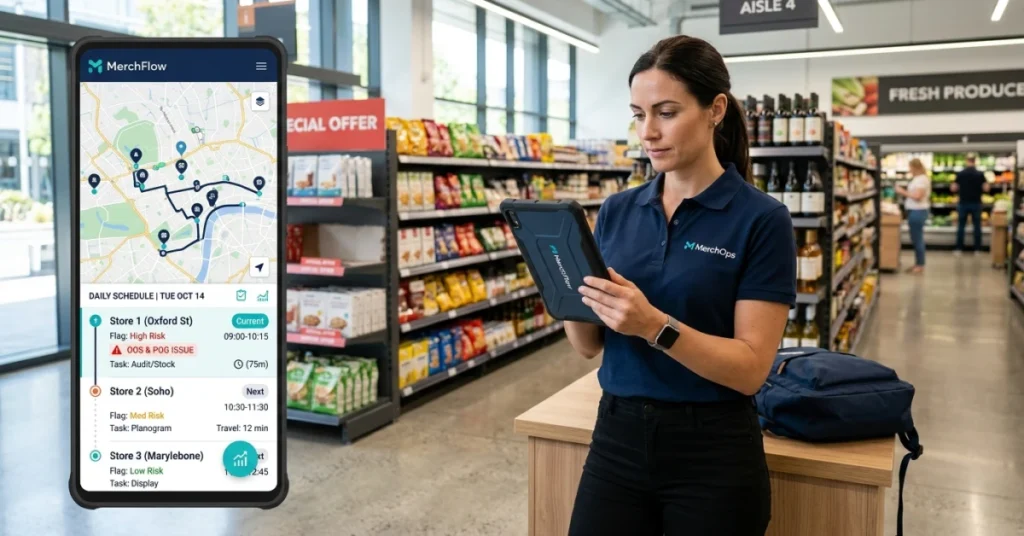
Once you rank stores by execution risk, the next step is turning that ranked list into an actual schedule — one built around damage prevention, not driving convenience. Most teams skip this translation and end up with a route that looks efficient on a map but leaves high-risk stores waiting too long.
Store visit planning for merchandisers works best when the schedule reflects three hard constraints: territory boundaries, travel clustering, and visit capacity. Ignore any one of them and your risk-ranked list falls apart in the field.
Assign Stores by Territory and Workload
Territory design is a risk-distribution problem, not a map-drawing exercise. Each rep should own a store mix where the total execution risk is roughly balanced — not just the store count.
Uneven workloads burn out your best reps and leave weak territories under-covered. According to Link Springer, balanced territory design can lift field team productivity by up to 20% without adding headcount.
Group Nearby Stores to Reduce Travel Time
Clustering stores by location cuts dead drive time — but only after risk ranking sets the visit order. Geography shapes the route; risk determines which stops are non-negotiable.
A rep who clusters low-risk stores to save 30 minutes is trading efficiency for exposure. Smart retail execution tools let teams cluster by zone while locking high-risk stores at the top of each day’s run.
Balance Visit Duration, Frequency, and Capacity
Not every store needs the same time on-site. A store running an active promotion with a compliance gap needs 45 minutes; a stable, low-risk store might need 15.
As Retaildogma notes, the merchandise planning process breaks down when field capacity isn’t matched to store complexity — reps rush high-need stores and over-service easy ones. Set visit durations by risk tier, not by habit.
📊 By the Numbers
Balanced territory design lifts field team productivity by up to 20% without adding headcount.
A ranked list and a smart schedule get you to the right stores — but the real leverage is in what your reps actually do when they walk through the door.

Store Visit Planning Workflow
Most merchandising plans fall apart when turning a risk-ranked store list into a real field schedule.
Risk Drives the Route: Geography shapes travel. But execution risk decides which stores come first.
Capacity Is a Hard Ceiling: A rep can finish 6–8 quality store visits per day — not 12.
Objectives Must Be Set Before Arrival: Walking in without defined tasks wastes time and produces incomplete data.
Data Prep Prevents Surprises: Review planogram specs and promo calendars before the visit. It cuts on-floor confusion fast.
Evidence Closes the Loop: Photos tied to a timestamp make findings defensible and actionable — not just anecdotal.
Follow-Up Must Be Assigned Same Day: Unassigned findings from retail execution tools expire fast — delay kills compliance momentum.
Define Visit Objectives and Required Tasks
Every store visit needs a written objective before the rep leaves the office. Without one, the visit becomes a walkthrough — not a risk-triage event.
Tie each objective to the risk flag that put the store on the schedule. A store ranked high for out-of-stock risk needs a shelf audit — not a general check-in.
Prepare Store, Product, and Promotion Data
Merchandisers who review store-level sell-through data before visiting catch compliance gaps 40% faster (Anaplan). That prep pays back right away on the floor.
Pull the current planogram, active promotions, and last visit’s open issues. Arriving informed means less time hunting for context and more time fixing real problems.
Anaplan notes that integrated data prep directly improves on-shelf availability rates across retail chains.
Complete Check-In, Shelf Checks, and Photo Evidence
A time-stamped check-in confirms presence and starts the compliance record. It also protects the rep if a store later disputes a visit outcome.
Shelf checks should follow a fixed sequence — facing, pricing, planogram compliance, then promotional display. Photos taken out of sequence create gaps that are hard to audit later.
Record Findings and Assign Follow-Up Actions
Every finding needs an owner and a deadline before the rep leaves the parking lot. Unassigned issues have a near-zero resolution rate within the same cycle.
Findings, photos, and tasks must feed back into the next cycle’s risk ranking. That closed loop turns one visit into better decisions for the next ten.
“Visits without assigned follow-up are just observations. Observations don’t move product.”
Field visit data only matters if it changes decisions. The final section covers exactly how that happens.
Conclusion
A ranked-risk schedule is only as good as the system behind it. Celerant reports that retailers using data-driven merchandise planning cut out-of-stock events by up to 30%.
That stat is hard proof. Structured store visit planning for merchandisers pays off in real numbers.
Most merchandisers still build schedules around geography and habit. That leaves high-risk stores unvisited until damage is already done.
Solid retail route planning strategies fix that by putting risk rank first and geography second.
Unvisited high-risk stores quietly bleed revenue every cycle. FieldPie’s scheduling, real-time photo reporting, and customizable field forms give merchandisers the tools to act fast. They can hit ranked priorities before stock gaps or compliance failures get worse.
Toolio confirms that location-specific data is essential to any strong merchandise planning process.
Start your first risk-ranked visit cycle with FieldPie. Turn your schedule into a revenue protection tool.