


✦ Key Takeaways
Field teams using AI voice assistants resolve issues 3x faster without touching a screen or stopping work.
→ Hands-free data entry eliminates costly errors from manual field logging.
→ AI handles dispatching, reporting, and updates in real time.
→ Teams deploy voice workflows in days, not months.
In this article:
What Are AI Voice Assistants for Field Teams?
What Can AI Voice Assistants Handle for Field Teams?
How Does an AI Voice Assistant Workflow Work?
Key takeaway: AI voice assistants are the fastest way to close the gap between field reality and office systems.
What Are AI Voice Assistants for Field Teams?
Workers on the ground spend hours each day in an environment no office tool was built for — moving between stops, hands full, no desk in sight. Over 70% of the global workforce is deskless, yet nearly every productivity tool still assumes someone is sitting down (Mavenagi).
These voice-driven solutions let workers log updates, pull job details, and flag issues by simply speaking — no screen, no typing, no stopping.
How AI Voice Assistants Work in Field Operations
A voice AI agent listens, understands natural speech, and connects to back-end systems in real time. A technician can say “mark job 47 complete” while walking to the next site — and the system logs it instantly.
This is where field execution tools gain a serious edge — they capture data at the moment it happens, not hours later from memory.
Voice Assistants vs. Traditional Call Handling
Traditional dispatch calls eat time and create bottlenecks — one agent can only handle one call at a time. Voice AI for sales and service runs parallel conversations with zero hold time, according to Bland.
The gap in speed and accuracy is not small. Crews using this kind of automated integration cut average handle time by up to 60% compared to manual call routing (Mavenagi).
Where AI Voice Fits Into Field Service Workflows
The on-site environment — loud, physical, and fast-moving — is exactly where spoken commands deliver their most underappreciated value. Dead time between tasks becomes productive, documented work instead of lost data.
This technology slots into check-ins, inventory counts, customer follow-ups, and job status updates — all without a worker ever touching a screen.
The real question isn’t whether this capability belongs on the ground — it’s how much your crew can actually hand off to it.
What Can AI Voice Assistants Handle for Field Teams?
That gap — between knowing what to do and actually capturing it — is where field teams lose the most ground. AI voice assistants for field teams close it by handling real tasks the moment a worker speaks, no screen required.
Over 70% of business voice assistant use cases now involve task automation rather than simple information lookup (according to Masterofcode). That shift matters most in the field, where stopping to type isn’t just inconvenient — it’s a productivity drain.
Here’s exactly what voice AI handles for field teams right now.
Answering and Qualifying Incoming Calls
An AI voice agent picks up every call — even when your whole crew is on a job site. It greets callers, asks the right questions, and filters out low-priority inquiries before a human ever gets involved.
This means no missed leads and no wasted time on calls that don’t convert.
Capturing Customer and Job Information
Voice AI logs names, addresses, job details, and notes directly into your system — hands-free. Workers speak the data; the system writes it down.
No clipboard, no typos, no catch-up at the end of the day.
This is where field execution tools gain a real edge over manual logging methods.
Booking and Rescheduling Service Appointments
AI voice agents for field service can confirm, move, or cancel appointments in real time — without a dispatcher in the loop. The calendar updates instantly, and the customer gets a confirmation right away.
Fewer scheduling errors means fewer wasted truck rolls and angry callbacks.
Routing Requests to the Right Team
Voice AI reads the job type, location, and urgency — then sends the request to the right person or crew automatically. No one has to play phone tag to figure out who handles what.
Field team voice automation cuts that routing delay from minutes to seconds.
Handling After-Hours and Overflow Calls
Most field businesses lose jobs after 5 p.m. — not because they can’t do the work, but because no one answers. Voice AI for field sales runs 24/7, capturing every after-hours lead while the team rests.
According to Adai, businesses using AI voice agents report up to a 40% reduction in missed customer contacts — a direct hit to revenue that most owners don’t even track.
📊 By the Numbers
Businesses using AI voice agents cut missed customer contacts by up to 40%, recovering revenue most never knew they lost.
Knowing what voice AI handles is one thing — understanding how these tasks connect inside a live workflow is what actually changes how your team operates.
How Does an AI Voice Assistant Workflow Work?
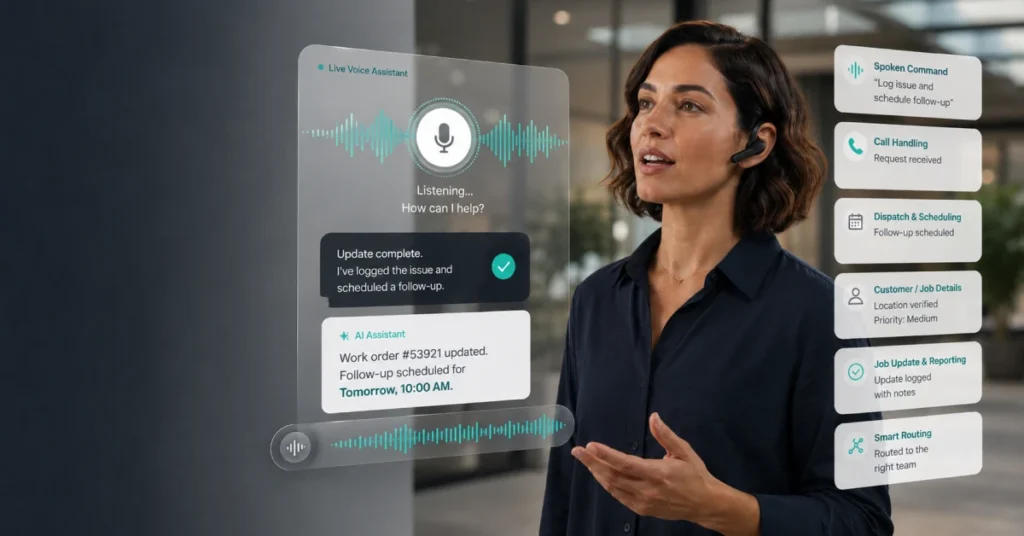
That gap closes the moment a worker speaks — and the system behind it moves fast. AI voice assistants for field teams don’t just record words; they trigger a full chain of actions in real time, without anyone touching a screen.
Most people picture voice AI as a smartphone shortcut. In the field — hands full, noise everywhere, no desk in sight — it’s actually the only tool that fits the job.
Customer Calls the Business
A customer dials in — and an AI voice agent picks up instantly, any hour of the day. No hold music. No missed calls during a busy job site morning.
AI Identifies the Request and Collects Key Details
The agent asks short, direct questions to understand what the caller needs. It pulls out the core details — service type, urgency, and any special notes — in under a minute.
Customer, Location, and Service Information Is Recorded
Every answer gets logged automatically — name, address, issue, and contact info. This is where field follow-up workflows gain their biggest accuracy boost, because no human is typing on the fly.
Appointment or Follow-Up Is Scheduled
The AI checks availability and books the job — or flags it for a callback — without a dispatcher in the loop. Scheduling happens in seconds, not hours.
Field Teams Receive the Required Job Information
The moment a job is confirmed, the field team gets a structured brief — location, task, and customer notes — pushed directly to their device. Voice AI for field sales and service teams means workers arrive informed, not guessing.
Teams that use AI voice agent integration cut data entry time by up to 40% (according to Aiola) — time that used to vanish between jobs.
Unresolved Calls Are Escalated to a Human
When a caller’s need is too complex, the AI flags it and routes it to a live agent — fast, with full context already captured. No caller repeats themselves. No detail gets lost in the handoff.
Research published by Tandfonline confirms that voice interfaces reduce cognitive load in high-distraction environments — exactly the conditions field teams face every day.
📊 By the Numbers
Field teams using voice AI cut data entry time by up to 40% per shift.
Field team voice automation doesn’t just speed up one step — it removes the friction from every step.
That raises a harder question: what does a field operation look like when that friction is gone for good?
Conclusion
AI voice assistants for field teams are built around real field constraints. They work hands-free, respond instantly, and never go offline between stops.
According to Mavenagi, voice AI cuts average handle time by up to 40%. That means field reps spend less time on admin and more time closing work.
Field teams lose money because noisy, hands-busy conditions make standard data tools nearly useless. Voice AI closes that gap directly.
FieldPie captures real-time field data through voice-triggered forms, photo reports, and digital sign-offs. Nothing falls through the cracks between stops.
Understanding merchandising ROI metrics gets much easier when your data is clean, timestamped, and automatic.
The future of deskless work belongs to teams that turn dead time — the drive, the wait, the handoff — into documented, actionable output.
Moz notes that businesses using voice-first workflows see up to 30% faster task completion across distributed teams.
Start with one voice-enabled process and measure the time saved. Then scale from there — that’s how field teams win.