


✦ Key Takeaways
Skipping HVAC maintenance costs building owners up to 25% more in energy bills annually.
→ Neglected systems fail 3x faster than regularly serviced units.
→ Maintenance frequency depends on system type, age, and climate.
→ A structured checklist catches small issues before they become costly repairs.
In this article:
What Is HVAC Recurring Maintenance?
How Often Should HVAC Maintenance Be Scheduled?
What Should an HVAC Recurring Maintenance Checklist Include?
How Does an HVAC Recurring Maintenance Workflow Work?
Key takeaway: Consistent HVAC maintenance is the single smartest investment a property owner can make.
What Is HVAC Recurring Maintenance?
Most homeowners call their HVAC technician only when something breaks — and that single habit costs them thousands. Neglected systems fail up to 75% more often than those on a scheduled HVAC maintenance plan (according to Worktrek).
HVAC recurring maintenance is a planned, repeating service schedule that keeps your system running before problems start. Think of it like oil changes for your car — skip them long enough, and the engine pays the price.
How Recurring Maintenance Differs From One-Time Service
A one-time HVAC tune-up fixes what’s wrong today. A recurring plan stops problems before they start tomorrow.
One-time visits are reactive. Preventative HVAC maintenance is built around your equipment’s seasonal needs — and the difference shows up in your energy bill. Systems on a regular schedule use up to 25% less energy than neglected ones.
Which HVAC Systems Require Routine Maintenance?
Every forced-air system needs scheduled attention. Furnaces, central air conditioners, heat pumps, and mini-splits all qualify.
Research published by Sciencedirect confirms that unserviced HVAC equipment loses efficiency within a single season. Boilers, radiant systems, and ventilation units need recurring visits too. No heating or cooling system is “low maintenance” by default.
How Maintenance Frequency Changes by Equipment Type
Heat pumps run year-round, so they need service twice a year — once before summer, once before winter. A gas furnace or central AC unit typically needs one visit per season it runs.
Know your equipment type first. That tells you how to build a plan that fits your home.
Then check your HVAC first-time fix rate. That number tells you whether your technician is doing the job right.
Most homeowners ask whether to maintain their system. That’s the wrong question.
The right question is how often each part needs attention to stay ahead of failure.
How Often Should HVAC Maintenance Be Scheduled?
That proactive schedule only works if you know exactly when to act — and most homeowners don’t. The good news: the timing is simpler than any technician will tell you.
Most systems need at least two service visits per year — one before cooling season, one before heating season. According to Oxmaint, skipping even one seasonal tune-up can cut system efficiency by up to 5% per year.
Seasonal Maintenance for Heating and Cooling Systems
Think of your HVAC as two machines sharing one body — a furnace and an air conditioner. Each one needs its own prep before its heavy season starts.
Schedule your cooling check in March or April, before summer heat hits. Book your heating check in September or October, before the first cold snap arrives.
Monthly, Quarterly, and Annual Maintenance Tasks
Not every task needs a technician — some belong on your own calendar. Here’s how to split the work by frequency:
Monthly: Check and replace air filters (every 30–90 days depending on pets or allergies).
Quarterly: Clear debris from outdoor units; check vents for blockages.
Annually (×2): Full professional HVAC tune-up — once per season, spring and fall.
Knowing this split matters. It means you can verify your technician’s work against your own records — and that’s exactly how you avoid being overcharged.
Factors That Affect Maintenance Frequency
Two visits a year is the baseline — but your home may need more. Older systems, pets, dusty climates, and heavy daily use all shorten the gap between service calls.
Commercial properties face even tighter demands. Entouchcontrols notes that commercial HVAC maintenance costs average $0.15–$0.25 per square foot annually — a figure that climbs fast when visits are skipped.
Your own HVAC first-time fix rate drops sharply when service intervals stretch too long.
📊 By the Numbers
Systems serviced twice yearly last up to 40% longer than those on a single annual visit schedule.
Once you know the schedule, the next question hits harder: do you actually know what the technician is supposed to do during that visit?

What Should an HVAC Recurring Maintenance Checklist Include?
Those two yearly visits only protect your system if the technician actually covers the right ground. Most homeowners have no idea what a complete HVAC recurring maintenance visit looks like — and that gap is exactly how shoddy work slips through unnoticed.
Knowing the checklist turns you into an informed customer, not just a signature on an invoice. The U.S. HVAC service industry tops $100 billion annually (Ibisworld), which means there’s serious money at stake — and serious incentive to cut corners if you’re not watching.
Filters, Coils, Belts, and Moving Components
A clogged filter forces your system to work harder, burning more energy and wearing parts faster. Technicians should inspect or replace the air filter, clean evaporator and condenser coils, and check belts and bearings for wear.
Dirty coils alone can cut system efficiency by up to 30%, according to Goodway — that’s a real cost you pay every month on your energy bill.
Electrical Connections and Controls
Loose wiring causes equipment failures — and sometimes fires. Your tech should tighten all electrical connections, test capacitors, and check contactors for pitting or wear.
Good HVAC field service management tracks these checks visit by visit, so nothing gets skipped between seasons.
Refrigerant, Drainage, and Airflow Checks
Low refrigerant means your system can’t cool properly — and it usually signals a leak, not just a top-off situation. The tech should check refrigerant levels, inspect the condensate drain line, and verify airflow through the system.
A blocked drain line can cause water damage fast. This step takes five minutes but saves hundreds in repairs.
Thermostat and System Performance Testing
A thermostat that reads two degrees off wastes energy all season long. Your tech should calibrate the thermostat, test heating and cooling cycles, and confirm the system hits its target temperatures.
This step proves the system actually works — not just that it turns on. There’s a big difference.
Safety and Condition Documentation
Every visit should end with a written report — not a verbal “looks good.” That document is your proof of service and your baseline for the next scheduled HVAC maintenance visit.
If a tech won’t hand you paperwork, that’s a red flag. Your preventative HVAC maintenance plan is only as strong as the records behind it.
📊 By the Numbers
Dirty coils can reduce HVAC system efficiency by up to 30%, directly raising your monthly energy costs.
Knowing what belongs on the checklist is step one — but knowing how to build that visit into a repeatable system is what actually keeps your HVAC running year after year.
How Does an HVAC Recurring Maintenance Workflow Work?
Knowing what’s on the checklist is step one. Turning that knowledge into a repeatable system is what actually protects your equipment — and your wallet.
An HVAC recurring maintenance workflow isn’t complicated. It’s a short chain of steps that runs twice a year, every year, without you having to remember a thing.
📊 By the Numbers
Homeowners on a scheduled HVAC maintenance plan spend up to 30% less on emergency repairs annually (Worktrek).
Scheduling Recurring Service Visits
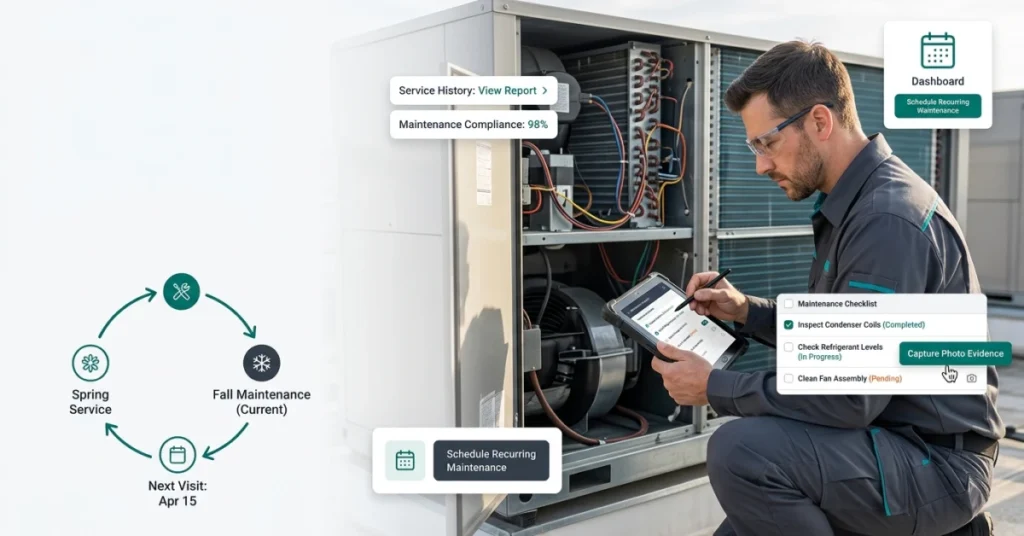
Book spring and fall visits the same way you schedule a dentist — set it once, then forget it. Most HVAC maintenance plans auto-schedule reminders so nothing slips through.
Timing matters. Spring prep protects your cooling system before summer heat hits; fall prep protects your furnace before the first cold snap.
Assigning Technicians Based on Skills and Location
Good service companies match the right tech to your job — not just whoever is closest. A tech familiar with your equipment brand finishes faster and catches more.
Ask your provider if the same technician returns each visit. Consistency means they already know your system’s history.
Completing Digital HVAC Checklists
Modern techs use a digital checklist — not a paper form they can lose. Every item gets checked off in real time, and you can request a copy.
That checklist is your accountability tool. If a line item is blank, ask why — a good tech always has a clear answer.
Capturing Photos, Notes, and Equipment Readings
A thorough tech logs refrigerant pressure, airflow readings, and photos of worn parts. You should receive these — not just a verbal summary at the door.
Written records let you compare visit to visit. A slow refrigerant drop spotted early costs far less than a full recharge later.
Flagging Issues and Creating Follow-Up Work
When a tech spots a worn capacitor or a cracked heat exchanger, it should trigger a written follow-up — not a vague “you might want to watch that.” Understanding HVAC first-time fix rates shows why catching issues early matters.
A written flag protects you. It creates a paper trail that prevents the same “surprise” problem from appearing on every invoice.
Closing the Visit and Updating Service History
At the end of every visit, your service record should update automatically. That history is proof of preventative HVAC maintenance — and it matters when you sell your home.
A complete log also tells the next tech exactly where to start. No guessing, no duplicate work, no inflated bills.
Systems that run on a documented workflow — not memory or goodwill — are the ones that last 15 to 20 years instead of 10 (Worktrek). The only question left is whether you’re ready to make one decision now that pays off every season after.
Conclusion
That twice-yearly system you just built is the one decision that separates informed homeowners from reactive ones.
Systems kept on a regular schedule last 40% longer than neglected units, according to 75f. That’s years of extra life from just two visits a year.
You now know the schedule, the checklist, and the workflow. That means you can check every technician’s work and never overpay for a skipped step.
Oxmaint confirms that most HVAC failures show warning signs weeks before breakdown. A scheduled technician catches those signs — an uninformed homeowner misses them.
Use your HVAC ventilation requirements knowledge alongside your maintenance plan. Together, they keep you fully ahead of problems.
Missed or disorganized HVAC visits cost homeowners hundreds in avoidable repairs every season. That’s money you keep when you stay on schedule.
FieldPie lets service businesses schedule recurring jobs and track technician visits. It also captures signed service records in real time, so nothing gets missed.
Book your first scheduled tune-up before the next season changes. Let the system run itself from there.