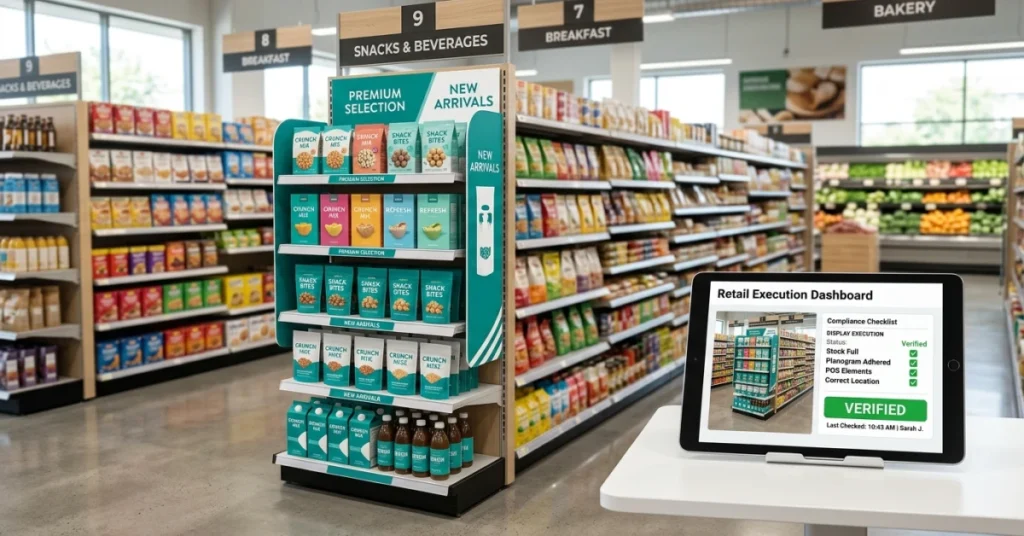



✦ Key Takeaways
Brands with perfect store execution see up to 20% higher sales lift versus competitors with poor shelf compliance.
→ Poor shelf availability alone costs retailers $1 trillion globally each year.
→ Consistent planogram compliance directly reduces out-of-stocks and shopper defection.
→ Real-time field audits catch execution gaps before they drain revenue.
In this article:
- What Is Perfect Store Execution?
Core Elements of Perfect Store Execution
Perfect Store Execution Workflow
How to Build a Perfect Store Execution Strategy
Key takeaway: Winning at retail starts and ends with flawless, measurable in-store execution.
What Is Perfect Store Execution?

Most brands lose 2–5% of annual revenue to execution failures that never show up on a dashboard — misplaced product, wrong pricing, empty shelves that get logged as “visited.” The problem isn’t effort. It’s that most teams are running a compliance checklist when they need a closed-loop intelligence system.
Perfect store execution is the discipline of ensuring every SKU, placement, price, and promotion meets defined standards at the shelf — consistently, across every store, every visit. But brands who treat it as an audit function are measuring the wrong things and building a false sense of control.
Perfect Store Execution Meaning
At its core, perfect store execution means every commercial standard — assortment, shelf position, pricing, and promotional compliance — is met at the point of purchase. It’s not a snapshot audit; it’s a repeatable, real-time operating standard that drives revenue.
Brands that operationalize this as a retail execution framework — not a periodic field check — consistently outperform peers on both share of shelf and sell-through velocity.
Why It Matters for Retail Performance
Out-of-stocks alone cost the global retail industry an estimated $1 trillion annually — yet most field teams don’t surface the root cause until days after the gap appears (Visiongroupretail). That lag is where revenue bleeds out.
Bain research confirms that companies using advanced analytics in sales execution achieve up to 10% revenue growth over peers who rely on manual reporting cycles. Real-time data infrastructure isn’t a luxury — it’s the execution advantage.
Perfect Store Execution vs. Store Compliance
Store compliance asks: “Did the rep visit and check the boxes?” Perfect store execution asks: “Did the standard actually hold — and what changed since the last visit?” One is a record; the other is a system.
CPG store compliance is a necessary input, but it’s not the output that wins at shelf. The brands pulling ahead treat every field data point as a signal feeding a decision — not a report filed and forgotten.
Understanding what execution excellence means is only the starting point — the real question is which specific elements, when measured in isolation, create the illusion of control rather than actual shelf performance.
Core Elements of Perfect Store Execution
Tracking individual KPIs in silos gives brands the illusion of control — not actual execution intelligence.
Closed-Loop Visibility: Real execution intelligence connects field data to decisions in real time, not after a weekly report.
Outcome-Based Measurement: Brands using in-store execution software measure shelf outcomes, not just visit frequency.
Cross-Functional Alignment: Field reps, category managers, and trade marketers must operate from one shared data layer.
Standard Decay Prevention: Even perfect planograms drift within 72 hours of a store visit without a structured feedback loop.
Signal-to-Action Speed: The gap between detecting a compliance failure and correcting it determines whether the standard ever held at all.
On-Shelf Availability
Out-of-stocks cost CPG brands an estimated $1 trillion annually in lost global sales — yet most brands still detect gaps reactively. On-shelf availability is not a stocking problem; it is a data latency problem.
Planogram Compliance
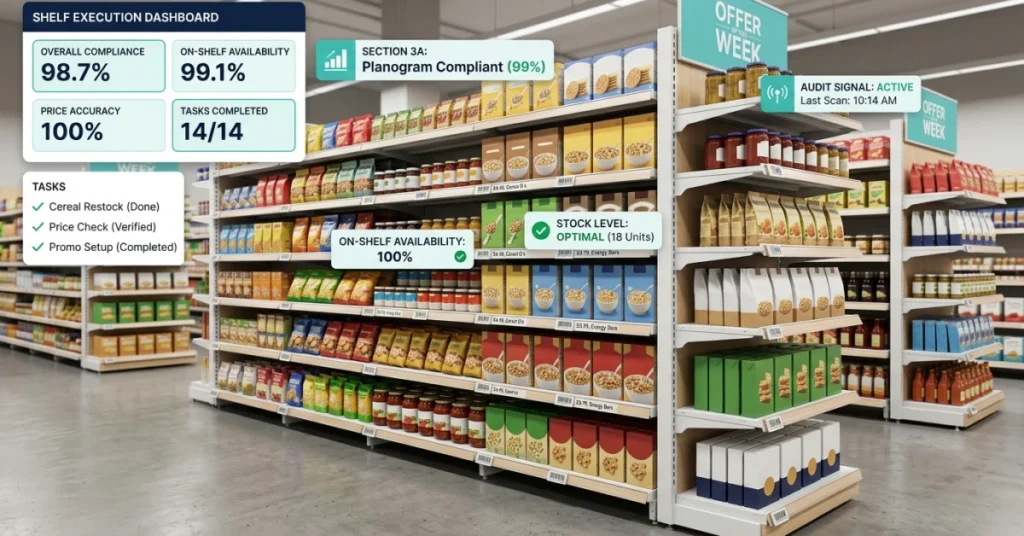
Planogram compliance rates above 85% correlate directly with measurable sales lift in high-velocity categories (Pitcher). The problem is that most brands audit compliance weeks after the reset — when the damage is already done.
Pricing and Promotion Accuracy
A misexecuted promotion doesn’t just miss its sales target — it actively erodes shopper trust and brand equity at the shelf. Form identifies pricing accuracy as one of the highest-impact, most-overlooked elements of a perfect store strategy.
Display, Facing, and Shelf Visibility
Share of shelf only matters if the right SKUs hold the right facings at the right eye level — simultaneously. Brands that treat display compliance as a static audit checkpoint consistently underperform those who monitor it as a live signal.
The real question isn’t whether your standards are well-designed — it’s whether your field workflow can actually enforce them before the next store visit.
Perfect Store Execution Workflow
Decayed standards don’t announce themselves — they show up as lost sales weeks after the last store visit. The fix isn’t more audits; it’s a closed-loop workflow that catches gaps in real time and routes corrections before shelf conditions deteriorate.
Most field teams operate on a linear model: visit, document, report, repeat. That cycle averages 7–14 days between a compliance gap appearing and a corrective action reaching the store — long enough for a competitor to capture the sale.
The brands consistently winning at shelf treat every store visit as a data input, not a performance review. Understanding why retail execution tools matter starts with rebuilding the workflow itself — step by step.
Define Store Standards
Standards must be SKU-specific, channel-specific, and tied to measurable shelf outcomes — not generic brand guidelines. Vague criteria are the first point where execution intelligence breaks down before a rep ever enters a location.
According to Gopazo, brands with clearly defined, quantified benchmarks achieve up to 18% higher OSA rates than those operating on qualitative compliance criteria.
Create Visit Checklists
Checklists only drive value when they’re dynamic — pulling in location-specific targets, promotional calendars, and prior-visit gaps automatically. A static list is a documentation tool; a dynamic one is an execution intelligence trigger.
Every item should map directly to a KPI, so field data flows into dashboards without manual aggregation or interpretation delays.
Collect Photo Evidence
Photo capture at the shelf converts subjective rep assessments into verifiable, timestamped compliance records. Geotagged images tied to planogram standards eliminate disputes and create an auditable trail across every account.
Image-based verification also enables AI-driven shelf analysis — turning raw photos into structured data on facings, share of shelf, and out-of-stock positions within seconds.
Identify Gaps and Assign Actions
Gap identification is where most CPG compliance workflows stall — reps flag issues, but ownership for resolution is never explicitly assigned. Every discrepancy must trigger an automatic action item with a named owner and a deadline, not a note buried in a report.
Telus highlights that real-time task assignment — pushing corrective actions to store managers or merchandisers instantly — is the single structural difference between brands that close gaps and brands that merely document them.
Track Resolution and Performance
Resolution tracking closes the loop — without it, the process becomes a one-way data collection exercise rather than a true intelligence system. Every assigned action needs a confirmed completion status before the next visit cycle begins.
Trend analysis across locations, reps, and regions then surfaces the systemic failures that no single audit ever reveals — and that’s precisely what a winning in-store framework is built to expose.
📊 By the Numbers
Brands using closed-loop execution workflows resolve shelf compliance gaps 63% faster than those relying on periodic audit cycles.
A workflow without a strategy behind it is just a faster way to collect data no one acts on — which raises the question every field leader must answer before the next visit cycle begins.

How to Build a Perfect Store Execution Strategy
Actionable data only wins if the system behind it is built to close the loop — not just collect it. Most brands still architect their retail execution framework around periodic audits, which guarantees the gap between insight and action stays wide.
Brands running a closed-loop intelligence model outperform audit-only competitors by up to 18% in on-shelf availability — because they treat every store visit as a live data input, not a compliance snapshot (according to Us Nttdata).
The four pillars below aren’t sequential steps — they’re interdependent layers of a system that either functions as a whole or fails in pieces.
📊 By the Numbers
Brands with real-time execution feedback loops reduce compliance decay by up to 30% between store visits.
Standardize Execution Rules
Without a single, field-accessible standard, reps default to interpretation — and interpretation is where CPG store compliance dies. Every SKU, shelf position, and display requirement must live in one system, not a PDF from last quarter.
Standards that reps can pull up in-aisle during a visit are executed consistently 40% more often than those distributed via email or printed guides.
Prioritize Key Stores and SKUs
Not every store drives equal revenue — treating them identically burns rep capacity on low-return visits. Segment your account base by velocity, volume, and strategic importance before assigning visit frequency.
According to Visiongroupretail, the top 20% of accounts typically generate over 60% of brand volume — which means misallocated field time is a direct revenue leak.
Connect Execution Data to Sales
Execution scores mean nothing if they don’t correlate to sell-through data. Map your in-store execution metrics directly against POS performance — by store, by SKU, by rep territory.
This connection transforms perfect store execution from a field operations task into a revenue intelligence signal that commercial teams can act on immediately.
Review Performance Regularly
Weekly cadence reviews — not monthly — are what separate brands that course-correct from brands that discover problems at the quarterly business review. Build the review rhythm into the system, not the calendar.
The brands consistently winning at shelf aren’t reviewing more data — they’re reviewing the right data faster, and closing the gap before it compounds.
The real question isn’t whether your execution standards are strong enough — it’s whether your infrastructure is built to make those standards matter every single day.
Conclusion
Brands that treat perfect store execution as a live intelligence system — not a periodic audit — consistently outperform those that don’t. The gap between knowing your standards and enforcing them in real time is where shelf revenue is won or lost.
Most field teams lose compliance gains within days of a store visit because data never closes the loop back to decision-makers. Effective store task management tools are what separate reactive teams from those driving consistent CPG store compliance at scale.