✦ Key Takeaways · 5 min read
AI-powered field workforce scheduling helps teams match jobs with worker skills, availability, location, and service priorities while adapting plans as conditions change.
→ Traditional scheduling leaves technicians reactive, not strategically deployed.
→ AI matches the right worker to each job based on real-time context.
→ Emergency dispatches become faster and smarter without human bottlenecks.
In this article:
Why Traditional Scheduling Fails Field Operations Today
How Does AI Field Workforce Scheduling Actually Work?
Benchmark Results: What AI Scheduling Delivers in Practice
How AI Handles Last-Minute Changes and Emergency Dispatches
Conclusion
Key takeaway: Field operations that ignore AI scheduling are choosing inefficiency over competitive advantage.
Why Traditional Scheduling Fails Field Operations Today
Field scheduling breaks down fast, and most teams still use tools that were never built for that speed. Picture a dispatcher working from a whiteboard, a spreadsheet, and a group text thread. One technician calls in sick or a job runs two hours long, and the entire day collapses. No amount of experience lets a person re-optimize 40 routes in real time.
Most operations treat this as a people problem, a matter of hiring sharper dispatchers or building better habits. The real problem is structural: conventional dispatch is a one-time decision made at the start of the day, while field operations break down continuously throughout it.
Rule-Based vs. Automated vs. AI Scheduling
Rule-based systems follow fixed logic: assign the nearest tech, fill the earliest slot, repeat. Automated tools speed that process up but still apply the same rigid rules without learning from outcomes. AI-powered field workforce scheduling works differently. It weighs dozens of variables at once, skill, location, traffic, priority, and customer history, and keeps adjusting as conditions change.
Say your team runs 30 jobs a day. A rule-based system locks in assignments at 7 a.m. and holds them. An AI-driven approach treats that plan as a living document, quietly revising it every time a variable shifts, without anyone picking up a phone.
The Real Cost: Missed SLAs and Overtime Spend
When a job runs late and no one re-routes in time, the next customer waits and a service-level agreement gets missed. A technician then logs overtime to catch up. That chain reaction repeats dozens of times a week in teams that rely on manual dispatch. Risk-based audit scheduling frameworks show that unplanned delays cluster around the same predictable failure points. Yet most teams never fix the underlying cause.
The cost isn’t just overtime pay. Missed SLAs erode customer trust, and that damage compounds quietly until a contract is at risk. Intelligent dispatch and scheduling exists precisely to break this cycle before it starts.
Knowing why the old approach breaks down is useful. The more pressing question is what makes AI field service software capable of doing what no dispatcher physically can. That’s where the real difference becomes clear.
How Does AI Field Workforce Scheduling Actually Work?
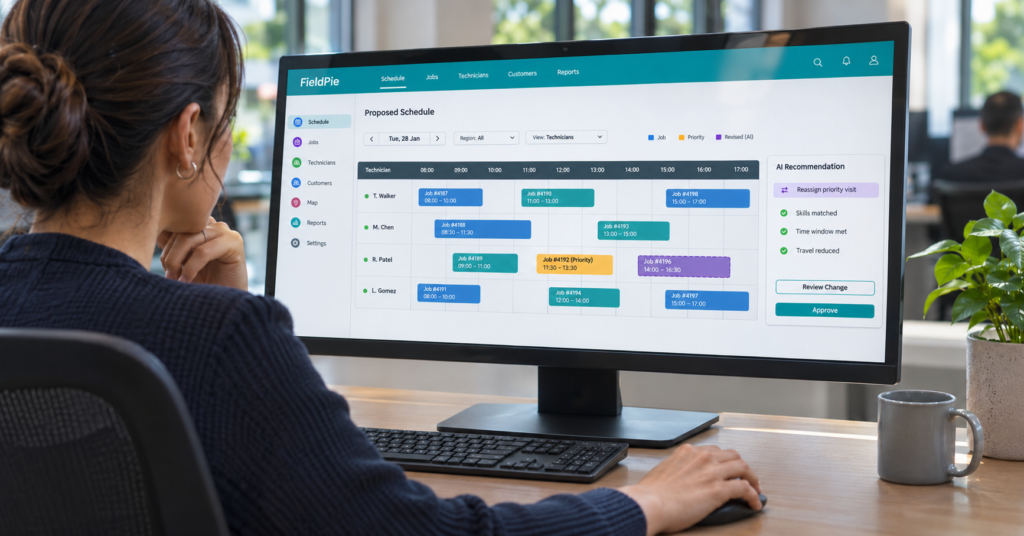
A fixed morning plan fails because field operations don’t stop changing after 9 a.m. AI-powered field workforce scheduling works differently, treating the schedule as a living system that updates itself every time something shifts. Think of it less like a spreadsheet and more like a GPS that quietly recalculates the moment a road closes, without you touching the wheel.
Say your team has 12 technicians on the road and a high-priority job cancels at 10:15 a.m. A human dispatcher has to stop, scan the board, make calls, and rebuild part of the day by hand. An AI scheduling engine does the same thing in seconds. It silently reorders every remaining assignment to fill the gap, cut drive time, and protect your highest-priority jobs first.
That speed is the real advantage. It’s not just efficiency on a calm day, but resilience the moment things break down.
Data Inputs That Drive Accurate Technician Assignments
Automated field workforce scheduling pulls from several live data streams at once: technician location, skill certifications, current job status, traffic conditions, and customer time windows. The system weighs all these inputs against each other. It then picks the assignment that scores best across all of them, not just the one that looks closest on a map. That’s why intelligent dispatch and scheduling consistently beats gut instinct, even when the dispatcher is highly experienced.
Picture it this way: the AI runs thousands of possible assignment combinations in the background, much like a chess engine sizing up moves. It then surfaces only the best one. Risk-based scheduling methods work on a similar principle, using structured criteria to rank decisions rather than relying on whoever picks up the phone first.
Dynamic Rescheduling and Dispatcher Control
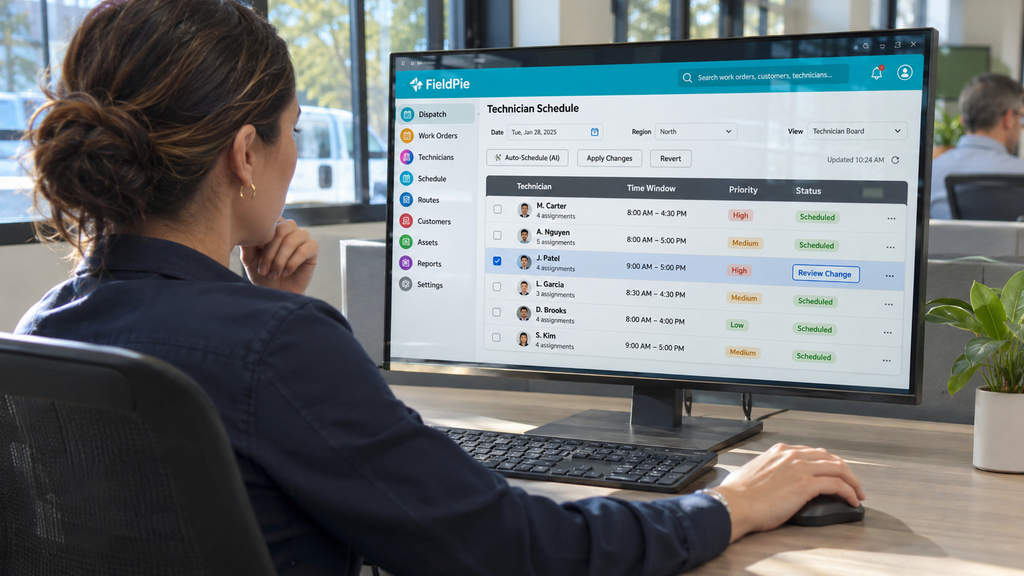
Dynamic rescheduling can use optimization algorithms, business rules, AI, or a combination of these approaches. The practical question is whether the system can update assignments when availability, job duration, or priorities change.
Define which changes can happen automatically and which require dispatcher approval. Protect jobs already in progress, customer commitments, required certifications, and working-hour limits when adjusting the schedule.
The real question isn’t whether AI can build a good schedule. It’s whether the numbers prove how much better that schedule holds up under pressure.

How to Measure AI Scheduling Performance
That living-system behavior produces measurable gaps between teams that use it and teams that don’t.
First-Time Fix Rates, Travel Time, and Labor Costs
First-time fix rate is the share of service calls a technician resolves without a return visit. It’s one of the clearest signals of whether your scheduling is working or just filling calendar slots.
AI-powered field workforce scheduling raises this rate by matching the right technician to each job. It weighs skills, parts on hand, and location before making that match. Say your team sends whoever is closest, regardless of skill set. A second visit becomes almost certain, and that second visit costs you a full labor hour plus fuel.
Travel time and labor costs follow the same pattern. Automated field workforce scheduling clusters nearby jobs and cuts dead miles. It also fills gaps that a dispatcher juggling a whiteboard simply can’t spot in real time.
Industries Seeing the Strongest ROI
Not every industry feels the impact equally. Fields with high job volume, tight service-level agreements, or unpredictable demand see the sharpest gains from intelligent dispatch and scheduling.
Utilities, telecom, HVAC, and medical equipment service all share one trait: a missed appointment or a failed fix is a real financial hit. It’s never a minor inconvenience. Those failures can mean regulatory penalties, lost contracts, or patient harm.
AI scheduling for field service management removes the guesswork that makes those failures more likely. That’s why risk-based scheduling methods are gaining traction across these sectors.
Here is how the performance picture compares across key operational areas:
| Metric | What to Measure |
|---|---|
| First-time fix rate | Eligible jobs resolved without a return visit ÷ eligible completed jobs |
| Travel time per completed job | Total travel time ÷ completed jobs |
| Schedule recovery time | Time from a disruption being recorded to a feasible revised plan |
| Overtime hours | Overtime required for comparable workloads |
| Appointment compliance | Eligible visits started within the agreed customer window ÷ eligible visits |
Compare results with your baseline using similar workloads and job types. First-time fix rate also depends on diagnosis, parts availability, and technician capability—not scheduling alone.
The real performance gap between human dispatchers and AI isn’t visible on a calm Tuesday. It shows up the moment a technician calls in sick, a job runs long, or traffic shuts down a route.
That gap comes down to speed, not intelligence. No dispatcher, no matter how experienced, can physically recalculate dozens of interdependent assignments in seconds. AI-powered field workforce scheduling was built to do exactly that.
The benchmarks above describe steady-state gains. The real test of any scheduling system isn’t how it performs when the day goes to plan.
How AI Handles Last-Minute Changes and Emergency Dispatches
Those gains in first-time fix rates look great on a calm Tuesday morning, but field operations rarely stay calm. A technician calls in sick at 7 a.m. Then a priority job lands at noon and wipes out the day’s schedule. AI-powered field workforce scheduling earns its real value right here, in the messy middle of a broken day.
Say your team has twelve technicians on the road when a burst pipe emergency comes in across town. A human dispatcher has to scan availability, skill sets, and locations in their head. Then they make calls, wait for answers, and rebuild routes by hand. Intelligent dispatch and scheduling does that same work in seconds. It quietly re-optimizes every open assignment in the background. It never pulls a technician off a job they are already close to finishing.
No experienced dispatcher can match that speed, and skill is not the issue. The human brain simply cannot hold twelve moving variables and recalculate them all at once. Risk-based scheduling methods follow a similar logic: prioritize by impact, not by who called last.
Until something changes, your operation will keep absorbing the cost of disruptions it cannot see coming. AI scheduling is one practical way to stop that pattern before it compounds.
Conclusion
Field operations can fall apart fast. A human dispatcher simply can’t respond at the same speed. That gap is the core problem AI-powered field workforce scheduling was built to solve.
Picture a team of twelve technicians spread across a city. A traffic accident blocks two key routes at 10 a.m. A human dispatcher might then spend twenty minutes rerouting everyone. Dynamic field scheduling software rebalances every assignment in seconds, without anyone picking up a phone.
The bigger shift this article asks you to make is how you think about scheduling failure. It’s not a people problem, your dispatchers aren’t slow or careless. It’s a speed problem. Automated field workforce scheduling is the first tool that truly matches the pace of real-world disruptions.
FieldPie’s workforce planning tools help teams coordinate assignments using location, skills, capacity, and availability. Start with one team and measure travel time, appointment compliance, and schedule recovery before expanding. Book a demo to test your scheduling requirements.