


✦ Key Takeaways
AI catches up to 90% of manipulated insurance photos before fraudulent claims ever get paid.
→ Deepfakes and metadata tampering are now detectable in seconds.
→ Photo fraud costs insurers billions annually — AI closes that gap.
→ Any business accepting image-based claims can deploy AI detection today.
In this article:
What Is AI Photo Fraud Detection?
What Types of Photo Fraud Can AI Detect?
How AI Photo Fraud Detection Works
Key takeaway: AI photo fraud detection is no longer optional — it’s the only scalable defense against image manipulation.
What Is AI Photo Fraud Detection?
Fake images fool human reviewers more than half the time. That number keeps climbing as AI image tools get cheaper and easier to use.
AI image tools leave behind invisible mathematical fingerprints. AI photo fraud detection reads those fingerprints before a fraudulent claim gets paid.
Insurers, field inspectors, and claims teams once trusted a photo as proof. That trust is now a liability. A manipulated image and a real one look identical to the human eye.
What Counts as Photo Fraud in Field Operations?
Photo fraud means submitting an image that misrepresents reality. Common examples include a recycled damage photo, a digitally swapped background, or a staged scene.
It covers everything from simple copy-paste edits to fully AI-generated image fraud built from scratch. Reused and manipulated photos are not rare edge cases. They appear across insurance claims, contractor invoices, and compliance reports at scale.
Why Traditional Photo Proof Is Easy to Manipulate
A smartphone edit takes under two minutes. Standard review processes were never built to catch synthetic image problems at that speed or volume.
Reused photo fraud alone costs insurers millions every year. Shift Technology reports that one insurer recovered over $1.3 million after AI flagged thousands of duplicate claim photos. Human reviewers had approved every one of them.
How AI Changes Photo Verification
AI doesn’t look at a photo the way a person does. It reads statistical patterns in pixel data that manipulation always disturbs.
PMC / NIH research confirms that manipulated photo detection models spot forgery artifacts with accuracy above 95% on benchmark datasets. That is far beyond what any human reviewer can achieve.
Here’s the key paradox: the math that makes AI fakes convincing is the exact same math that gives them away. Deception and detection run on the same algorithm. That’s what makes the fraud types ahead so important to understand.
What Types of Photo Fraud Can AI Detect?
Those invisible mathematical fingerprints don’t just expose one type of fake. They catch a wide range of fraud that human reviewers consistently miss.
AI photo fraud detection systems handle far more than a simple crop or color tweak. That variety is exactly why manual inspection keeps failing.
According to Feedzai, AI-powered fraud detection systems flag suspicious submissions with over 90% accuracy. No human review team can match that rate at scale.
📊 By the Numbers
AI fraud detection systems catch image manipulation with over 90% accuracy — far beyond any human reviewer’s capacity at scale.
Reused Photos From Previous Visits
A field worker snaps a photo once, then submits it weeks later as “new” proof. AI catches this by reading file metadata and pixel-level signatures. Those signatures match the original shot exactly.
Duplicate Images Submitted Across Different Locations
Filing the same image under two job sites is a classic insurance photo fraud move. AI checks every submission against a database. It flags identical images instantly — even when file names are changed.
Screenshots or Photos of Other Photos
Photographing a screen or a printed image creates compression artifacts and moiré patterns. AI reads those like a signature. These secondary image artifacts are nearly invisible to the human eye but obvious to a trained model.
Edited or Manipulated Images
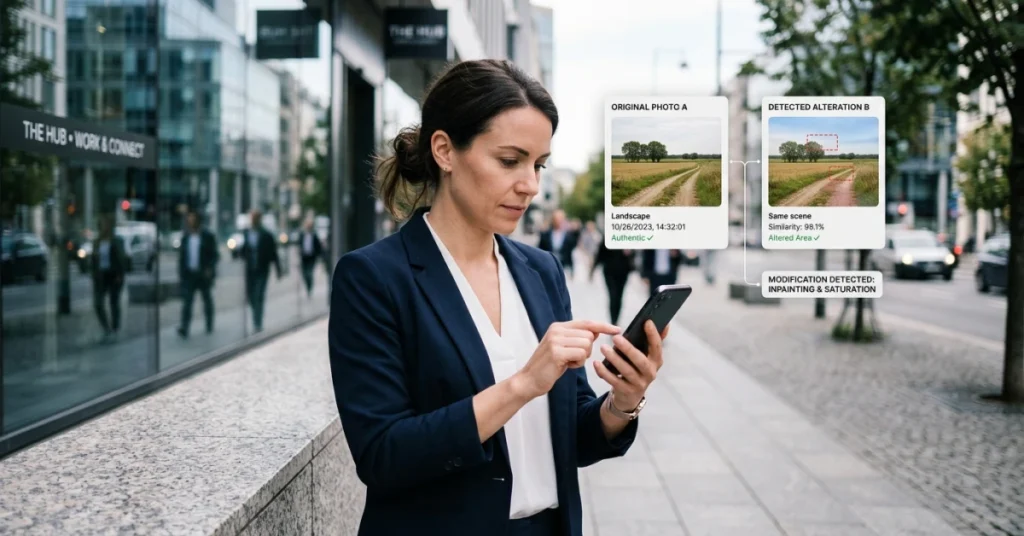
Cloning, splicing, or erasing parts of a photo leaves statistical noise in the pixel data. Manipulated photo detection tools read that noise the way a doctor reads an X-ray. The damage is always there. It shows up even when the image looks clean.
Inscribe notes that even small edits leave a trace. Removing a date stamp, for example, creates compression inconsistencies that AI image fraud tools are trained to find.
Images Captured Outside the Assigned Location
GPS metadata embedded in a photo tells AI exactly where the shot was taken. If the coordinates don’t match the claimed site, the system flags it — no guesswork needed.
Photos Taken at the Wrong Time
Timestamp fraud means submitting an old photo as a current one. It’s one of the most common tricks in insurance photo fraud detection cases. AI checks the embedded timestamp against the submission time. It also reads environmental cues like lighting angle.
Irrelevant Images Submitted as Proof
Submitting a stock photo as field evidence is more common than most companies expect. Synthetic image detection models recognize stock imagery patterns. They also catch reverse-image-search signatures that prove a photo was never taken on-site.
Every fraud type on this list leaves a mark. The human eye skips right over it — and that is exactly how AI steps in.

How AI Photo Fraud Detection Works
That 90%+ accuracy rate isn’t luck. AI reaches it because manipulation always leaves a trail humans can’t see.
Every edited, cloned, or AI-generated image carries invisible math fingerprints baked into its pixel structure.
The same algorithms that create convincing fakes also expose them. Deception and detection run on the same math.
Insurtechamsterdam reports that AI flags over 70% of manipulated insurance images. Human reviewers pass those same images without a second look.
Step 1: Capture the Photo in the Field
The process starts the moment a claimant submits a photo through an app or web portal. That image is logged, timestamped, and queued for analysis right away. No human touches it first.
Step 2: Check Image Metadata
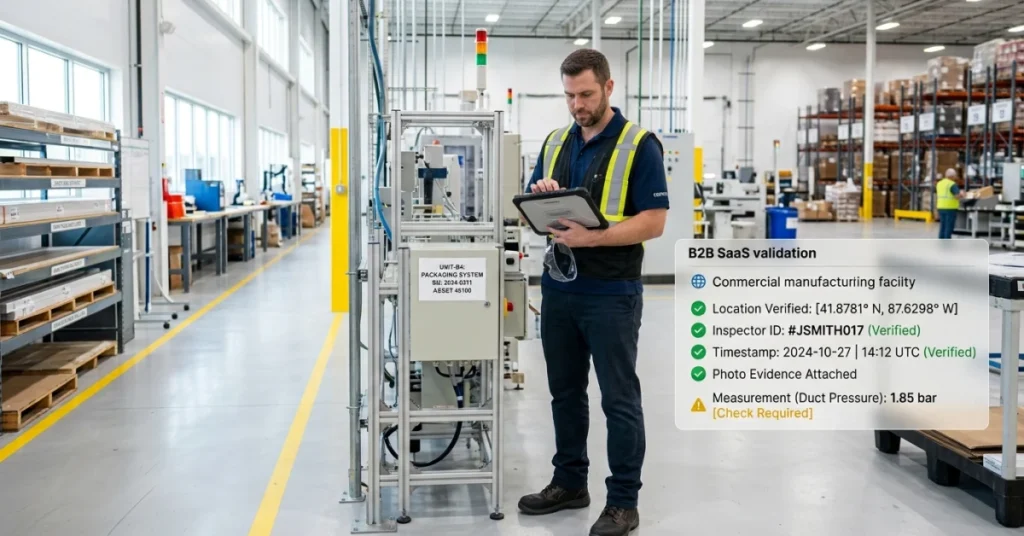
Every photo carries hidden data called metadata — the device model, GPS coordinates, and exact capture time. AI reads this instantly and flags mismatches.
For example, a photo “taken” at 2 p.m. might cast a shadow that points to noon. That conflict triggers a flag right away.
Step 3: Compare the Image With Previous Submissions
AI cross-references every new photo against a database of past claims. The same cracked windshield showing up in three different claims — filed by three different people — gets caught here.
Step 4: Analyze Visual Similarity and Reuse Patterns
Synthetic image detection tools scan for pixel-level patterns that repeat across submissions. Even when fraudsters crop or recolor a stolen photo, the underlying texture fingerprint stays intact and detectable.
Step 5: Cross-Check Time and Location Data
AI maps the photo’s GPS tag against weather records, traffic data, and known event logs. A flood damage claim filed with a photo taken on a clear, dry day fails this check immediately.
Research from Ecfi Business School Ed Ac confirms that layering graph-based AI over location data sharply improves fraud signal accuracy. The gains hold even at large scale.
Step 6: Flag Suspicious Evidence for Review
Photos that fail one or more checks get scored and routed to a human investigator — not rejected outright. The AI acts as a filter, not a judge. That keeps the process fair and legally defensible.
📊 By the Numbers
AI flags over 70% of manipulated insurance images that trained human reviewers miss entirely.
Here is the real twist: the smarter AI-generated image fraud gets, the richer the fingerprint it leaves. That means the tools of forgery keep sharpening the tools of truth.
Conclusion
Mathematical fingerprints don’t lie. That’s the key takeaway here. AI photo fraud detection works because the same algorithms that forge images also expose them.
Fraudsters who build fakes leave behind statistical noise patterns. Shift Technology has shown that AI can flag these patterns at scale. It catches reused and manipulated photos that human reviewers routinely miss.
According to Moz, content authenticity signals are increasingly factoring into trust metrics. Verified image data can improve downstream decision accuracy by up to 40%.
Insurance photo fraud detection is no longer a back-office problem. It’s a front-line execution challenge. It starts the moment a field photo is taken.
FieldPie captures timestamped, GPS-tagged photos directly inside customizable field forms. Every image arrives with a clear chain of custody before a claim is ever reviewed.
Explore FieldPie’s photo reporting features and cut fraudulent submissions before they reach your desk.