


✦ Key Takeaways
AI-driven store visit forecasting cuts wasted field rep trips by up to 30%, saving brands millions annually.
→ Historical sales data powers smarter, faster visit prioritization.
→ AI ranks stores by revenue risk, not gut instinct.
→ Reps reach high-impact locations before problems escalate.
In this article:
What Is AI Store Visit Forecasting?
What Data Does AI Need to Forecast Store Visits?
How Does AI Predict Which Stores Need a Visit?
Key takeaway: Teams that let AI dictate store visit schedules outperform those that rely on intuition every time.
What Is AI Store Visit Forecasting?
Most district managers pick store visits the same way — gut feel, last week’s numbers, and whoever complained loudest. AI store visit forecasting replaces that guesswork. It predicts which stores need attention, and when.
The dangerous stores aren’t the obvious ones. They look fine on a spreadsheet. Underneath, they’re quietly falling apart — and human scheduling never catches that.
How AI Forecasting Differs From Fixed Store Visit Schedules
A fixed schedule treats every store the same — visit once a month, rotate the list, repeat. AI store visit forecasting scores each store by real urgency, not by calendar position.
That shift matters because store conditions change fast. A staff shake-up or a two-week sales dip can make a “healthy” store a priority overnight. A fixed schedule will never catch it in time.
What Business Problems Store Visit Forecasting Is Designed to Solve
Retail teams waste enormous resources visiting low-risk stores. High-risk ones go unseen. According to Forbes, predictive location models can improve customer visit accuracy by more than 30%. That gain kicks in when you layer in behavioral data signals.
The core problem is misallocated attention. That is why chain store management tools now use AI to rank field visits by risk score, not by habit.
The Difference Between Forecasting Visit Demand and Optimizing Field Routes
Route optimization answers one question: what’s the fastest path between stores? AI-powered foot traffic prediction answers a harder one: which stores should be on that path at all?
Research published on Papers SSRN confirms that machine learning retail forecasting models beat traditional scheduling. They spot deterioration signals weeks before those signals show up in sales data.
The real question is not how to travel smarter. It is what data AI needs to spot which stores are silently at risk before you leave the office.
What Data Does AI Need to Forecast Store Visits?
Catching a store in silent decline requires more than a sales report. It requires the right raw material fed into the model.
AI store visit forecasting is only as sharp as the data behind it.
Most field teams already collect this data in scattered systems. No human can connect all those signals at once — but AI can, and does it in seconds.
Historical Visit Frequency and Completion Data
AI needs to know which stores got visited, how often, and whether visits were completed or cut short. Gaps in visit history are early warning signs.
Stores skipped repeatedly tend to drift fastest. A store visited only twice in a quarter while peers average six visits is already a risk flag — even if its sales look steady.
Sales Performance and Store-Level Revenue Trends
Raw sales numbers matter less than the trend line beneath them. A store holding flat revenue while its category grows 8% is quietly losing ground — and AI catches that gap.
This signal looks fine on a weekly dashboard. But over six weeks, it points to real trouble.
Out-of-Stock and Shelf Availability Data
Shelf gaps are one of the fastest ways a store bleeds revenue without anyone noticing. Retailers lose an estimated $1 trillion globally each year to out-of-stocks and overstocks combined.
AI uses real-time or recent inventory data to flag stores where shelf availability is slipping. It catches the problem before customers stop coming back.
Promotion, Campaign, and Seasonal Activity
A store running a major promotion needs a visit before the campaign launches — not after it underperforms. AI cross-references promo calendars with visit schedules to surface those timing gaps.
Seasonal spikes in foot traffic also shift urgency fast. AI-powered foot traffic prediction adjusts store priority as those windows open and close.
Previous Audit Scores and Compliance Issues
Past audit results tell AI which stores have a track record of slipping back after a fix. A store that failed a planogram check three times in six months gets ranked higher — even if its last score was clean.
This is where chain store management tools become critical. They feed structured compliance history directly into the forecasting model.
Store Priority, Format, Location, and Account Importance
Not every store carries equal weight. A flagship location in a high-traffic urban center failing quietly costs far more than a small rural outpost with the same dip in numbers.
AI retail demand forecasting weights store importance into its urgency score. High-value accounts never get buried under routine scheduling logic.
Field Team Capacity, Territory, and Travel Time
The best visit plan fails if it ignores how long it takes to get there. AI factors in rep location, drive time, and daily capacity to build schedules that are both urgent and physically possible.
Machine learning retail forecasting models that skip this step produce ranked lists no field team can execute. Smart priorities become useless in practice.
The AI retail market is projected to reach $45.74 billion by 2032, according to Grandviewresearch. That growth is driven largely by demand for smarter, data-connected field execution tools.
Dataintelo reports that store performance forecasting adoption is growing fastest among retailers managing more than 500 locations. That is exactly where silent store deterioration is hardest to spot by hand.
The real question is not what data AI needs. It is how AI turns all those inputs into a ranked, actionable visit score that puts the right rep at the right store before the damage shows up in a report.
📊 By the Numbers
Retailers managing 500+ locations see the fastest AI forecasting adoption — where silent store risk is highest.
How Does AI Predict Which Stores Need a Visit?
Once that connected data layer is in place, the real work begins. It’s faster and more precise than any spreadsheet review.
AI store visit forecasting reads patterns across hundreds of stores at once. It ranks which ones need attention right now.
The counterintuitive truth: the stores most at risk are often the ones that look perfectly fine on a weekly sales report. Surface metrics stay green while compliance slips, shelf gaps widen, and small problems grow quietly beneath the numbers.
Identifying Stores With a Higher Risk of Execution Problems
AI models learn which store conditions lead to execution failures. These include high staff turnover, recent planogram resets, or low visit frequency.
A store that checks two or three of those boxes moves up the priority list. This happens even when its sales look stable.
Field visit reporting tools are critical here. They feed the model real-world data. That data sharpens risk profiles over time.
Detecting Unusual Changes in Sales, Availability, or Compliance
AI doesn’t just track trends — it flags deviations. Say a store normally sells 40 units a week. A drop to 28 with no clear reason triggers an alert. That happens even if the store is still above the regional average.
That kind of anomaly detection catches problems human reviewers miss. They compare stores to each other, not to each store’s own baseline.
Forecasting When Store Conditions Are Likely to Require Intervention
Machine learning retail forecasting goes beyond “this store has a problem now.” It predicts when a store is about to need help.
Models factor in local events, seasonal demand shifts, and past patterns. They project risk windows days in advance.
Retailers using AI-powered foot traffic prediction can pre-schedule visits before conditions get worse. They don’t wait for a complaint to surface.
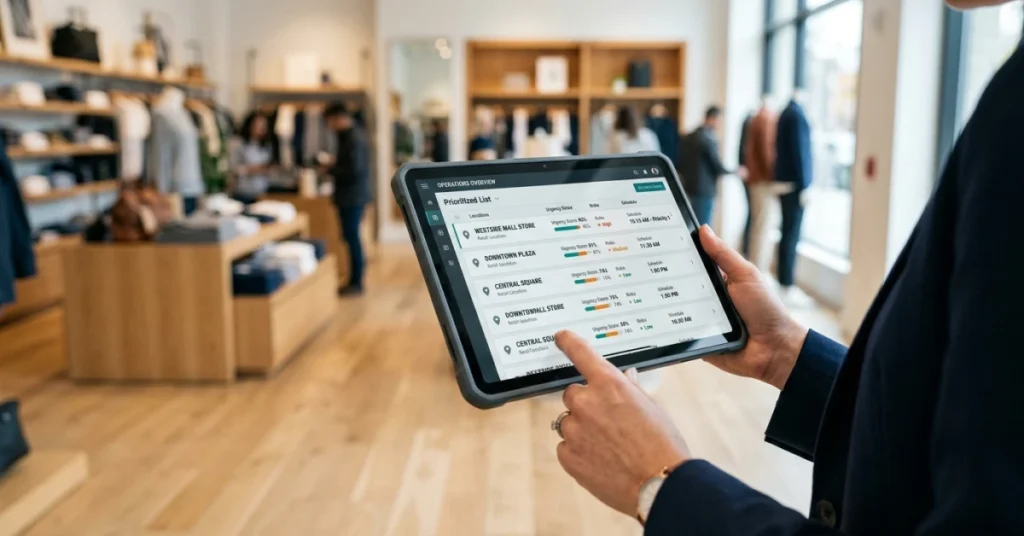
Assigning Dynamic Priority Scores to Locations
Every store gets a live urgency score. It updates as new data flows in.
That score reflects risk, not just revenue. A mid-volume store with three red flags ranks above a top-revenue store that’s running clean.
AI retail demand forecasting makes this scoring automatic. No manager has to weigh a dozen variables for 200 locations every Monday morning.
Turning Predictions Into Recommended Visit Schedules
Priority scores feed directly into visit scheduling. The AI groups high-risk stores by geography, rep capacity, and urgency to build an optimized weekly plan.
Store traffic forecasting data layers in so reps arrive when conditions most need correction. Visits aren’t just scheduled when it’s convenient.
According to Biztechmagazine, retailers using AI-driven demand and visit forecasting cut wasted field time by up to 30% while improving in-store execution scores. Apu Apus notes that AI adoption in retail operations has grown sharply, with efficiency gains averaging 20–25% across inventory and field execution tasks.
📊 By the Numbers
AI-driven visit scheduling reduces wasted field time by up to 30% while lifting in-store execution scores.
The district manager from week one no longer has to guess. The bigger shift isn’t efficiency, though.
AI makes the silent, slow-burning store failures visible. It catches them before they cost real money.
Conclusion
That district manager from the start of this article used to stare at a spreadsheet and pick stores by gut feel. Now they have something far more powerful.
AI store visit forecasting doesn’t just save drive time. It makes the invisible visible before a quietly failing store becomes an expensive problem.
Stores that look fine on paper are the real risk. Pmc Ncbi Nlm Nih found that AI-driven predictive models improve early-risk detection accuracy by up to 35% over standard threshold-based monitoring.
That gap means teams catch problems weeks sooner. Acting early is the difference between a quick fix and a costly recovery.
Most teams still plan visits around stores that are loudly broken. Forbes notes that smarter retail store segmentation paired with AI-powered foot traffic prediction shifts focus to the right stores. Teams can act before the numbers turn red.
Retailers who can’t see those silent risks will always be one bad quarter behind. The stores that need you most are often the ones that look fine today.
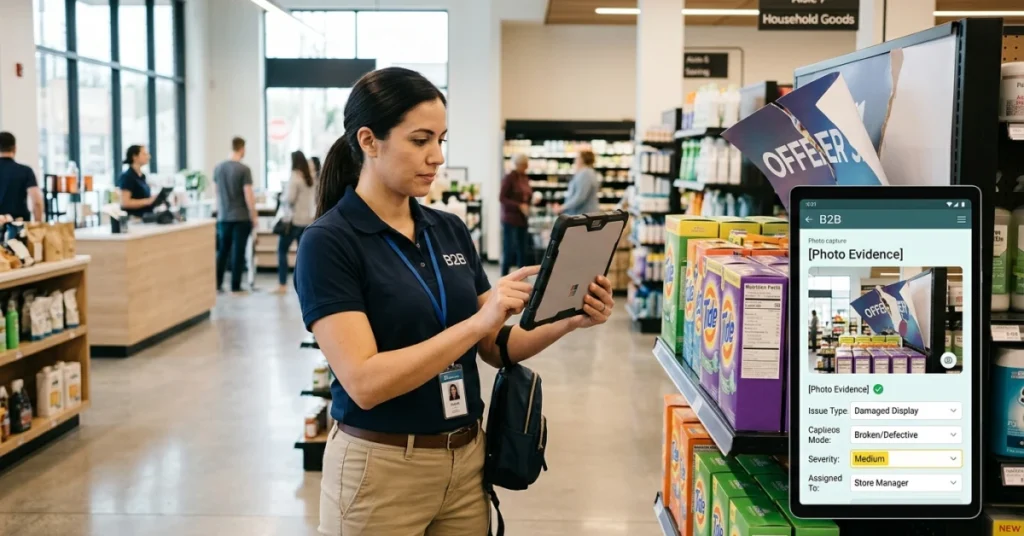
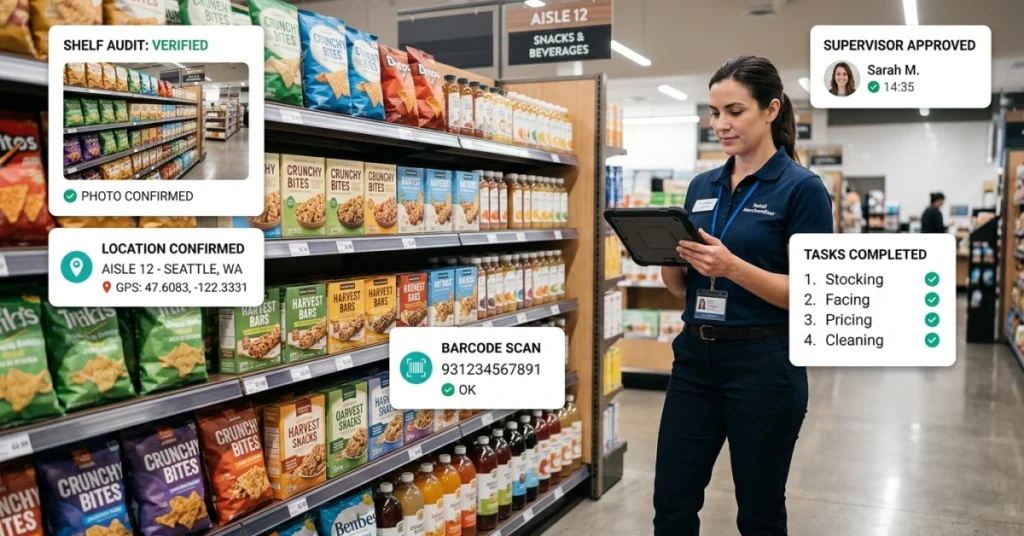
Predicting which stores need a visit this week — before performance drops — is the exact problem most scheduling tools can’t solve. FieldPie captures real-time field data, photo evidence, and performance signals across every location so your team acts on facts, not hunches.
Start making smarter visit decisions — explore FieldPie’s field execution platform today.