


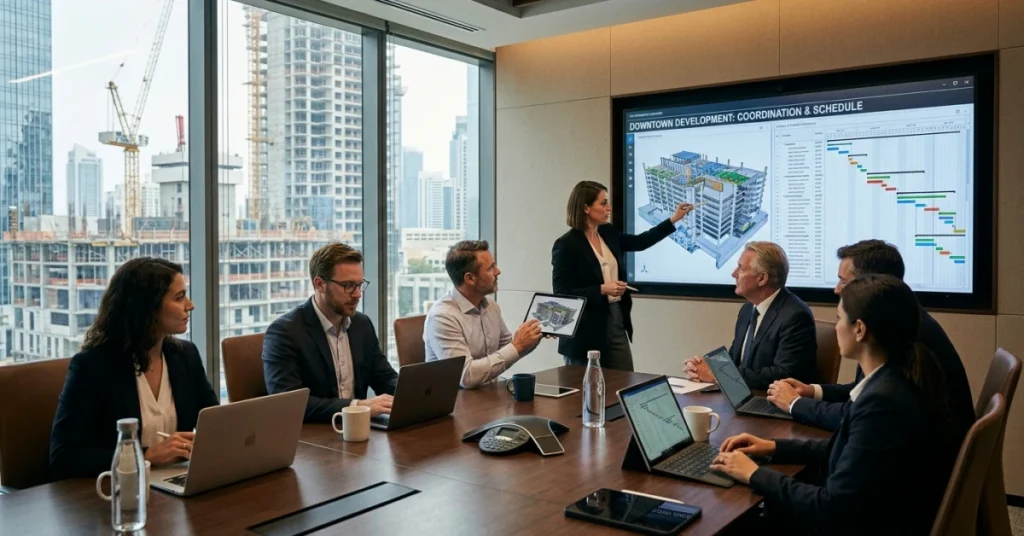
Construction meetings are structured, scheduled gatherings of project stakeholders — including owners, general contractors, engineers, subcontractors, and architects — held to coordinate work, resolve issues, track progress, and document decisions throughout a construction project’s lifecycle.
What Are Construction Meetings and Why Do They Matter?
Every construction project involves dozens of moving parts: shifting schedules, budget pressures, engineering changes, and site safety concerns. Without regular, structured meetings, these variables spiral into costly miscommunication. According to construction industry research, poor communication is one of the leading drivers of rework — which costs the U.S. construction industry an estimated $31.3 billion annually.
The stakes are simply too high to wing it. A well-run meeting keeps your project on schedule, your team aligned, and your documentation airtight. A poorly run one wastes time, breeds confusion, and creates legal exposure.
As Constructing Minds notes, proper meeting minutes reflect the views of all stakeholders and should serve as a complete, reliable, and accurate record of both the current project status and the next steps agreed upon by all parties. That documentation standard isn’t optional — it’s the backbone of every successful project.
What Are the Main Types of Construction Meetings?
Not every meeting serves the same purpose. Each type targets a specific phase or function of the project. Understanding which meeting to call — and when — is the mark of a seasoned project manager.
Preconstruction Kickoff Meeting
This is the first formal gathering before any work begins on site. Stakeholders align on scope, schedule, contract terms, and communication protocols. It sets the tone for the entire project and is the right moment to establish how future meetings will be structured and documented.
Key agenda items:
- Project scope review and milestone schedule
- Contract obligations and risk allocation
- Communication hierarchy and reporting lines
- Safety plan overview
Progress (Job Site) Meeting
Held weekly or bi-weekly on site, this is the most frequent type of meeting throughout the project lifecycle. As Designing Buildings describes, progress meetings typically review work completed against the program, identify delays, address resource constraints, and assign action items with clear owners and deadlines.
Key agenda items:
- Schedule status vs. baseline
- Open RFIs and submittals
- Safety incidents and near-misses
- Subcontractor coordination issues
Owner-Architect-Contractor (OAC) Meeting
The OAC meeting brings together the three primary parties to review project health at a higher level. These meetings typically occur monthly and focus on budget performance, design changes, owner decisions required, and contract administration.
Subcontractor Coordination Meeting
This meeting coordinates the sequencing of trades — mechanical, electrical, plumbing, structural — to prevent conflicts on site. Engineering coordination is central here, particularly when BIM clash detection reveals overlapping systems.
Safety Meeting (Toolbox Talk)
Held at the start of each shift or week, toolbox talks address specific hazards relevant to current site conditions. OSHA regulations require documented safety training; these meetings satisfy that requirement while reinforcing a safety-first culture.
Closeout Meeting
This meeting marks the transition from construction to occupancy. Punch lists, as-built documentation, warranty submissions, and final lien waivers are the primary focus.

How Should You Structure a Construction Meeting for Maximum Efficiency?
Structure is everything. A meeting without a clear agenda, a designated facilitator, and a documentation process is just a conversation — and conversations don’t create accountability.
| Meeting Element | Best Practice Standard |
|---|---|
| Agenda | Distributed 24–48 hours in advance |
| Duration | 60 minutes maximum for site meetings |
| Facilitator | Project manager or designated lead |
| Minutes | Distributed within 24 hours of meeting |
| Action Items | Named owner + specific deadline for each |
| Attendance | Sign-in sheet or digital log required |
| Follow-up | Open items carried forward to next meeting |
How Do You Write Effective Meeting Minutes?
Meeting minutes are the legal and operational record of every decision made. Weak minutes create disputes; strong minutes prevent them. The general contractor typically owns this responsibility, though the format should be agreed upon at kickoff.
A standard construction meeting minutes document should include:
- Project name, number, and date
- Names and companies of all attendees
- A summary of each agenda item discussed
- All decisions made, with rationale
- Action items: task, responsible party, due date
- Next meeting date and location
Use a consistent template on every project. Inconsistent formatting wastes time and makes it harder to track open items across the project lifecycle. If your team manages construction project documentation, a standardized minutes template should be part of your document control system from day one.
Construction Meeting Checklist: Before, During, and After
This checklist covers every critical step to run a meeting that drives results rather than burns time.
Before the Meeting
- Define the meeting type and purpose
- Confirm attendee list and send calendar invites
- Prepare and distribute agenda 24–48 hours in advance
- Attach relevant drawings, RFIs, or schedule updates to the agenda
- Book the conference room or set up the video link
- Review previous meeting minutes and open action items
During the Meeting
- Start on time — every time
- Take attendance (sign-in sheet or digital log)
- Follow the agenda; table off-topic items for later
- Assign a note-taker separate from the facilitator
- Capture every decision and action item in real time
- Confirm next meeting date before adjourning
After the Meeting
- Distribute minutes within 24 hours
- Enter all action items into your project management system
- Follow up with responsible parties on overdue items
- File minutes in the project’s official document record
- Update the meeting log with attendance and decisions
What Are the Most Common Problems With Construction Meetings — and How Do You Fix Them?
Even experienced project managers struggle with meeting dysfunction. The problems are predictable; the fixes are practical.
Problem: Meetings run long and lose focus. Fix: Enforce a hard agenda with time-boxed items. The facilitator’s job is to keep discussion on track, not to participate in it.
Problem: Action items aren’t followed up on. Fix: Every action item needs a named owner and a specific date — not “ASAP.” Use your project management software to track open items and send automated reminders.
Problem: The wrong people are in the room. Fix: Audit your attendee list before every meeting. Subcontractors don’t need to sit through owner-level financial discussions. Invite only those whose input or decision authority is required.
Problem: Minutes are inaccurate or disputed. Fix: Circulate draft minutes within 24 hours and allow a 48-hour comment window. Once the window closes, the record stands.
Problem: Remote participants are disengaged. Fix: Use video conferencing with screen sharing for drawings and schedules. Assign a remote facilitator to manage chat and ensure virtual attendees can contribute.
Construction Meeting Minutes Template
Use this structure as a baseline for every project meeting. Customize the agenda section to match the meeting type.
For teams managing multiple concurrent projects, storing this template in a centralized construction document management system ensures every project team is working from the same standard.

Conclusion
Construction meetings are not administrative overhead — they are the operational engine of every successful project. When run with discipline, documented accurately, and followed up on consistently, meetings drive accountability, prevent disputes, and keep projects on schedule and on budget.
The fundamentals haven’t changed: prepare a clear agenda, invite the right people, capture accurate minutes, and follow through on every action item. What has changed is the technology available to make that process faster, more reliable, and fully integrated with the rest of your project management workflow.
Whether you’re managing a single site meeting or coordinating across an international conference of engineering stakeholders, the principles are the same — clarity, accountability, and documentation.
Frequently Asked Questions (FAQ)
What is the purpose of a construction meeting?
A construction meeting aligns project stakeholders on schedule status, budget performance, open issues, and upcoming decisions. It creates a documented record of what was discussed, what was decided, and who is responsible for each action — reducing disputes and keeping the project on track.
How often should construction site meetings be held?
Most active construction projects hold weekly progress meetings on site. Owner-architect-contractor (OAC) meetings typically occur monthly. Safety toolbox talks may happen daily or at the start of each shift, depending on site conditions and contract requirements.
Who is responsible for taking construction meeting minutes?
The general contractor typically owns the meeting minutes responsibility on most project types. The designated note-taker should be separate from the meeting facilitator to ensure accurate, unbiased documentation. Minutes should be distributed to all attendees and key stakeholders within 24 hours of the meeting.