


✦ Key Takeaways
80% of sales require 5+ follow-ups, yet most field reps quit after just one attempt.
→ Speed wins: first follow-up within an hour triples conversion rates.
→ A structured workflow eliminates missed leads and forgotten prospects permanently.
→ Personalized follow-up messages outperform generic templates by 2x response rate.
In this article:
What Is a Field Sales Follow-Up Process?
The Step-by-Step Field Sales Follow-Up Workflow
How Quickly Should Field Sales Reps Follow Up?
Key takeaway: A disciplined, same-day follow-up process is the single habit separating top field reps from average ones.
What Is a Field Sales Follow-Up Process?
Most reps reach out after a visit — but very few send the right message at the right moment. 80% of sales require at least five touches, yet the majority of reps stop after one or two (Ircsalessolutions).
A field sales follow-up process is a set sequence of actions a rep takes after an in-person visit. It covers calls, emails, texts, and check-ins — each timed to push a deal forward.
Without that structure, reps confuse activity with strategy. Staying busy is not the same as moving a deal ahead.
What Happens After a Field Sales Visit?
After a visit, most reps feel good — handshakes, eye contact, and real conversation create a sense of momentum. That feeling is the trap. The buyer hasn’t moved; only the rep’s confidence has.
A strong outreach cadence starts within 24 hours. Each touch should tie to a specific buyer action or signal — not to a spot on the calendar.
Why Follow-Up Quality Matters More Than Visit Volume
Reps who log more visits don’t automatically close more deals. Pipeline Zoominfo reports that targeted, well-timed outreach beats generic high-frequency contact every time.
A bland email sent the day after a visit wastes the rapport you just built. Matching your message to where the buyer actually stands beats raw speed every time.
Field Sales Follow-Up vs General Sales Follow-Up
Inside sales reps reach out cold — field reps reach out warm, which sounds like an advantage. But warmth breeds overconfidence, and overconfidence kills urgency across a multi-touch sequence.
That’s why a structured outreach audit matters more in field sales than anywhere else. The cost of misreading deal proximity is simply higher here.
Speed alone won’t win the deal. What matters is whether your next touch fits the buyer’s actual decision window — and knowing that takes a system, not gut feeling.
The Step-by-Step Field Sales Follow-Up Workflow
Structure is what turns a good visit into a closed deal — here is exactly how to build it.
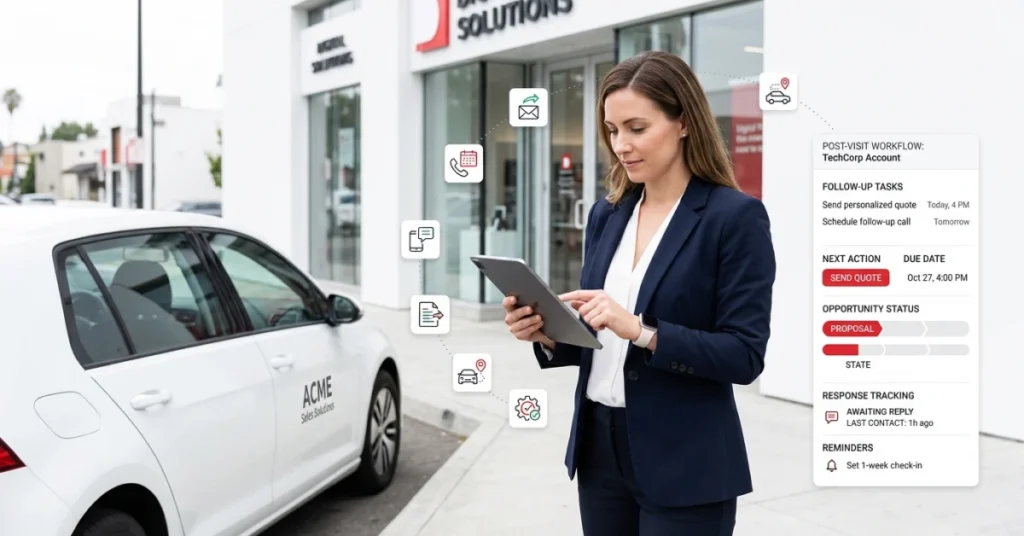
Record visit outcomes before leaving the location
Classify the opportunity by priority and next action
Assign a single owner to every open item
Set a clear deadline for each required action
Send the first outreach message within 24 hours
Track responses and update opportunity status
Schedule the next visit or remote touchpoint
Close, escalate, or move the opportunity into nurture
Record Visit Outcomes Before Leaving the Location
Log every key detail while the conversation is still fresh in your mind. Reps who wait until end-of-day lose critical context that shapes the right outreach message.
Note the buyer’s exact words, objections raised, and any commitment made — even a vague one. These details are the raw material of a relevant, timely response.
Classify the Opportunity by Priority and Next Action
Not every visit deserves the same level of energy. Sort each opportunity into a clear tier — hot, warm, or cold — based on buyer signals, not gut feel.
Assign a specific next action to each tier before you leave the parking lot. “Follow up soon” is not an action — “send pricing by Thursday” is.
Assign a Follow-Up Owner
Every open item needs one name attached to it — not a team, not a manager, one person. Shared ownership in field sales is where deals quietly die.
If the rep who made the visit cannot own the next step, hand it off explicitly with full context. A clean transfer beats a dropped ball every time.
Set a Clear Deadline
An action without a deadline is just a wish. Pin every task to a specific date and time — your CRM should show a due date, not a vague status.
Hard dates also force you to match your outreach to the buyer’s actual decision window. That alignment — not speed alone — is what makes a field follow-up process work.
Send the First Follow-Up Message
Your opening email should reference something specific from the visit — a problem the buyer named, a product they touched, a question they asked. Generic messages get ignored.
Keep it short: one clear value point, one direct ask, and a single call to action. Buyers respond to clarity, not volume.
Track Responses and Update Opportunity Status
80% of sales require five or more touches before a buyer commits — yet most reps stop after two (Martal). That gap is where a structured multi-touch cadence pays off.
Log every response — or non-response — as a data point, not a dead end. Silence tells you something about timing; it rarely means the deal is gone.
Schedule the Next Visit or Remote Touchpoint
Every closed loop in your outreach cadence should open the next one. Before you mark a touchpoint complete, the next one must already be on the calendar.
Reps who rely on in-person rapport often skip this step — they feel the deal is warm, so they coast. That false confidence is exactly where structured engagement breaks down.
Close, Escalate, or Nurture the Opportunity
After each full sequence, every opportunity needs a verdict: close it, escalate it to a senior rep, or move it into a long-term nurture track. Leaving it in limbo wastes pipeline space.
Reps who operate within a defined system close at nearly twice the rate of those who improvise — because the structure removes guesswork at every stage (Salesgenie).
The workflow only holds if you know when to trigger each step — and that question is harder than it looks for field reps who mistake a warm handshake for a buying signal.
How Quickly Should Field Sales Reps Follow Up?
Keeping momentum alive after a field visit demands more than speed — it demands timing that matches where the buyer actually is, not where you think they are. Reps who just left a warm conversation often feel the deal is closer than it really is, and that false confidence is where most outreach falls apart.
The real failure in the field sales follow-up process isn’t slowness — it’s sending the right message at the wrong moment. Reps mistake in-person rapport for deal progress, then reach out too early with a close-focused pitch when the buyer still needs information.
Follow-Up Within the First 24 Hours
The first outreach should land within 24 hours of a field visit — full stop. This window keeps your visit fresh and signals professionalism before a competitor fills the gap.
Send a short, specific message that references something said in person. Generic “just checking in” emails waste this critical window and erode the rapport you built face-to-face.
Timing for Quotes, Samples and Product Information
Deliver quotes, samples, or product details within 48 hours of the request — not when it’s convenient for you. Buyers interpret slow delivery as a preview of your service quality after the sale.
Tie every delivery to a clear next step: a call, a decision date, or a question that advances the deal. Dropping information without a hook turns your outreach into a dead end.
Follow-Up Cadence for High-Intent Prospects
High-intent prospects need a tight multi-touch follow-up sequence — contact points on days 1, 3, and 7 after the visit. Each touch should shift the message: confirm interest, then add value, then ask for a decision.
Vary your channel across the sequence — email, phone, and text each carry different weight at different stages. Repeating the same channel with the same message is effort, not strategy.
Follow-Up Cadence for Long Sales Cycles
Extended cycles require a slower, value-driven outreach rhythm — think bi-weekly contact that educates rather than pushes. Each communication should give the buyer a reason to stay engaged, not just a reminder that you exist.
Use these moments to share field sales pitch examples or relevant case studies that match the buyer’s specific challenge. Relevance over time builds trust faster than frequency alone.
When to Stop Following Up
Most reps quit after two attempts — but Invespcro reports that 80% of sales require five or more touches to close. Stopping early isn’t professional restraint — it’s leaving money on the table.
Set a firm exit point: after 8–10 attempts with no response, send a clean break-up message and move on. Profitoutreach confirms that a well-timed final note often re-engages prospects who went cold.
📊 By the Numbers
80% of sales close only after 5 or more contact attempts — most reps stop at two.
Timing and relevance aren’t separate levers — they only work when they move together, which is exactly what separates reps who close from reps who just stay busy.
Conclusion
Misreading rapport as deal progress is why most field reps lose winnable deals. The fix is proven sales pitch tactics paired with a follow-up cadence built around the buyer’s real decision window.
80% of sales require at least five follow-up touches, yet most reps quit after two (Peaksalesrecruiting). Reps who match their message to the right moment close at measurably higher rates.
A structured multi-touch sequence removes that guesswork. It keeps every rep on track without relying on gut feeling.
Most field teams lose deals because their follow-up has no system behind it. FieldPie tracks every rep’s follow-up activity, flags stalled deals, and shows the right next action at the right time.
Teams that work this way convert more pipeline without adding headcount. Ircsalessolutions reports that consistent follow-up strategies lift close rates by up to 70%.